







Question: Database Systems problem - ER diagram Problem 4 (30 points) Consider the following set of requirements for a company database: (a) Each customer is assigned
Database Systems problem - ER diagram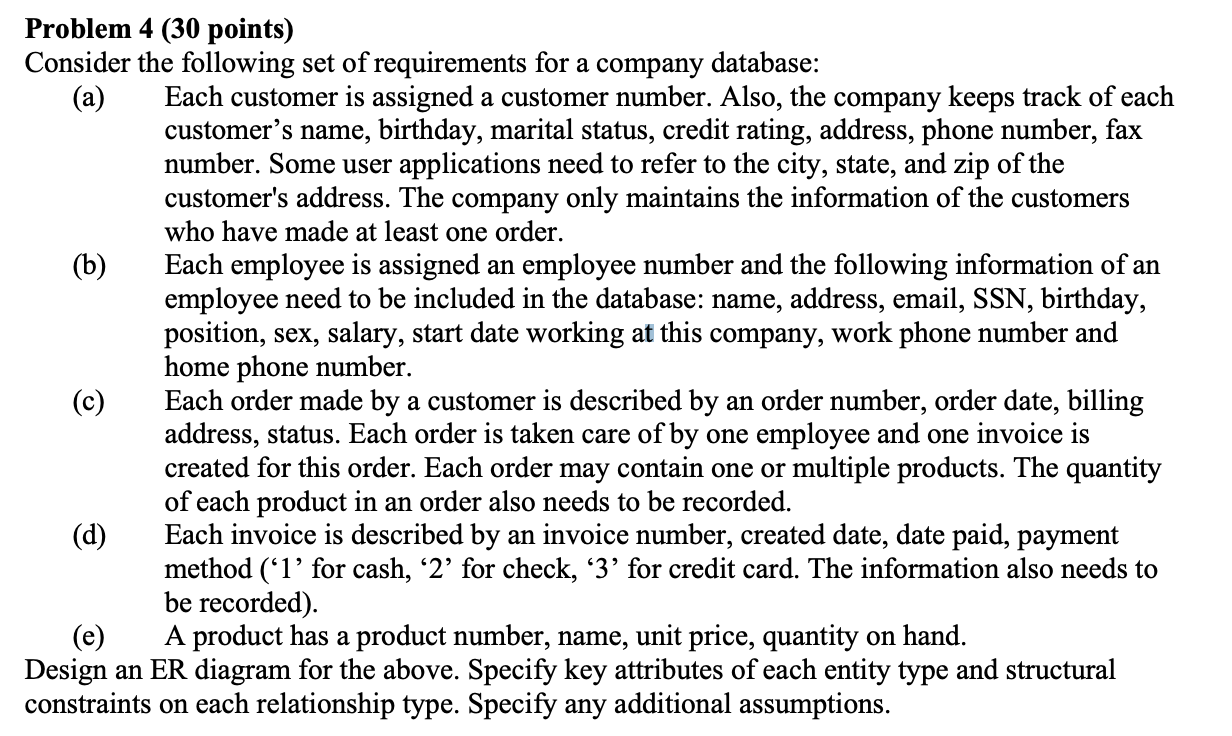

Problem 4 (30 points) Consider the following set of requirements for a company database: (a) Each customer is assigned a customer number. Also, the company keeps track of each customer's name, birthday, marital status, credit rating, address, phone number, fax number. Some user applications need to refer to the city, state, and zip of the customer's address. The company only maintains the information of the customers who have made at least one order. (b) Each employee is assigned an employee number and the following information of an employee need to be included in the database: name, address, email, SSN, birthday, position, sex, salary, start date working at this company, work phone number and home phone number. Each order made by a customer is described by an order number, order date, billing address, status. Each order is taken care of by one employee and one invoice is created for this order. Each order may contain one or multiple products. The quantity of each product in an order also needs to be recorded. (d) Each invoice is described by an invoice number, created date, date paid, payment method ('1' for cash, '2' for check, 3' for credit card. The information also needs to be recorded) (e) A product has a product number, name, unit price, quantity on hand. Design an ER diagram for the above. Specify key attributes of each entity type and structural constraints on each relationship type. Specify any additional assumptions. (c) Construct a relational model for the database described in Problem 4. For each relation, specify its primary key
Step by Step Solution
There are 3 Steps involved in it

Get step-by-step solutions from verified subject matter experts
 Study Help