







Question: Dcedure: 31/2 common nails were pounded into the same 24 piece of kiln-dried spruce lumber, such that each nail protruded 3.00cm above the face
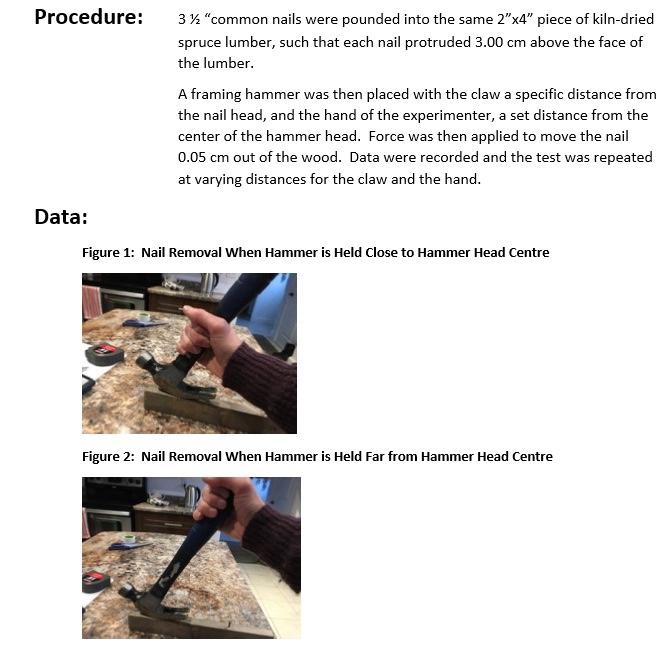
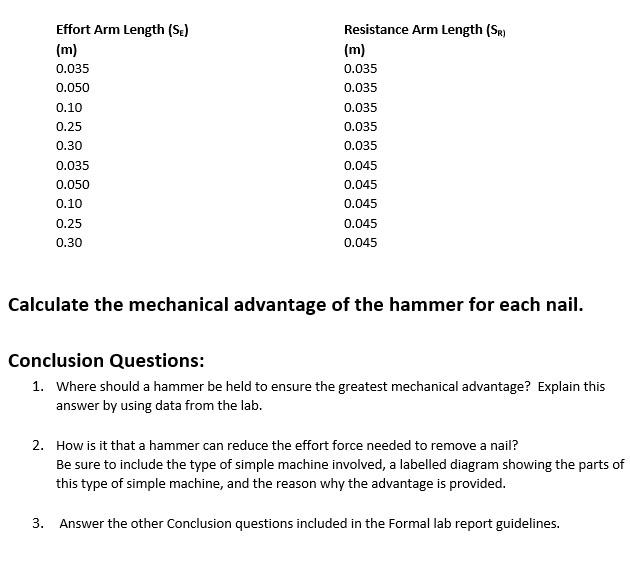
Dcedure: 31/2 "common nails were pounded into the same 2"4 " piece of kiln-dried spruce lumber, such that each nail protruded 3.00cm above the face of the lumber. A framing hammer was then placed with the claw a specific distance from the nail head, and the hand of the experimenter, a set distance from the center of the hammer head. Force was then applied to move the nail 0.05cm out of the wood. Data were recorded and the test was repeated at varying distances for the claw and the hand. ta: Figure 1: Nail Removal When Hammer is Held Close to Hammer Head Centre Figure 2: Nail Removal When Hammer is Held Far from Hammer Head Centre Calculate the mechanical advantage of the hammer for each nail. Conclusion Questions: 1. Where should a hammer be held to ensure the greatest mechanical advantage? Explain this answer by using data from the lab. 2. How is it that a hammer can reduce the effort force needed to remove a nail? Be sure to include the type of simple machine involved, a labelled diagram showing the parts of this type of simple machine, and the reason why the advantage is provided. 3. Answer the other Conclusion questions included in the Formal lab report guidelines. Dcedure: 31/2 "common nails were pounded into the same 2"4 " piece of kiln-dried spruce lumber, such that each nail protruded 3.00cm above the face of the lumber. A framing hammer was then placed with the claw a specific distance from the nail head, and the hand of the experimenter, a set distance from the center of the hammer head. Force was then applied to move the nail 0.05cm out of the wood. Data were recorded and the test was repeated at varying distances for the claw and the hand. ta: Figure 1: Nail Removal When Hammer is Held Close to Hammer Head Centre Figure 2: Nail Removal When Hammer is Held Far from Hammer Head Centre Calculate the mechanical advantage of the hammer for each nail. Conclusion Questions: 1. Where should a hammer be held to ensure the greatest mechanical advantage? Explain this answer by using data from the lab. 2. How is it that a hammer can reduce the effort force needed to remove a nail? Be sure to include the type of simple machine involved, a labelled diagram showing the parts of this type of simple machine, and the reason why the advantage is provided. 3. Answer the other Conclusion questions included in the Formal lab report guidelines
Step by Step Solution
There are 3 Steps involved in it

Get step-by-step solutions from verified subject matter experts
 Study Help