







Question: ddfd The Case Study is attached, please answer the following question. In Case Study 8 (pages 330332), you learned that three vendors had been considered
 ddfd
ddfd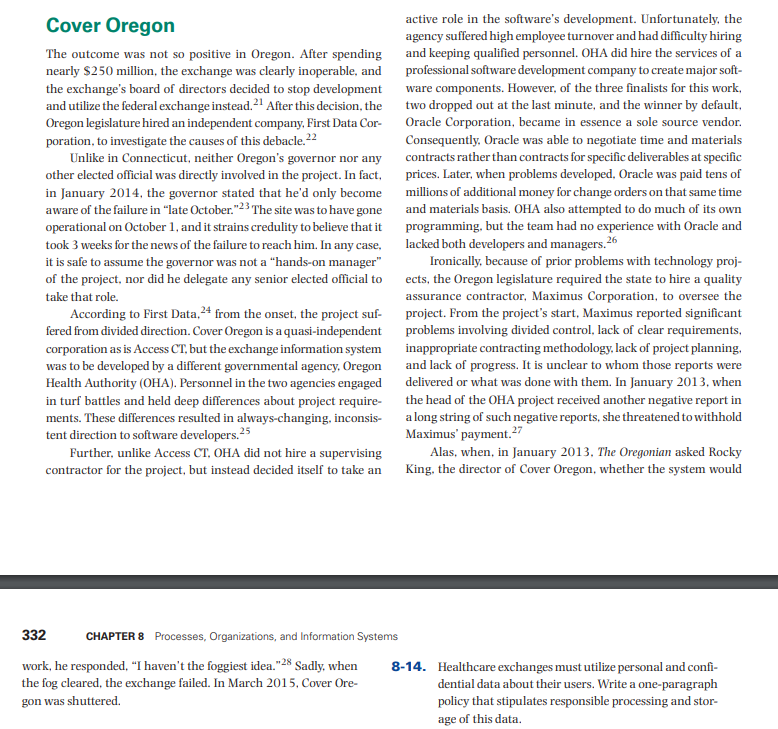
The Case Study is attached, please answer the following question.
In Case Study 8 (pages 330332), you learned that three vendors had been considered as outside contractors, but two of them bowed out of the competition. Describe three reasons that they may have done so.
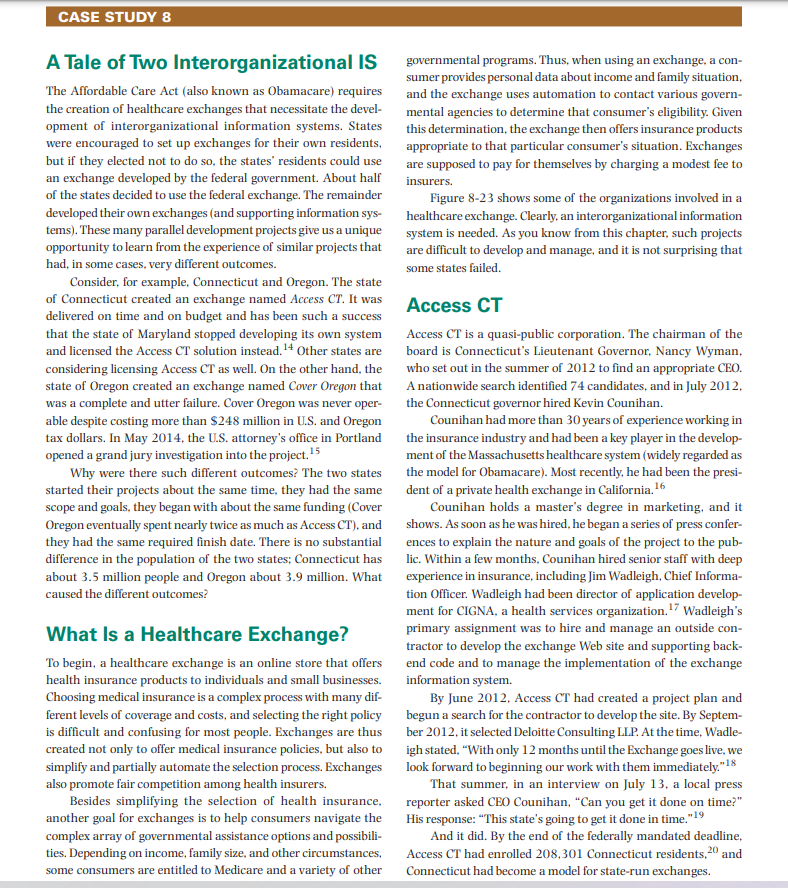
CASE STUDY 8 A Tale of Two Interorganizational IS governmental programs. Thus, when using an exchange, a con- sumer provides personal data about income and family situation, The Affordable Care Act (also known as Obamacare) requires and the exchange uses automation to contact various govern- the creation of healthcare exchanges that necessitate the devel- mental agencies to determine that consumer's eligibility. Given opment of interorganizational information systems. States this determination, the exchange then offers insurance products were encouraged to set up exchanges for their own residents, appropriate to that particular consumer's situation. Exchanges but if they elected not to do so, the states' residents could use are supposed to pay for themselves by charging a modest fee to an exchange developed by the federal government. About half insurers. of the states decided to use the federal exchange. The remainder Figure 8-23 shows some of the organizations involved in a developed their own exchanges and supporting information sys- healthcare exchange. Clearly, an interorganizational information tems). These many parallel development projects give us a unique system is needed. As you know from this chapter, such projects opportunity to learn from the experience of similar projects that are difficult to develop and manage, and it is not surprising that had, in some cases, very different outcomes. some states failed Consider, for example, Connecticut and Oregon. The state of Connecticut created an exchange named Access CT. It was Access CT delivered on time and on budget and has been such a success that the state of Maryland stopped developing its own system Access CT is a quasi-public corporation. The chairman of the and licensed the Access CT solution instead. 14 other states are board is Connecticut's Lieutenant Governor, Nancy Wyman, considering licensing Access CT as well. On the other hand, the who set out in the summer of 2012 to find an appropriate CEO. state of Oregon created an exchange named Cover Oregon that A nationwide search identified 74 candidates, and in July 2012, was a complete and utter failure. Cover Oregon was never oper- the Connecticut governor hired Kevin Counihan. able despite costing more than $248 million in U.S. and Oregon Counihan had more than 30 years of experience working in tax dollars. In May 2014, the U.S. attorney's office in Portland the insurance industry and had been a key player in the develop- opened a grand jury investigation into the project.15 ment of the Massachusetts healthcare system (widely regarded as Why were there such different outcomes? The two states the model for Obamacare). Most recently, he had been the presi- started their projects about the same time, they had the same dent of a private health exchange in California. 16 scope and goals, they began with about the same funding (Cover Counihan holds a master's degree in marketing, and it Oregon eventually spent nearly twice as much as Access CT), and shows. As soon as he was hired, he began a series of press confer- they had the same required finish date. There is no substantial ences to explain the nature and goals of the project to the pub- difference in the population of the two states: Connecticut has lic. Within a few months, Counihan hired senior staff with deep about 3.5 million people and Oregon about 3.9 million. What experience in insurance, including Jim Wadleigh, Chief Informa- caused the different outcomes? tion Officer. Wadleigh had been director of application develop- ment for CIGNA, a health services organization." Wadleigh's What Is a Healthcare Exchange? primary assignment was to hire and manage an outside con- tractor to develop the exchange Web site and supporting back- To begin, a healthcare exchange is an online store that offers end code and to manage the implementation of the exchange health insurance products to individuals and small businesses. information system. Choosing medical insurance is a complex process with many dif- By June 2012, Access CT had created a project plan and ferent levels of coverage and costs, and selecting the right policy begun a search for the contractor to develop the site. By Septem- is difficult and confusing for most people. Exchanges are thus ber 2012, it selected Deloitte Consulting LLP. At the time, Wadle- created not only to offer medical insurance policies, but also to igh stated, With only 12 months until the Exchange goes live, we simplify and partially automate the selection process. Exchanges look forward to beginning our work with them immediately."13 also promote fair competition among health insurers. That summer, in an interview on July 13, a local press Besides simplifying the selection of health insurance, reporter asked CEO Counihan, "Can you get it done on time?" another goal for exchanges is to help consumers navigate the His response: This state's going to get it done in time." complex array of governmental assistance options and possibili- And it did. By the end of the federally mandated deadline, ties. Depending on income, family size, and other circumstances, Access CT had enrolled 208,301 Connecticut residents 20 and , some consumers are entitled to Medicare and a variety of other Connecticut had become a model for state-run exchanges. -19 Cover Oregon The outcome was not so positive in Oregon. After spending nearly $250 million, the exchange was clearly inoperable, and the exchange's board of directors decided to stop development and utilize the federal exchange instead. 21 After this decision, the Oregon legislature hired an independent company, First Data Cor- poration, to investigate the causes of this debacle.22 Unlike in Connecticut, neither Oregon's governor nor any other elected official was directly involved in the project. In fact, in January 2014, the governor stated that he'd only become aware of the failure in "late October. "23 The site was to have gone operational on October 1, and it strains credulity to believe that it took 3 weeks for the news of the failure to reach him. In any case, it is safe to assume the governor was not a "hands-on manager" of the project, nor did he delegate any senior elected official to take that role. According to First Data,24 from the onset, the project suf- fered from divided direction. Cover Oregon is a quasi-independent corporation as is Access CT, but the exchange information system was to be developed by a different governmental agency, Oregon Health Authority (OHA). Personnel in the two agencies engaged in turf battles and held deep differences about project require ments. These differences resulted in always-changing, inconsis- tent direction to software developers.25 Further, unlike Access CT, OHA did not hire a supervising contractor for the project, but instead decided itself to take an active role in the software's development. Unfortunately, the agency suffered high employee turnover and had difficulty hiring and keeping qualified personnel. OHA did hire the services of a professional software development company to create major soft- ware components. However, of the three finalists for this work, two dropped out at the last minute, and the winner by default, Oracle Corporation, became in essence a sole source vendor. Consequently. Oracle was able to negotiate time and materials contracts rather than contracts for specific deliverables at specific prices. Later, when problems developed, Oracle was paid tens of millions of additional money for change orders on that same time and materials basis. OHA also attempted to do much of its own programming, but the team had no experience with Oracle and lacked both developers and managers.26 Ironically, because of prior problems with technology proj- ects, the Oregon legislature required the state to hire a quality assurance contractor, Maximus Corporation, to oversee the project. From the project's start, Maximus reported significant problems involving divided control, lack of clear requirements, inappropriate contracting methodology, lack of project planning, and lack of progress. It is unclear to whom those reports were delivered or what was done with them. In January 2013, when the head of the OHA project received another negative report in a long string of such negative reports, she threatened to withhold Maximus' payment.27 Alas, when, in January 2013, The Oregonian asked Rocky King, the director of Cover Oregon, whether the system would 332 CHAPTER 8 Processes, Organizations, and Information Systems work, he responded, "I haven't the foggiest idea. "28 Sadly, when 8-14. Healthcare exchanges must utilize personal and confi- the fog cleared, the exchange failed. In March 2015, Cover Ore- dential data about their users. Write a one-paragraph gon was shuttered. policy that stipulates responsible processing and stor- age of this dataStep by Step Solution
There are 3 Steps involved in it
1 Expert Approved Answer
Step: 1 Unlock

Question Has Been Solved by an Expert!
Get step-by-step solutions from verified subject matter experts
Step: 2 Unlock
Step: 3 Unlock
 Study Help