







Question: Based on the Defence Project case study (The Defence Project) answer the following questions: 5.1 Appraise the relevant aspects of the project risk that contributed
Based on the Defence Project case study (The Defence Project) answer the following questions:
5.1 Appraise the relevant aspects of the project risk that contributed to problems encountered. (5 marks)
5.2 Critically assess the extent to which those problems could have been resolved if a standard methodology in project management had been in place and applied in practice. (5 marks)
5.3 Identify the lessons learned from the above critical evaluations. You can use the following table to answer this question. (10 marks)
Lessons learned from the Defence Project
| Category | Problem | Impact | Improvement Recommendation |
| Human Resources Management |
|
|
|
| Scope Management |
|
|
|
| Quality Management |
|
|
|
| Risk Management |
|
|
|
| Time Management |
|
|
|
If you were the Project Manager of the Defence Project,
5.4 Prepare a WBS (at least 3 levels) and a Gantt chart for the project. Determine the overall duration and when activities and events will happen. Include activities with estimated activity durations in your project schedule. The start date for the project is the first working Monday after your Birthday this year. Adopt the NZ holidays (Christmas, Easter, ANZAC day, etc.). (15 marks)
The project has been slow due to low labour productivity and you are running behind on your planned programme. As a result, you are to attend a crisis meeting to discuss the following agenda:
5.5 What project control measures will you use? (5 marks)
5.6 Prepare a progress status report to the client. Your client is open to suggestions on changes in scope, time and cost but not prepared to relax the quality aspects of the project. You need to use the appropriate project progress report template. (5 marks)
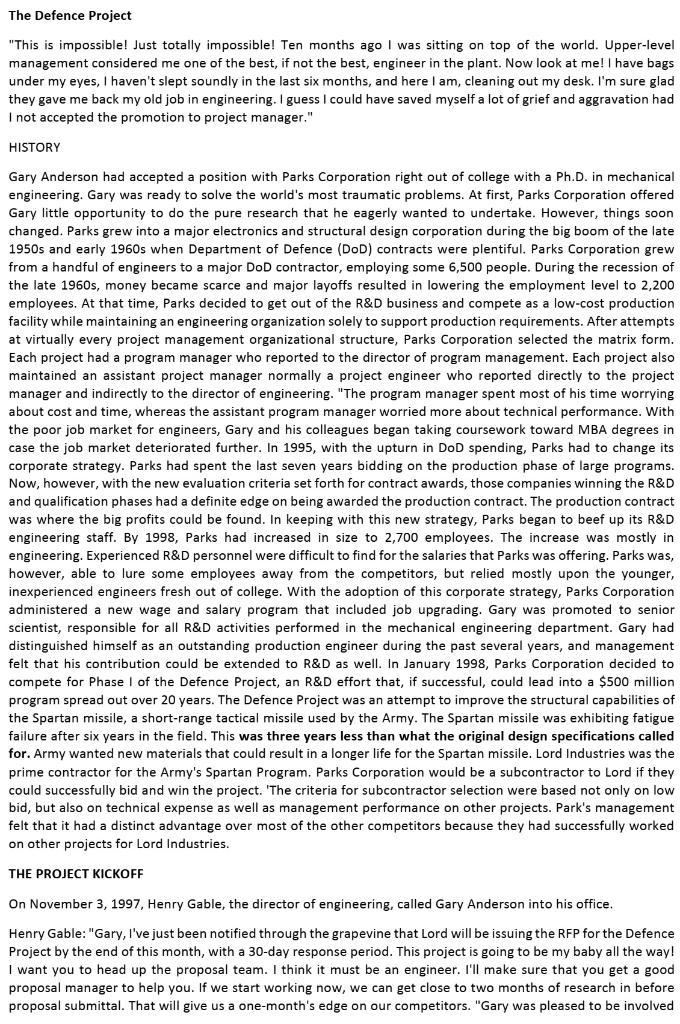
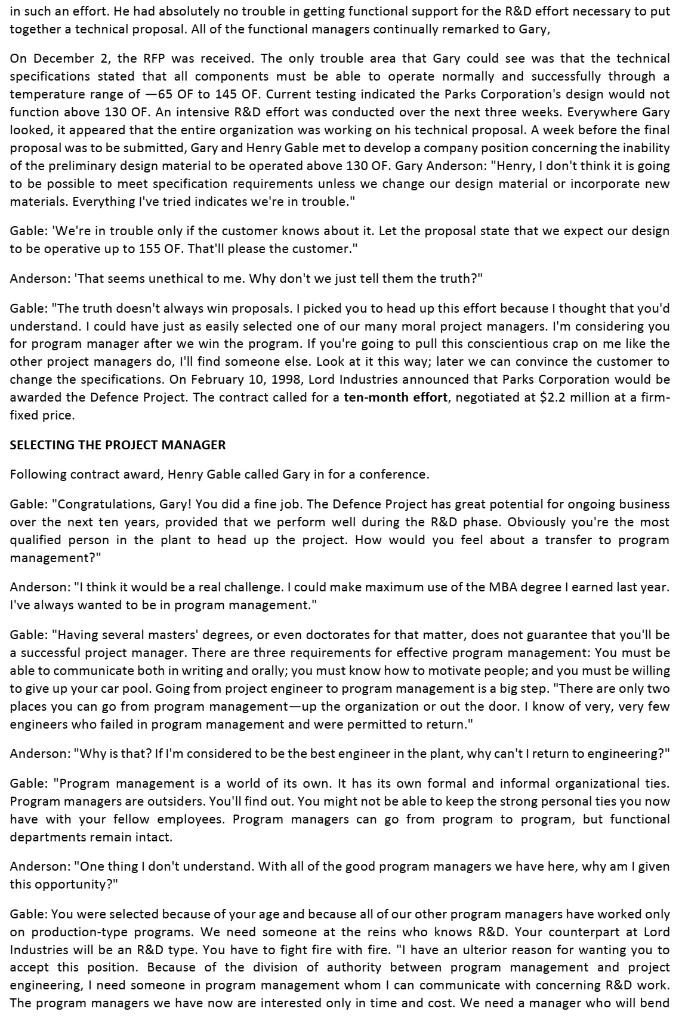
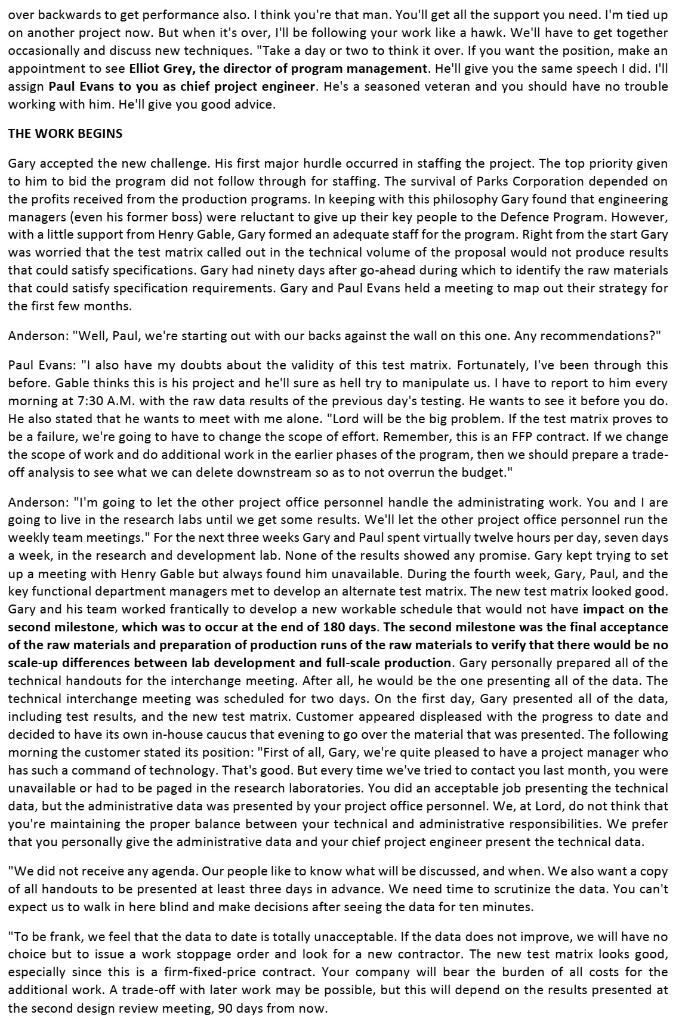
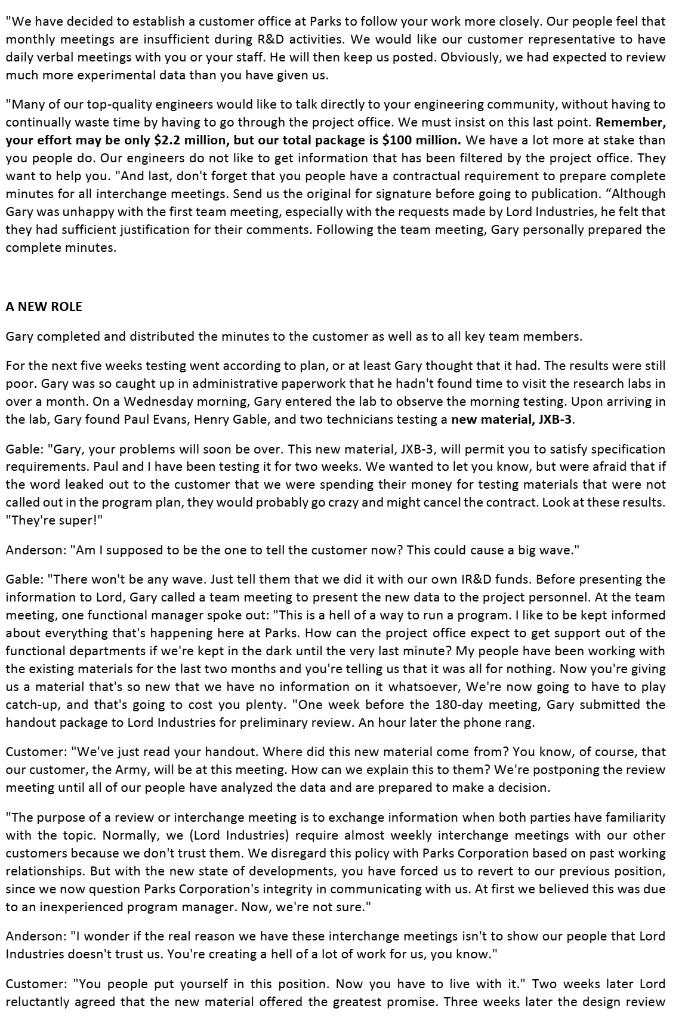
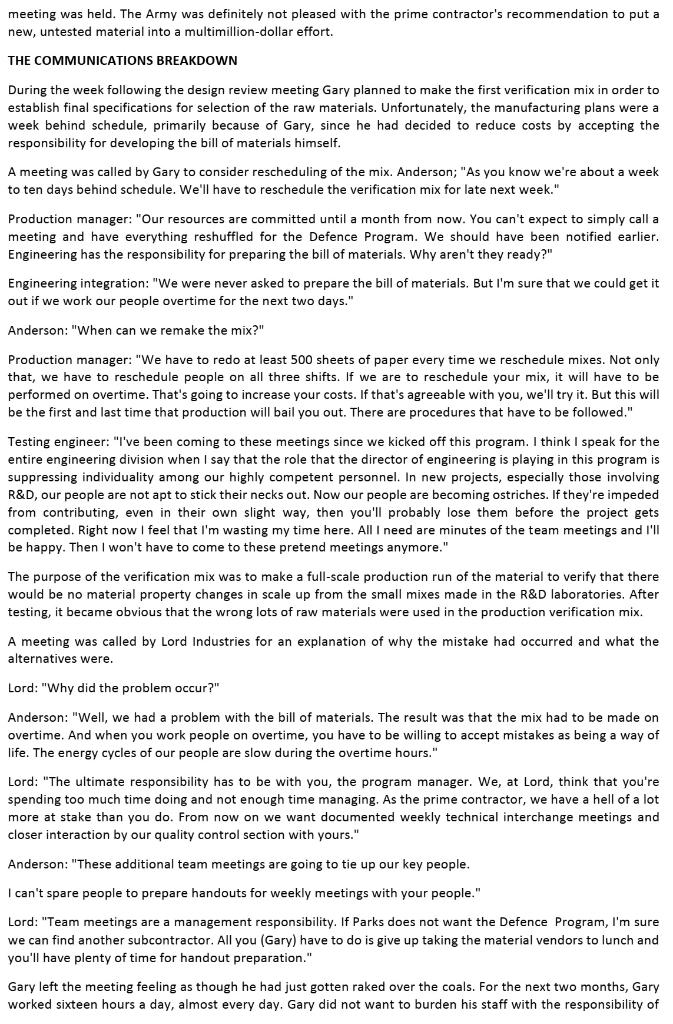
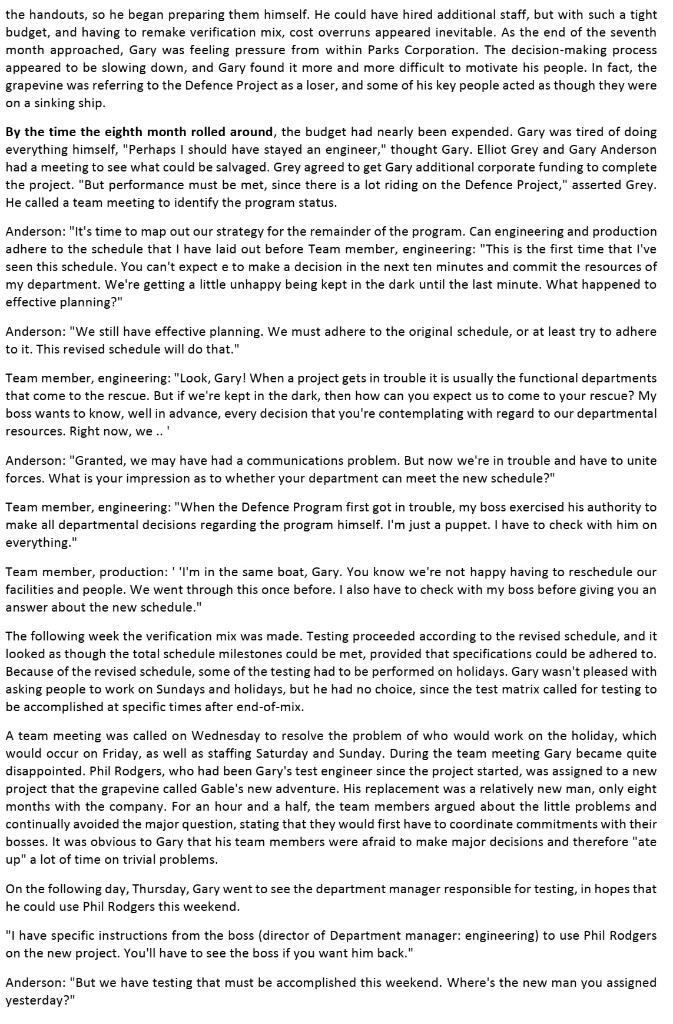
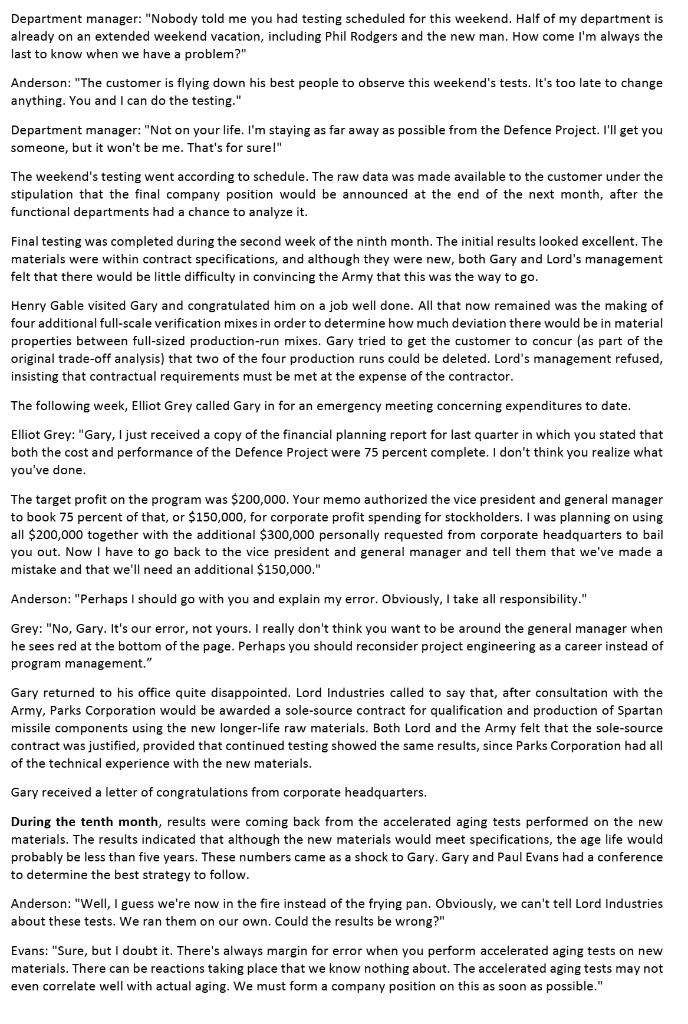
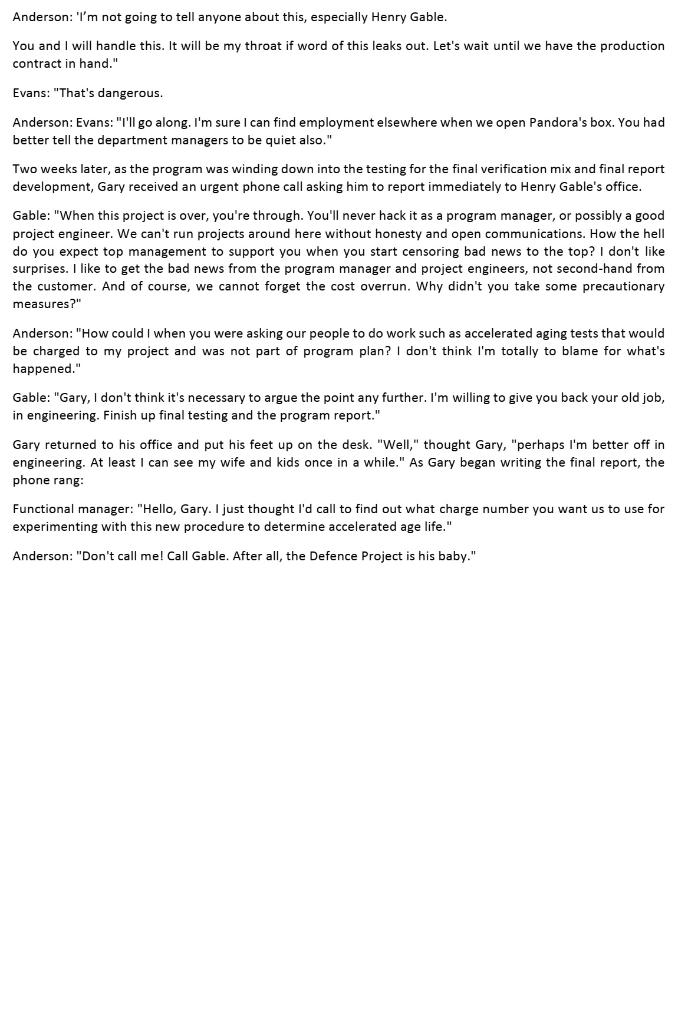
The Defence Project "This is impossible! Just totally impossible! Ten months ago I was sitting on top of the world. Upper-level management considered me one of the best, if not the best, engineer in the plant. Now look at me! I have bags under my eyes, I haven't slept soundly in the last six months, and here I am, cleaning out my desk. I'm sure glad they gave me back my old job in engineering. I guess I could have saved myself a lot of grief and aggravation had I not accepted the promotion to project manager." HISTORY Gary Anderson had accepted a position with Parks Corporation right out of college with a Ph.D. in mechanical engineering. Gary was ready to solve the world's most traumatic problems. At first, Parks Corporation offered Gary little opportunity to do the pure research that he eagerly wanted to undertake. However, things soon changed. Parks grew into a major electronics and structural design corporation during the big boom of the late 1950s and early 1960s when Department of Defence (DOD) contracts were plentiful. Parks Corporation grew from a handful of engineers to a major DoD contractor, employing some 6,500 people. During the recession of the late 1960s, money became scarce and major layoffs resulted in lowering the employment level to 2,200 employees. At that time, Parks decided to get out of the R&D business and compete as a low-cost production facility while maintaining an engineering organization solely to support production requirements. After attempts at virtually every project management organizational structure, Parks Corporation selected the matrix form. Each project had a program manager who reported to the director of program management. Each project also maintained an assistant project manager normally a project engineer who reported directly to the project manager and indirectly to the director of engineering. "The program manager spent most of his time worrying about cost and time, whereas the assistant program manager worried more about technical performance. With the poor job market for engineers, Gary and his colleagues began taking coursework toward MBA degrees in case the job market deteriorated further. In 1995, with the upturn in DoD spending, Parks had to change its corporate strategy. Parks had spent the last seven years bidding on the production phase of large programs. Now, however, with the new evaluation criteria set forth for contract awards, those companies winning the R&D and qualification phases had a definite edge on being awarded the production contract. The production contract was where the big profits could be found. In keeping with this new strategy, Parks began to beef up its R&D engineering staff. By 1998, Parks had increased in size to 2,700 employees. The increase was mostly in engineering. Experienced R&D personnel were difficult to find for the salaries that Parks was offering. Parks was, however, able to lure some employees away from the competitors, but relied mostly upon the younger, inexperienced engineers fresh out of college. With the adoption of this corporate strategy, Parks Corporation administered a new wage and salary program that included job upgrading. Gary was promoted to senior scientist, responsible for all R&D activities performed in the mechanical engineering department. Gary had distinguished himself as an outstanding production engineer during the past several years, and management felt that his contribution could be extended to R&D as well. In January 1998, Parks Corporation decided to compete for Phase I of the Defence Project, an R&D effort that, if successful, could lead into a $500 million program spread out over 20 years. The Defence Project was an attempt to improve the structural capabilities of the Spartan missile, a short-range tactical missile used by the Army. The Spartan missile was exhibiting fatigue failure after six years in the field. This was three years less than what the original design specifications called for. Army wanted new materials that could result in a longer life for the Spartan missile. Lord Industries was the prime contractor for the Army's Spartan Program. Parks Corporation would be a subcontractor to Lord if they could successfully bid and win the project. 'The criteria for subcontractor selection were based not only on low bid, but also on technical expense as well as management performance on other projects. Park's management felt that it had a distinct advantage over most of the other competitors because they had successfully worked on other projects for Lord Industries. THE PROJECT KICKOFF On November 3, 1997, Henry Gable, the director of engineering, called Gary Anderson into his office. Henry Gable: "Gary, I've just been notified through the grapevine that Lord will be issuing the RFP for the Defence Project by the end of this month, with a 30-day response period. This project is going to be my baby all the way! I want you to head up the proposal team. I think it must be an engineer. I'll make sure that you get a good proposal manager to help you. If we start working now, we can get close to two months of research in before proposal submittal. That will give us a one-month's edge on our competitors. "Gary was pleased to be involved in such an effort. He had absolutely no trouble in getting functional support for the R&D effort necessary to put together a technical proposal. All of the functional managers continually remarked to Gary, On December 2, the RFP was received. The only trouble area that Gary could see was that the technical specifications stated that all components must be able to operate normally and successfully through a temperature range of -65 OF to 145 OF. Current testing indicated the Parks Corporation's design would not function above 130 OF. An intensive R&D effort was conducted over the next three weeks. Everywhere Gary looked, it appeared that the entire organization was working on his technical proposal. A week before the final proposal was to be submitted, Gary and Henry Gable met to develop a company position concerning the inability of the preliminary design material to be operated above 130 OF. Gary Anderson: "Henry, I don't think it is going to be possible to meet specification requirements unless we change our design material or incorporate new materials. Everything I've tried indicates we're in trouble." Gable: 'We're in trouble only if the customer knows about it. Let the proposal state that we expect our design to be operative up to 155 OF. That'll please the customer." Anderson: 'That seems unethical to me. Why don't we just tell them the truth?" Gable: "The truth doesn't always win proposals. I picked you to head up this effort because I thought that you'd understand. I could have just as easily selected one of our many moral project managers. I'm considering you for program manager after we win the program. If you're going to pull this conscientious crap on me like the other project managers do, I'll find someone else. Look at it this way; later we can convince the customer to change the specifications. On February 10, 1998, Lord Industries announced that Parks Corporation would be awarded the Defence Project. The contract called for a ten-month effort, negotiated at $2.2 million at a firm- fixed price. SELECTING THE PROJECT MANAGER Following contract award, Henry Gable called Gary in for a conference. Gable: "Congratulations, Gary! You did a fine job. The Defence Project has great potential for ongoing business over the next ten years, provided that we perform well during the R&D phase. Obviously you're the most qualified person in the plant to head up the project. How would you feel about a transfer to program management?" Anderson: "I think it would be a real challenge. I could make maximum use of the MBA degree learned last year. I've always wanted to be in program management." Gable: "Having several masters' degrees, or even doctorates for that matter, does not guarantee that you'll be a successful project manager. There are three requirements for effective program management: You must be able to communicate both in writing and orally; you must know how to motivate people, and you must be willing to give up your car pool. Going from project engineer to program management is a big step. "There are only two places you can go from program management-up the organization or out the door. I know of very, very few engineers who failed in program management and were permitted to return." Anderson: "Why is that? If I'm considered to be the best engineer in the plant, why can't I return to engineering?" Gable: "Program management is a world of its own. It has its own formal and informal organizational ties. Program managers are outsiders. You'll find out. You might not be able to keep the strong personal ties you now have with your fellow employees. Program managers can go from program to program, but functional departments remain intact. Anderson: "One thing I don't understand. With all of the good program managers we have here, why am I given this opportunity?" Gable: You were selected because of your age and because all of our other program managers have worked only on production-type programs. We need someone at the reins who knows R&D. Your counterpart at Lord Industries will be an R&D type. You have to fight fire with fire. "I have an ulterior reason for wanting you to accept this position. Because of the division of authority between program management and project engineering, I need someone in program management whom I can communicate with concerning R&D work. The program managers we have now are interested only in time and cost. We need a manager who will bend over backwards to get performance also. I think you're that man. You'll get all the support you need. I'm tied up on another project now. But when it's over, I'll be following your work like a hawk. We'll have to get together occasionally and discuss new techniques. "Take a day or two to think it over. If you want the position, make an appointment to see Elliot Grey, the director of program management. He'll give you the same speech I did. I'll assign Paul Evans to you as chief project engineer. He's a seasoned veteran and you should have no trouble working with him. He'll give you good advice. THE WORK BEGINS Gary accepted the new challenge. His first major hurdle occurred in staffing the project. The top priority given to him to bid the program did not follow through for staffing. The survival of Parks Corporation depended on the profits received from the production programs. In keeping with this philosophy Gary found that engineering managers (even his former boss) were reluctant to give up their key people to the Defence Program. However, with a little support from Henry Gable, Gary formed an adequate staff for the program. Right from the start Gary was worried that the test matrix called out in the technical volume of the proposal would not produce results that could satisfy specifications. Gary had ninety days after go-ahead during which to identify the raw materials that could satisfy specification requirements. Gary and Paul Evans held a meeting to map out their strategy for the first few months. Anderson: "Well, Paul, we're starting out with our backs against the wall on this one. Any recommendations?" Paul Evans: "I also have my doubts about the validity of this test matrix. Fortunately, I've been through this before. Gable thinks this is his project and he'll sure as hell try to manipulate us. I have to report to him every morning at 7:30 A.M. with the raw data results of the previous day's testing. He wants to see it before you do. He also stated that he wants to meet with me alone. "Lord will be the big problem. If the test matrix proves to be a failure, we're going to have to change the scope of effort. Remember, this is an FFP contract. If we change the scope of work and do additional work in the earlier phases of the program, then we should prepare a trade- off analysis to see what we can delete downstream so as to not overrun the budget." Anderson: "I'm going to let the other project office personnel handle the administrating work. You and I are going to live in the research labs until we get some results. We'll let the other project office personnel run the weekly team meetings." For the next three weeks Gary and Paul spent virtually twelve hours per day, seven days a week, in the research and development lab. None of the results showed any promise. Gary kept trying to set up a meeting with Henry Gable but always found him unavailable. During the fourth week, Gary, Paul, and the key functional department managers met to develop an alternate test matrix. The new test matrix looked good. Gary and his team worked frantically to develop new workable schedule that would not have impact on the second milestone, which was to occur at the end of 180 days. The second milestone was the final acceptance of the raw materials and preparation of production runs of the raw materials to verify that there would be no scale-up differences between lab development and full-scale production. Gary personally prepared all of the technical handouts for the interchange meeting. After all, he would be the one presenting all of the data. The technical interchange meeting was scheduled for two days. On the first day, Gary presented all of the data, including test results, and the new test matrix. Customer appeared displeased with the progress to date and decided to have its own in-house caucus that evening to go over the material that was presented. The following morning the customer stated its position: "First of all, Gary, we're quite pleased to have a project manager who has such command of technology. That's good. But every time we've tried to contact you last month, you were unavailable or had to be paged in the research laboratories. You did an acceptable job presenting the technical data, but the administrative data was presented by your project office personnel. We, at Lord, do not think that you're maintaining the proper balance between your technical and administrative responsibilities. We prefer that you personally give the administrative data and your chief project engineer present the technical data. "We did not receive any agenda. Our people like to know what will be discussed, and when. We also want a copy of all handouts to be presented at least three days in advance. We need time to scrutinize the data. You can't expect us to walk in here blind and make decisions after seeing the data for ten minutes. "To be frank, we feel that the data to date is totally unacceptable. If the data does not improve, we will have no choice but to issue a work stoppage order and look for a new contractor. The new test matrix looks good, especially since this is a firm-fixed-price contract. Your company will bear the burden of all costs for the additional work. A trade-off with later work may be possible, but this will depend on the results presented at the second design review meeting, 90 days from now. "We have decided to establish a customer office at Parks to follow your work more closely. Our people feel that monthly meetings are insufficient during R&D activities. We would like our customer representative to have daily verbal meetings with you or your staff. He will then keep us posted. Obviously, we had expected to review much more experimental data than you have given us. "Many of our top-quality engineers would like to talk directly to your engineering community, without having to continually waste time by having to go through the project office. We must insist on this last point. Remember, your effort may be only $2.2 million, but our total package is $100 million. We have a lot more at stake than you people do. Our engineers do not like to get information that has been filtered by the project office. They want to help you. "And last, don't forget that you people have a contractual requirement to prepare complete minutes for all interchange meetings. Send us the original for signature before going to publication. "Although Gary was unhappy with the first team meeting, especially with the requests made by Lord Industries, he felt that they had sufficient justification for their comments. Following the team meeting, Gary personally prepared the complete minutes. A NEW ROLE Gary completed and distributed the minutes to the customer as well as to all key team members. For the next five weeks testing went according to plan, or at least Gary thought that it had. The results were still poor. Gary was so caught up in administrative paperwork that he hadn't found time to visit the research labs in over a month. On a Wednesday morning, Gary entered the lab to observe the morning testing. Upon arriving in the lab, Gary found Paul Evans, Henry Gable, and two technicians testing a new material, JXB-3. Gable: "Gary, your problems will soon be over. This new material, JXB-3, will permit you to satisfy specification requirements. Paul and I have been testing it for two weeks. We wanted to let you know, but were afraid that if the word leaked out to the customer that we were spending their money for testing materials that were not called out in the program plan, they would probably go crazy and might cancel the contract. Look at these results. "They're super!" Anderson: "Am I supposed to be the one to tell the customer now? This could cause a big wave." Gable: "There won't be any wave. Just tell them that we did it with our own IR&D funds. Before presenting the information to Lord, Gary called a team meeting to present the new data to the project personnel. At the team meeting, one functional manager spoke out: "This is a hell of a way to run a program. I like to be kept informed about everything that's happening here at Parks. How can the project office expect to get support out of the functional departments if we're kept in the dark until the very last minute? My people have been working with the existing materials for the last two months and you're telling us that it was all for nothing. Now you're giving us a material that's so new that we have no information on it whatsoever, We're now going to have to play catch-up, and that's going to cost you plenty. "One week before the 180-day meeting, Gary submitted the handout package to Lord Industries for preliminary review. An hour later the phone rang. Customer: "We've just read your handout. Where did this new material come from? You know, of course, that our customer, the Army, will be at this meeting. How can we explain this to them? We're postponing the review meeting until all of our people have analyzed the data and are prepared to make a decision. "The purpose of a review or interchange meeting is to exchange information when both parties have familiarity with the topic. Normally, we (Lord Industries) require almost weekly interchange meetings with our other customers because we don't trust them. We disregard this policy with Parks Corporation based on past working relationships. But with the new state of developments, you have forced us to revert to our previous position, since we now question Parks Corporation's integrity in communicating with us. At first we believed this was due to an inexperienced program manager. Now, we're not sure." Anderson: "I wonder if the real reason we have these interchange meetings isn't to show our people that Lord Industries doesn't trust us. You're creating a hell of a lot of work for us, you know." Customer: "You people put yourself in this position. Now you have to live with it." Two weeks later Lord reluctantly agreed that the new material offered the greatest promise. Three weeks later the design review meeting was held. The Army was definitely not pleased with the prime contractor's recommendation to put a new, untested material into a multimillion-dollar effort. THE COMMUNICATIONS BREAKDOWN During the week following the design review meeting Gary planned to make the first verification mix in order to establish final specifications for selection of the raw materials. Unfortunately, the manufacturing plans were a week behind schedule, primarily because of Gary, since he had decided to reduce costs by accepting the responsibility for developing the bill of materials himself. A meeting was called by Gary to consider rescheduling of the mix. Anderson; "As you know we're about a week to ten days behind schedule. We'll have to reschedule the verification mix for late next week." Production manager: "Our resources are committed until a month from now. You can't expect to simply call a meeting and have everything reshuffled for the Defence Program. We should have been notified earlier. Engineering has the responsibility for preparing the bill of materials. Why aren't they ready?" Engineering integration: "We were never asked to prepare the bill of materials. But I'm sure that we could get it out if we work our people overtime for the next two days." Anderson: "When can we remake the mix?" Production manager: "We have to redo at least 500 sheets of paper every time we reschedule mixes. Not only that, we have to reschedule people on all three shifts. If we are to reschedule your mix, it will have to be performed on overtime. That's going to increase your costs. If that's agreeable with you, we'll try it. But this will be the first and last time that production will bail you out. There are procedures that have to be followed." Testing engineer: "I've been coming to these meetings since we kicked off this program. I think I speak for the entire engineering division when I say that the role that the director of engineering is playing in this program is suppressing individuality among our highly competent personnel. In new projects, especially those involving R&D, our people are not apt to stick their necks out. Now our people are becoming ostriches. If they're impeded from contributing, even in their own slight way, then you'll probably lose them before the project gets completed. Right now I feel that I'm wasting my time here. All I need are minutes of the team meetings and I'll be happy. Then I won't have to come to these pretend meetings anymore." The purpose of the verification mix was to make a full-scale production run of the material to verify that there would be no material property changes in scale up from the small mixes made in the R&D laboratories. After testing, it became obvious that the wrong lots of raw materials were used in the production verification mix. A meeting was called by Lord Industries for an explanation of why the mistake had occurred and what the alternatives were. Lord: "Why did the problem occur?" Anderson: "Well, we had a problem with the bill of materials. The result was that the mix had to be made on overtime. And when you work people on overtime, you have to be willing to accept mistakes as being a way of life. The energy cycles of our people are slow during the overtime hours." Lord: "The ultimate responsibility has to be with you, the program manager. We, at Lord, think that you're spending too much time doing and not enough time managing. As the prime contractor, we have a hell of a lot more at stake than you do. From now on we want documented weekly technical interchange meetings and closer interaction by our quality control section with yours." Anderson: "These additional team meetings are going to tie up our key people. I can't spare people to prepare handouts for weekly meetings with your people." Lord: "Team meetings are a management responsibility. If Parks does not want the Defence Program, I'm sure we can find another subcontractor. All you (Gary) have to do is give up taking the material vendors to lunch and you'll have plenty of time for handout preparation." Gary left the meeting feeling as though he had just gotten raked over the coals. For the next two months, Gary worked sixteen hours a day, almost every day. Gary did not want to burden his staff with the responsibility of the handouts, so he began preparing them himself. He could have hired additional staff, but with such a tight budget, and having to remake verification mix, cost overruns appeared inevitable. As the end of the seventh month approached, Gary was feeling pressure from within Parks Corporation. The decision-making process appeared to be slowing down, and Gary found it more and more difficult to motivate his people. In fact, the grapevine was referring to the Defence Project as a loser, and some of his key people acted as though they were on a sinking ship. By the time the eighth month rolled around, the budget had nearly been expended. Gary was tired of doing everything himself, "Perhaps I should have stayed an engineer," thought Gary. Elliot Grey and Gary Anderson had a meeting to see what could be salvaged. Grey agreed to get Gary additional corporate funding to complete the project. "But performance must be met, since there is a lot riding on the Defence Project," asserted Grey. He called a team meeting to identify the program status. Anderson: "It's time to map out our strategy for the remainder of the program. Can engineering and production adhere to the schedule that I have laid out before Team member, engineering: "This is the first time that I've seen this schedule. You can't expect e to make a decision in the next ten minutes and commit the resources of my department. We're getting a little unhappy being kept in the dark until the last minute. What happened to effective planning?" Anderson: "We still have effective planning. We must adhere to the original schedule, or at least try to adhere to it. This revised schedule will do that." Team member, engineering: "Look, Gary! When a project gets in trouble it is usually the functional departments that come to the rescue. But if we're kept in the dark, then how can you expect us to come to your rescue? My boss wants to know, well in advance, every decision that you're contemplating with regard to our departmental resources. Right now, we ..' Anderson: "Granted, we may have had a communications problem. But now we're in trouble and have to unite forces. What is your impression as to whether your department can meet the new schedule?" Team member, engineering: "When the Defence Program first got in trouble, my boss exercised his authority to make all departmental decisions regarding the program himself. I'm just a puppet. I have to check with him on everything." Team member, production:' 'I'm in the same boat, Gary. You know we're not happy having to reschedule our facilities and people. We went through this once before. I also have to check with my boss before giving you an answer about the new schedule." The following week the verification mix was made. Testing proceeded according to the revised schedule, and it looked as though the total schedule milestones could be met, provided that specifications could be adhered to. Because of the revised schedule, some of the testing had to be performed on holidays. Gary wasn't pleased with asking people to work on Sundays and holidays, but he had no choice, since the test matrix called for testing to be accomplished at specific times after end-of-mix. A team meeting was called on Wednesday to resolve the problem of who would work on the holiday, which would occur on Friday, as well as staffing Saturday and Sunday. During the team meeting Gary became quite disappointed. Phil Rodgers, who had been Gary's test engineer since the project started, was assigned to a new project that the grapevine called Gable's new adventure. His replacement was a relatively new man, only eight months with the company. For an hour and a half, the team members argued about the little problems and continually avoided the major question, stating that they would first have to coordinate commitments with their bosses. It was obvious to Gary that his team members were afraid to make major decisions and therefore "ate up" a lot of time on trivial problems. On the following day, Thursday, Gary went to see the department manager responsible for testing, in hopes that he could use Phil Rodgers this weekend. "I have specific instructions from the boss (director of Department manager: engineering) to use Phil Rodgers on the new project. You'll have to see the boss if you want him back." Anderson: "But we have testing that must be accomplished this weekend. Where's the new man you assigned yesterday?" Department manager: "Nobody told me you had testing scheduled for this weekend. Half of my department is already on an extended weekend vacation, including Phil Rodgers and the new man. How come I'm always the last to know when we have a problem?" Anderson: "The customer is flying down his best people to observe this weekend's tests. It's too late to change anything. You and I can do the testing." Department manager: "Not on your life. I'm staying as far away as possible from the Defence Project. I'll get you someone, but it won't be me. That's for sure!" The weekend's testing went according to schedule. The raw data was made available to the customer under the stipulation that the final company position would be announced at the end of the next month, after the functional departments had a chance to analyze it. Final testing was completed during the second week of the ninth month. The initial results looked excellent. The materials were within contract specifications, and although they were new, both Gary and Lord's management felt that there would be little difficulty in convincing the Army that this was the way to go. Henry Gable visited Gary and congratulated him on a job well done. All that now remained was the making of four additional full-scale verification mixes in order to determine how much deviation there would be in material properties between full-sized production-run mixes. Gary tried to get the customer to concur (as part of the original trade-off analysis) that two of the four production runs could be deleted. Lord's management refused, insisting that contractual requirements must be met at the expense of the contractor. The following week, Elliot Grey called Gary in for an emergency meeting concerning expenditures to date. Elliot Grey: "Gary, I just received a copy of the financial planning report for last quarter in which you stated that both the cost and performance of the Defence Project were 75 percent complete. I don't think you realize what you've done. The target profit on the program was $200,000. Your memo authorized the vice president and general manager to book 75 percent of that, or $150,000, for corporate profit spending for stockholders. I was planning on using all $200,000 together with the additional $300,000 personally requested from corporate headquarters to bail you out. Now I have to go back to the vice president and general manager and tell them that we've made a mistake and that we'll need an additional $150,000." Anderson: "Perhaps I should go with you and explain my error. Obviously, I take all responsibility." Grey: "No, Gary. It's our error, not yours. I really don't think you want to be around the general manager when he sees red at the bottom of the page. Perhaps you should reconsider project engineering as a career instead of program management." Gary returned to his office quite disappointed. Lord Industries called to say that, after consultation with the Army, Parks Corporation would be awarded a sole-source contract for qualification and production of Spartan missile components using the new longer-life raw materials. Both Lord and the Army felt that the sole-source contract was justified, provided that continued testing showed the same results, since Parks Corporation had all of the technical experience with the new materials. Gary received a letter of congratulations from corporate headquarters, During the tenth month, results were coming back from the accelerated aging tests performed on the new materials. The results indicated that although the new materials would meet specifications, the age life would probably be less than five years. These numbers came as a shock to Gary. Gary and Paul Evans had a conference to determi the best strategy to follow. Anderson: "Well, I guess we're now in the fire instead of the frying pan. Obviously, we can't tell Lord Industries about these tests. We ran them on our own. Could the results be wrong?" Evans: "Sure, but I doubt it. There's always margin for error when you perform accelerated aging tests on new materials. There can be reactions taking place that we know nothing about. The accelerated aging tests may not even correlate well with actual aging. We must form a company position on this as soon as possible." Anderson: 'I'm not going to tell anyone about this, especially Henry Gable. You and I will handle this. It will be my throat if word of this leaks out. Let's wait until we have the production contract in hand." Evans: "That's dangerous. Anderson: Evans: "I'll go along. I'm sure I can find employment elsewhere when we open Pandora's box. You had better tell the department managers to be quiet also." Two weeks later, as the program was winding down into the testing for the final verification mix and final report development, Gary received an urgent phone call asking him to report immediately to Henry Gable's office. Gable: "When this project is over, you're through. You'll never hack it as a program manager, or possibly a good project engineer. We can't run projects around here without honesty and open communications. How the hell do you expect top management to support you when you start censoring bad news to the top? I don't like surprises. I like to get the bad news from the program manager and project engineers, not second-hand from the customer. And of course, we cannot forget the cost overrun. Why didn't you take some precautionary measures?" Anderson: "How could I when you were asking our people to do work such as accelerated aging tests that would be charged to my project and was not part of program plan? I don't think I'm totally to blame for what's happened." Gable: "Gary, I don't think it's necessary to argue the point any further. I'm willing to give you back your old job, in engineering. Finish up final testing and the program report." Gary returned to his office and put his feet up on the desk. "Well," thought Gary, "perhaps I'm better off in engineering. At least I can see my wife and kids once in a while." As writing the final report, the phone rang: Functional manager: "Hello, Gary. I just thought I'd call to find out what charge number you want us to use for experimenting with this new procedure to determine accelerated age life." Anderson: "Don't call me! Call Gable. After all, the Defence Project is his baby
Step by Step Solution
There are 3 Steps involved in it

Get step-by-step solutions from verified subject matter experts
 Study Help