







Question: Debugging general constructions for Turing machines can be useful in proving claims of closure of the class of Turing-decidable and Turing-recognizable languages under certain
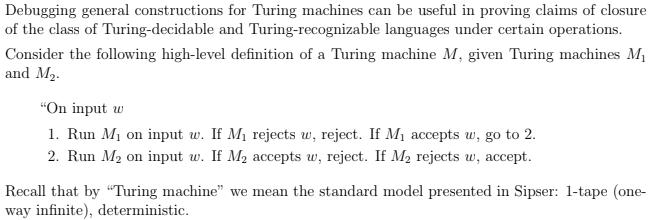
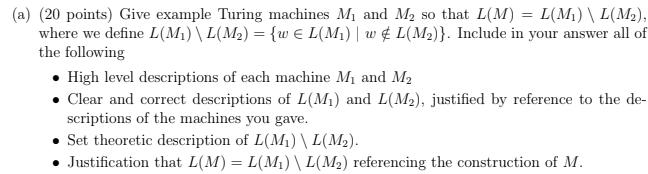
Debugging general constructions for Turing machines can be useful in proving claims of closure of the class of Turing-decidable and Turing-recognizable languages under certain operations. Consider the following high-level definition of a Turing machine M, given Turing machines M and M. "On input w 1. Run M on input w. If M rejects w, reject. If M accepts w, go to 2. 2. Run M on input w. If M accepts w, reject. If M rejects w, accept. Recall that by "Turing machine" we mean the standard model presented in Sipser: 1-tape (one- way infinite), deterministic. (a) (20 points) Give example Turing machines M and M so that L(M)=L(M) L(M), where we define L(M) \ L(M) = {w L(M) | w L(M)}. Include in your answer all of the following High level descriptions of each machine M and M Clear and correct descriptions of L(M) and L(M), justified by reference to the de- scriptions of the machines you gave. Set theoretic description of L(M) L(M). Justification that L(M)=L(M) \ L(M) referencing the construction of M.
Step by Step Solution
There are 3 Steps involved in it

Get step-by-step solutions from verified subject matter experts
 Study Help