



Question: DECISION CASES Reading and Interpreting Financial Statements Decision Case 5-1 Comparing Two Companies in the Same Industry: LO1-3 Chipotle and Panera Bread Refer to the
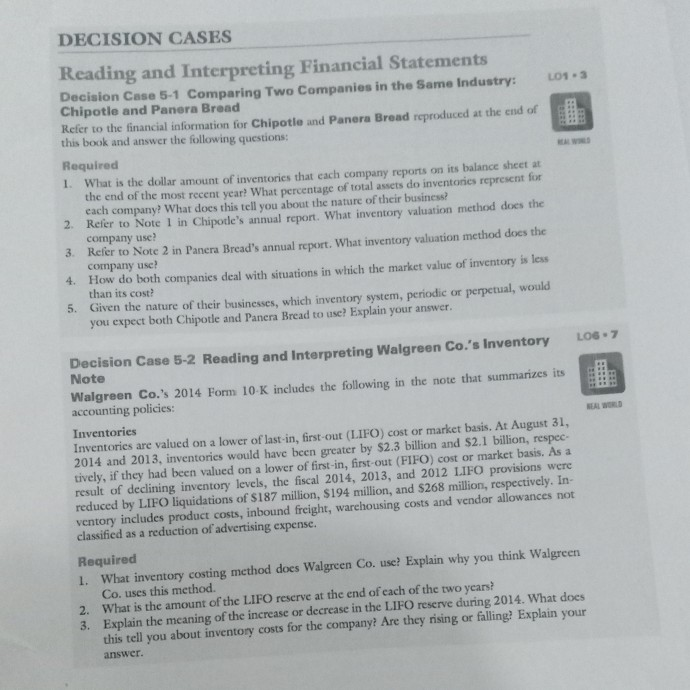
DECISION CASES Reading and Interpreting Financial Statements Decision Case 5-1 Comparing Two Companies in the Same Industry: LO1-3 Chipotle and Panera Bread Refer to the financial information for Chipotle and Panera Bread reproduced at the end of this book and answer the following questions: Required I. What is the dollar amount of inventories that each company reports on its balance sheet at the end of the most recent year? What percentage of total assets do inventories represent for each company? What does this tell you about the nature of their business? 2. Refer to Note 1 in Chipotle's annual report. What inventory valuation method does the company use? 3. Refer to Note 2 in Panera Bread's annual report. What inventory valuation method does the company use? 4. How do both companies deal with situations in which the market value of inventory is less than its cost 5. Given the nature of their businesses, which inventory system, periodic or perpetual, would you expect both Chipotle and Panera Bread to use? Explain your answer. Decision Case 5-2 Reading and Interpreting Walgreen Co.'s Inventory L-7 Note Walgreen Co.'s 2014 Form 10.K includes the following in the note that summarizes its accounting policies: Inventories EAL WORLD Inventories are valued on a lower of last -in, first-out (LIFO) cost or market basis. At August 31, 2014 and 2013, inventories would have been greater by $2.3 billion and $2.1 billion, respec- tively, if they had been valued on a lower of first-in, first-out (FIFO) cost or market basis. As a result of declining inventory levels, the fiscal 2014, 2013, and 2012 LIFO provisions were reduced by LIFO liquidations of $187 million, $194 million, and $268 million, respectively. In- ventory includes product costs, inbound freight, warehousing costs and vendor allowances not classified as a reduction of advertising expense. Required 1. What inventory costing method docs Walgreen Co. usc? Explain why you think Walgreen Co. uses this method. What is the amount of the LIFO reserve at the end of each of the two years? Explain the meaning of the increase or decrease in the LIFO reserve during 2014. What does this tell you about inventory costs for the company? Are they rising or falling? Explain your answer. 2. 3. DECISION CASES Reading and Interpreting Financial Statements Decision Case 5-1 Comparing Two Companies in the Same Industry: LO1-3 Chipotle and Panera Bread Refer to the financial information for Chipotle and Panera Bread reproduced at the end of this book and answer the following questions: Required I. What is the dollar amount of inventories that each company reports on its balance sheet at the end of the most recent year? What percentage of total assets do inventories represent for each company? What does this tell you about the nature of their business? 2. Refer to Note 1 in Chipotle's annual report. What inventory valuation method does the company use? 3. Refer to Note 2 in Panera Bread's annual report. What inventory valuation method does the company use? 4. How do both companies deal with situations in which the market value of inventory is less than its cost 5. Given the nature of their businesses, which inventory system, periodic or perpetual, would you expect both Chipotle and Panera Bread to use? Explain your answer. Decision Case 5-2 Reading and Interpreting Walgreen Co.'s Inventory L-7 Note Walgreen Co.'s 2014 Form 10.K includes the following in the note that summarizes its accounting policies: Inventories EAL WORLD Inventories are valued on a lower of last -in, first-out (LIFO) cost or market basis. At August 31, 2014 and 2013, inventories would have been greater by $2.3 billion and $2.1 billion, respec- tively, if they had been valued on a lower of first-in, first-out (FIFO) cost or market basis. As a result of declining inventory levels, the fiscal 2014, 2013, and 2012 LIFO provisions were reduced by LIFO liquidations of $187 million, $194 million, and $268 million, respectively. In- ventory includes product costs, inbound freight, warehousing costs and vendor allowances not classified as a reduction of advertising expense. Required 1. What inventory costing method docs Walgreen Co. usc? Explain why you think Walgreen Co. uses this method. What is the amount of the LIFO reserve at the end of each of the two years? Explain the meaning of the increase or decrease in the LIFO reserve during 2014. What does this tell you about inventory costs for the company? Are they rising or falling? Explain your answer. 2. 3
Step by Step Solution
There are 3 Steps involved in it

Get step-by-step solutions from verified subject matter experts