





Question: Decision process requires either a single or sequential set of decisions for its completion. Each allowable decision has a gain or loss associated with it
Decision process requires either a single or

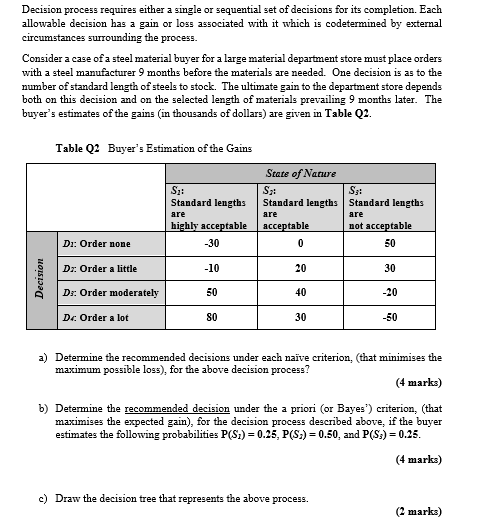
Decision process requires either a single or sequential set of decisions for its completion. Each allowable decision has a gain or loss associated with it which is codetermined by external circumstances surrounding the process. Consider a case of a steel material buyer for a large material department store must place orders with a steel manufacturer 9 months before the materials are needed. One decision is as to the number of standard length of steels to stock. The ultimate gain to the department store depends both on this decision and on the selected length of materials prevailing 9 months later. The buyer's estimates of the gains (in thousands of dollars) are given in Table Q2. Table Q2 Buyer's Estimation of the Gains S: Standard lengths are highly acceptable -30 State of Nature S: Sz: Standard lengths Standard lengths are are acceptable not acceptable 0 50 Di: Order none -10 20 30 Decision Dz: Order a little DE: Order moderately De Order a lot 50 40 -20 SO 30 -50 a) Determine the recommended decisions under each nave criterion (that minimises the maximum possible loss), for the above decision process? (4 marks) b) Determine the recommended decision under the a priori (or Bayes') criterion, (that maximises the expected gain), for the decision process described above, if the buyer estimates the following probabilities P(S1) = 0.25, P(S) = 0.50, and P(S3) = 0.25. (4 marks) c) Draw the decision tree that represents the above process. (2 marks)

Step by Step Solution

There are 3 Steps involved in it

1 Expert Approved Answer
Step: 1 Unlock blur-text-image

Question Has Been Solved by an Expert!

Get step-by-step solutions from verified subject matter experts

Step: 2 Unlock
Step: 3 Unlock

Students Have Also Explored These Related General Management Questions!