







Question: Decision process requires either a single or sequential set of decisions for its completion. Each allowable decision has a gain or loss associated with it
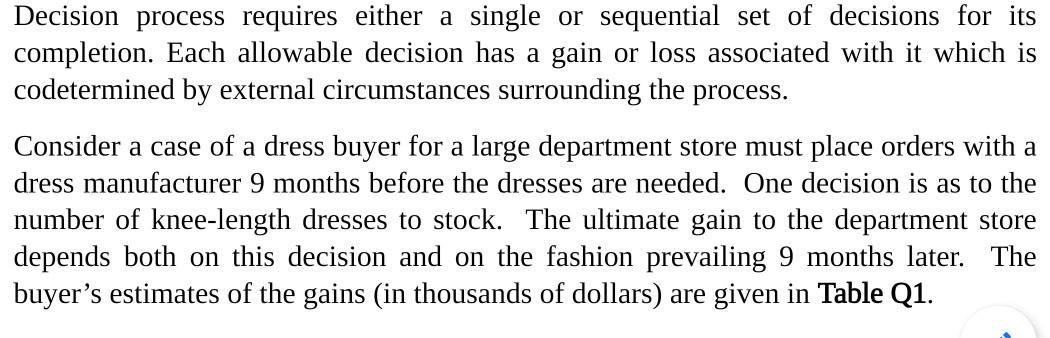
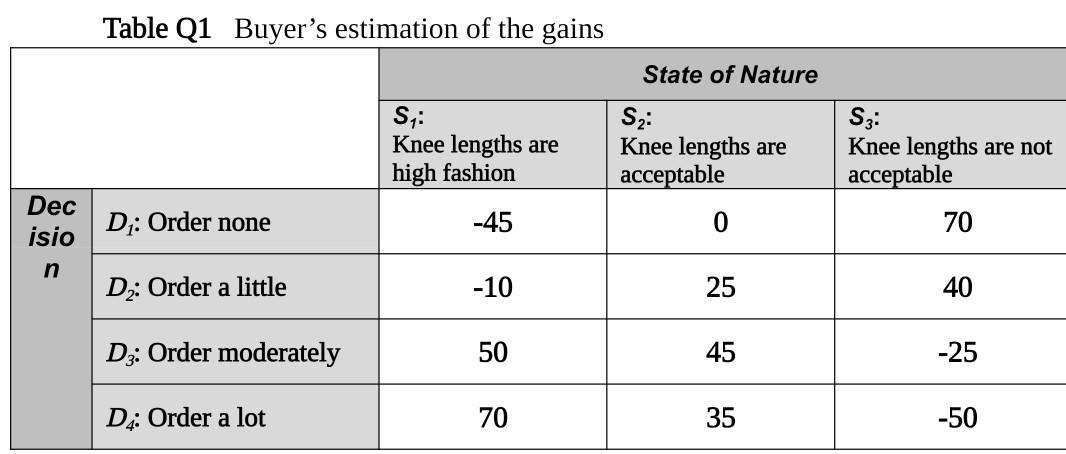
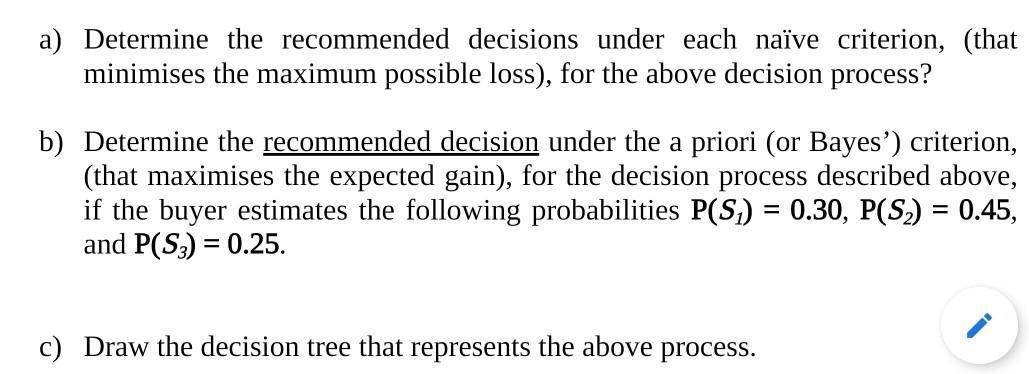
Decision process requires either a single or sequential set of decisions for its completion. Each allowable decision has a gain or loss associated with it which is codetermined by external circumstances surrounding the process. Consider a case of a dress buyer for a large department store must place orders with a dress manufacturer 9 months before the dresses are needed. One decision is as to the number of knee-length dresses to stock. The ultimate gain to the department store depends both on this decision and on the fashion prevailing 9 months later. The buyer's estimates of the gains (in thousands of dollars) are given in Table Q1. Table Q1 Buyer's estimation of the gains State of Nature S: Knee lengths are high fashion Sz: Knee lengths are acceptable Sz: Knee lengths are not acceptable 70 Dec D: Order none -45 0 isio n D: Order a little -10 25 40 Dz: Order moderately 50 45 -25 Da: Order a lot 70 35 -50 a) Determine the recommended decisions under each nave criterion, (that minimises the maximum possible loss), for the above decision process? b) Determine the recommended decision under the a priori (or Bayes') criterion, (that maximises the expected gain), for the decision process described above, if the buyer estimates the following probabilities P(Si) = 0.30, P(S) = 0.45, and P(S3) = 0.25. c) Draw the decision tree that represents the above process
Step by Step Solution
There are 3 Steps involved in it
1 Expert Approved Answer
Step: 1 Unlock

Question Has Been Solved by an Expert!
Get step-by-step solutions from verified subject matter experts
Step: 2 Unlock
Step: 3 Unlock
 Study Help