







Question: Defines the output data set. It can define a sequential data set, a member of a partitioned data set or PDSE, a partitioned data set
Defines the output data set. It can define a sequential data set, a member of a partitioned data set or PDSE, a partitioned data set or PDSE or a z/OS UNIX file. A sequential data set can be basic format, large format, extended format, compressed format, spooled output, tape, card punch, printer, TSO terminal or DUMMY\ Defines the control data set, or specifies DUMMY When the output is sequential and no editing is specified. The control data set normally resides in the input stream; however, it can be defined as a member in a partitioned data set or PDSE.\ Hopefully, you can see that the files assigned for IEBGENER in the JCL1 job, using the DD statements, do not match the files required by the program.\ Make appropriate changes to the DD statements in your JCL1 member (remember to save!) and submit again. If you made the correct changes, the job should complete with
CC=0000.\ If not, check the joblog again for messages that indicate the cause of the new errors; make adjustments and try again ...\ With this type of program, working out what went wrong with things like incorrect or missing DD statements is easy to identify and fix - it's in the book!
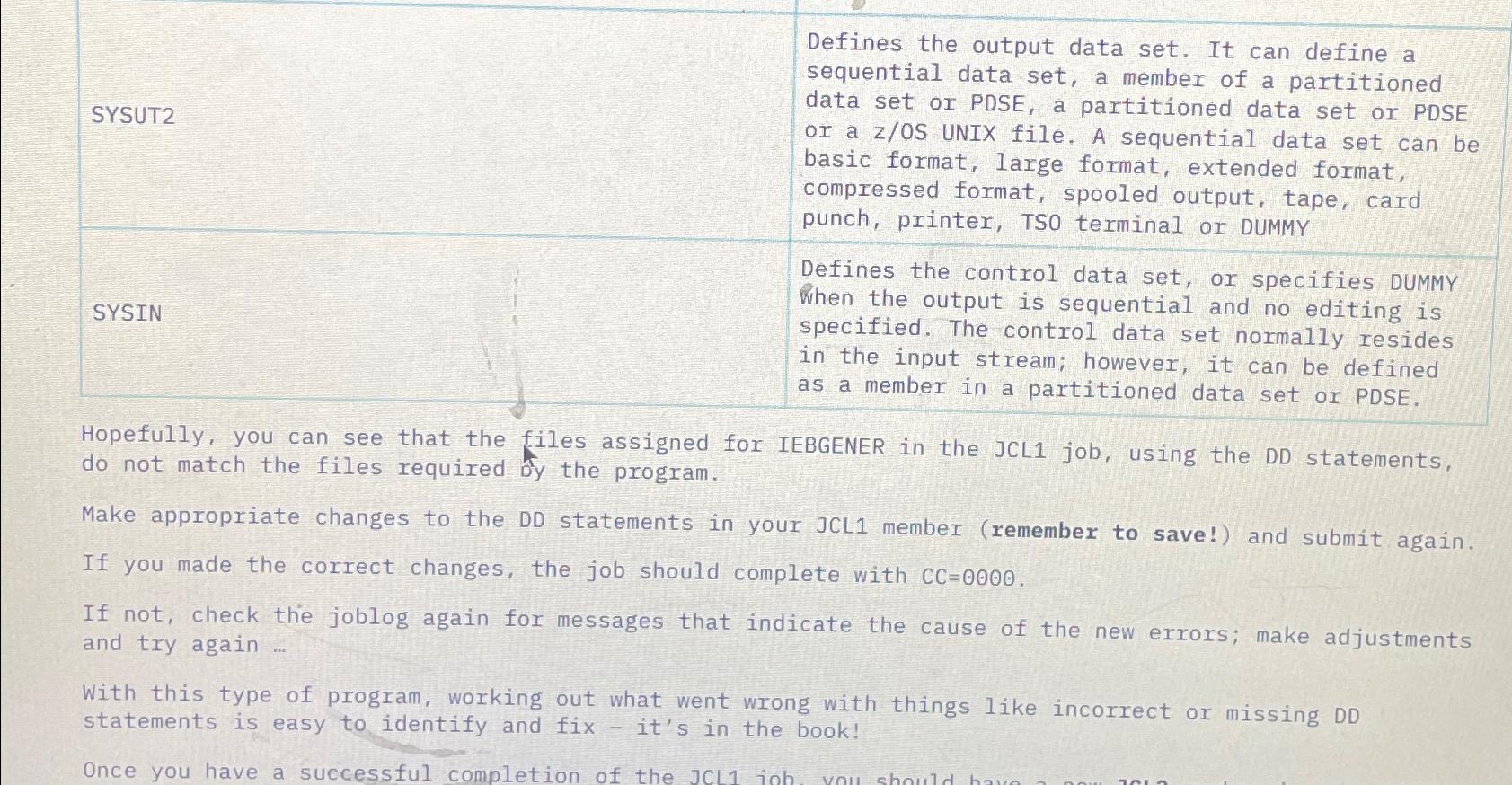
Hopefully, you can see that the files assigned for IEBGENER in the JCL1 job, using the DD statements, do not match the files required by the program. Make appropriate changes to the DD statements in your JCL1 member (remember to save!) and submit again. If you made the correct changes, the job should complete with CC=0000. If not, check the joblog again for messages that indicate the cause of the new errors; make adjustments and try again ... With this type of program, working out what went wrong with things like incorrect or missing DD statements is easy to identify and fix - it's in the book
Step by Step Solution
There are 3 Steps involved in it

Get step-by-step solutions from verified subject matter experts
 Study Help