







Question: Definition: The beam area or beam solid angle or a of an teana is given by the integral of the normalized power pattern over
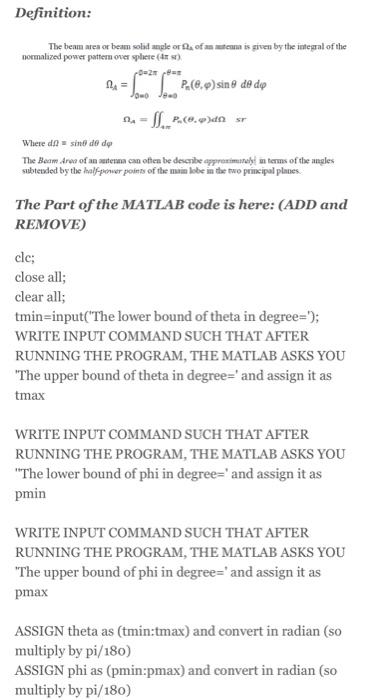
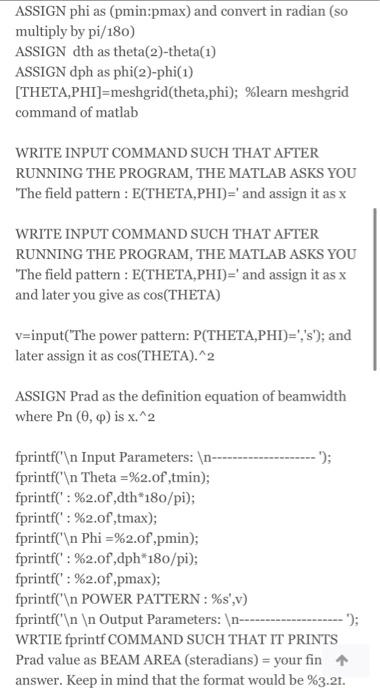
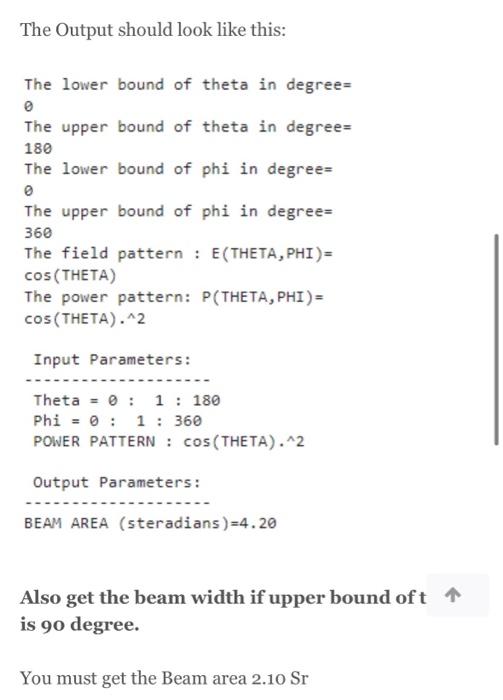
Definition: The beam area or beam solid angle or a of an teana is given by the integral of the normalized power pattern over sphere (4m st). 2 P = Jono P(0.9) sine de dep Jono - P.(0.9)40 sr Where do sin do do The Beam Area of an antenna can often be describe approximately in terms of the angles subtended by the half-power points of the main lobe in the two principal planes. The Part of the MATLAB code is here: (ADD and REMOVE) cle; close all; clear all; tmin=input('The lower bound of theta in degree='); WRITE INPUT COMMAND SUCH THAT AFTER RUNNING THE PROGRAM, THE MATLAB ASKS YOU "The upper bound of theta in degree=' and assign it as tmax WRITE INPUT COMMAND SUCH THAT AFTER RUNNING THE PROGRAM, THE MATLAB ASKS YOU "The lower bound of phi in degree-' and assign it as pmin WRITE INPUT COMMAND SUCH THAT AFTER RUNNING THE PROGRAM, THE MATLAB ASKS YOU "The upper bound of phi in degree=' and assign it as pmax ASSIGN theta as (tmin:tmax) and convert in radian (so multiply by pi/180) ASSIGN phi as (pmin:pmax) and convert in radian (so multiply by pi/180) ASSIGN phi as (pmin:pmax) and convert in radian (so multiply by pi/180) ASSIGN dth as theta(2)-theta(1) ASSIGN dph as phi(2)-phi(1) [THETA,PHI]=meshgrid (theta,phi); %learn meshgrid command of matlab WRITE INPUT COMMAND SUCH THAT AFTER RUNNING THE PROGRAM, THE MATLAB ASKS YOU "The field pattern: E(THETA,PHI)=' and assign it as x WRITE INPUT COMMAND SUCH THAT AFTER RUNNING THE PROGRAM, THE MATLAB ASKS YOU "The field pattern: E(THETA,PHI)=' and assign it as x and later you give as cos(THETA) v=input("The power pattern: P(THETA,PHI)=','s'); and later assign it as cos(THETA).^2 ASSIGN Prad as the definition equation of beamwidth where Pn (0, p) is x.^2 fprintf(" Input Parameters: ----- fprintf(" Theta =%2.of,tmin); fprintf(': %2.0f,dth*180/pi); -'); fprintf('%2.of,tmax); fprintf(" Phi =%2.of,pmin); fprintf(': %2.0f,dph*180/pi); fprintf(': %2.of,pmax); fprintf(" POWER PATTERN: %s',v) fprintf(" Output Parameters: - WRTIEfprintf COMMAND SUCH THAT IT PRINTS Prad value as BEAM AREA (steradians) = your fin answer. Keep in mind that the format would be %3.21. -); The Output should look like this: The lower bound of theta in degree= 0 The upper bound of theta in degree= 180 The lower bound of phi in degree= 0 The upper bound of phi in degree= 360 The field pattern: E(THETA, PHI) = cos (THETA) The power pattern: P(THETA, PHI) = cos (THETA).^2 Input Parameters: Theta = 0 Phi = 0 : 1 : 360 POWER PATTERN: cos (THETA).^2 Output Parameters: BEAM AREA (steradians) =4.20 1 180 Also get the beam width if upper bound oft is 90 degree. You must get the Beam area 2.10 Sr
Step by Step Solution
There are 3 Steps involved in it
Based on the provided screenshots it seems you need to write a MATLAB code that will accomplish the following 1 Ask the user to input the lower and up... View full answer

Get step-by-step solutions from verified subject matter experts
 Study Help