







Question: Degrees.py import csv import sys from util import Node, QueueFrontier, StackFrontier # Maps names to a set of corresponding person_ids people_to_ids = {} # Maps
Degrees.py import csv import sys from util import Node, QueueFrontier, StackFrontier # Maps names to a set of corresponding person_ids people_to_ids = {} # Maps person_ids to a dictionary of: name, birth, movies (a set of movie_ids) people = {} # Maps movie_ids to a dictionary of: title, year, stars (a set of person_ids) movies = {} def load_data(directory, print_messages): """ Load data from CSV files into memory """ if print_messages: print(f"Loading data from '{directory}' ...") # Load people and construct people_to_ids mapping with open(f"{directory}/people.csv", encoding="utf-8") as f: reader = csv.DictReader(f) for row in reader: people[row["id"]] = { "name": row["name"], "birth": row["birth"], "movies": set() } if row["name"].lower() not in people_to_ids: people_to_ids[row["name"].lower()] = {row["id"]} else: people_to_ids[row["name"].lower()].add(row["id"]) # Load movies with open(f"{directory}/movies.csv", encoding="utf-8") as f: reader = csv.DictReader(f) for row in reader: movies[row["id"]] = { "title": row["title"], "year": row["year"], "stars": set() } # Load stars and link them to people and movies with open(f"{directory}/stars.csv", encoding="utf-8") as f: reader = csv.DictReader(f) for row in reader: try: people[row["person_id"]]["movies"].add(row["movie_id"]) movies[row["movie_id"]]["stars"].add(row["person_id"]) except KeyError: pass if print_messages: print("Data loaded.") def main(directory, is_verbose=True): # Load data from files into memory load_data(directory, is_verbose) name_prompt = "Name: " if is_verbose else "" continue_prompt = "Try again (Y/N)? " if is_verbose else "" while True: # Ask user for names star_name_1 = input(name_prompt) star_name_2 = input(name_prompt) # Find ID for the first star source = person_id_for_name(star_name_1, is_verbose) if source is None: sys.exit("Person 1 not found.") # Find ID for the second star target = person_id_for_name(star_name_2, is_verbose) if target is None: sys.exit("Person 2 not found.") # Find shortest path between source and target stars path = shortest_path(source, target) if path is None: print("Not connected.") else: degrees = len(path) print(f"{degrees} degrees of separation.") path = [(None, source)] + path if is_verbose: for i in range(degrees): person1 = people[path[i][1]]["name"] person2 = people[path[i + 1][1]]["name"] movie = movies[path[i + 1][0]]["title"] print(f"{i + 1}: {person1} and {person2} starred in {movie}") give_another_pair = input(continue_prompt) if (give_another_pair.upper() != "Y"): break def shortest_path(source, target): """ Returns the shortest list of (movie_id, person_id) pairs that connect the source to the target. If no possible path, returns None. """ # TODO: Implement this function raise NotImplementedError def person_id_for_name(name, is_verbose): """ Returns the IMDB id for a person's name, resolving ambiguities as needed. """ person_ids = list(people_to_ids.get(name.lower(), set())) if len(person_ids) == 0: return None elif len(person_ids) > 1: if is_verbose: print(f"Which '{name}'?") for person_id in person_ids: person = people[person_id] name = person["name"] birth = person["birth"] print(f"ID: {person_id}, Name: {name}, Birth: {birth}") try: id_prompt = "Intended Person ID: " if is_verbose else "" person_id = input(id_prompt) if person_id in person_ids: return person_id except ValueError: pass return None else: return person_ids[0] def neighbors_for_person(person_id): """ Returns (movie_id, person_id) pairs for people who starred with a given person. """ movie_ids = people[person_id]["movies"] neighbors = set() for movie_id in movie_ids: for person_id in movies[movie_id]["stars"]: neighbors.add((movie_id, person_id)) return neighbors if __name__ == "__main__": verbose = True directory = None if len(sys.argv) == 3 and sys.argv[1] == "--quiet": # disable user prompts and other extra output (used inside grader) verbose = False directory = sys.argv[2] elif len(sys.argv) == 2: if sys.argv[1] == "--quiet": # disable user prompts and other extra output (used inside grader) verbose = False # use large dataset by default if directory is not provided directory = "large" else: directory = sys.argv[1] elif len(sys.argv) == 1: # use large dataset by default if directory is not provided directory = "large" if directory is None or len(directory.strip()) == 0: sys.exit("Usage: python degrees.py [--quiet] [directory]") main(directory, verbose)
Util.py
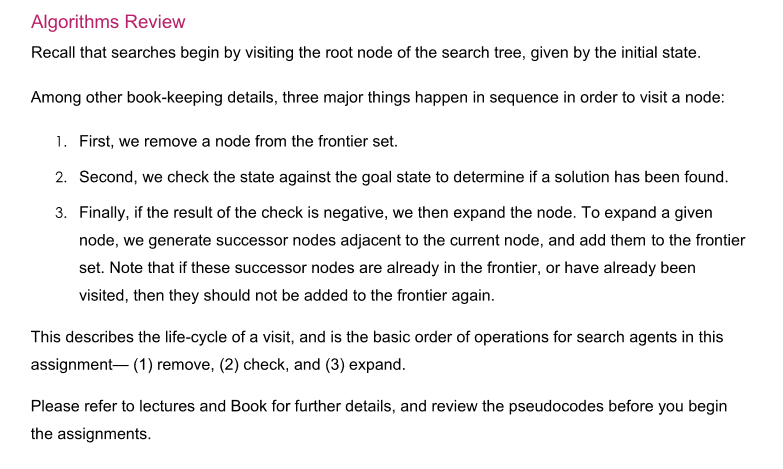
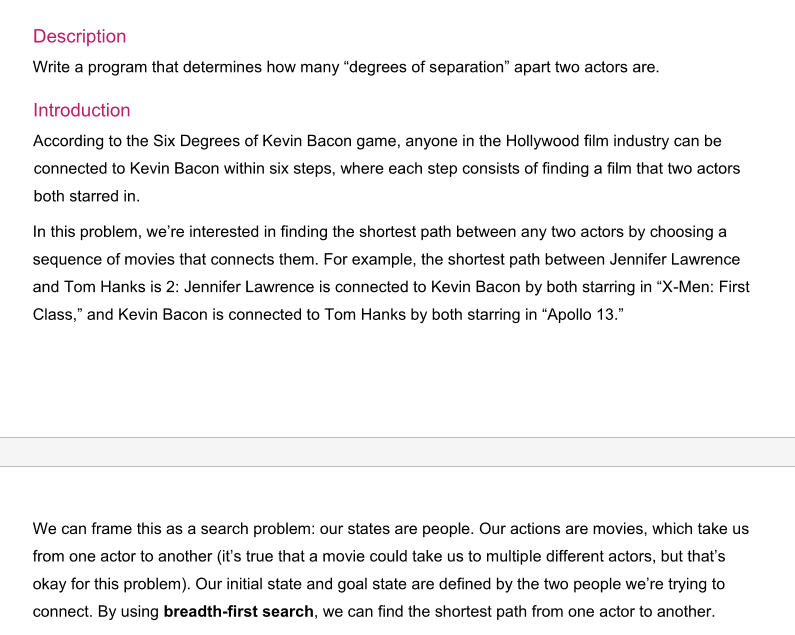
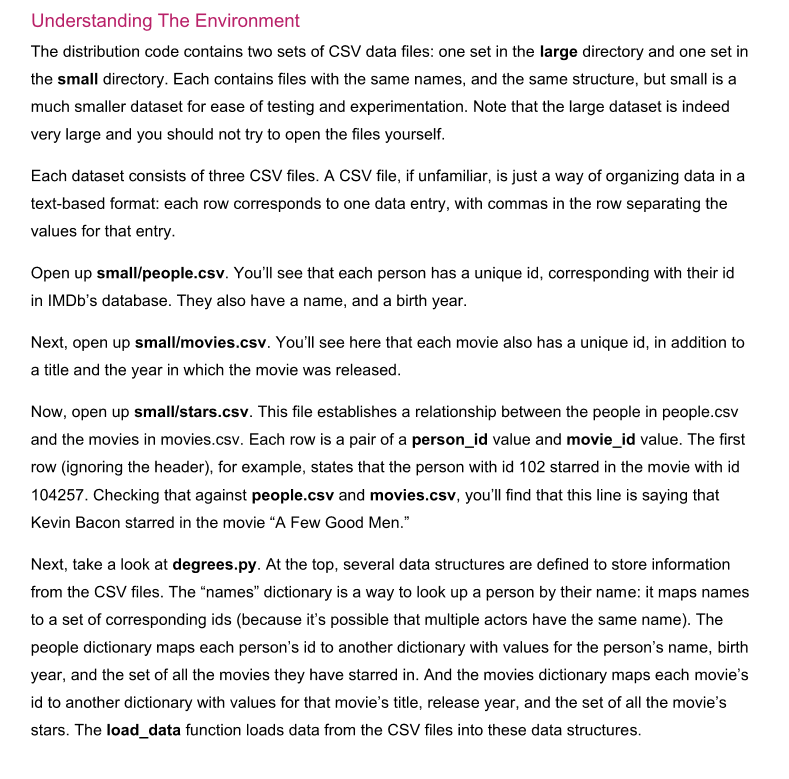
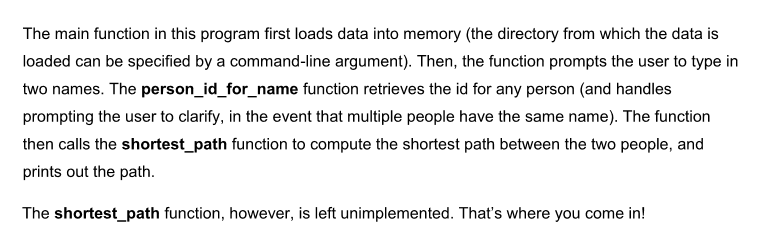
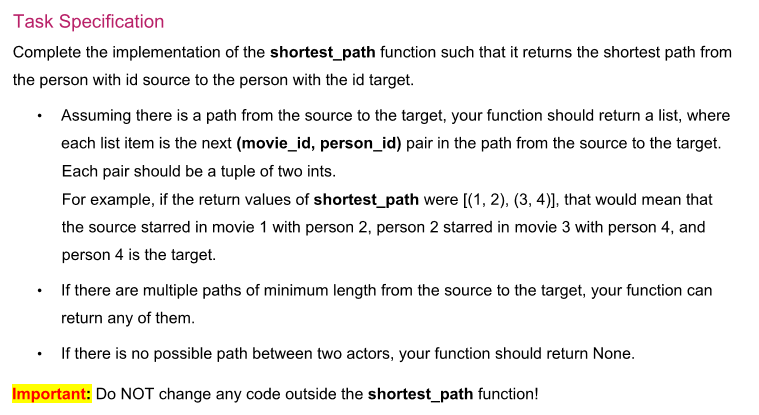
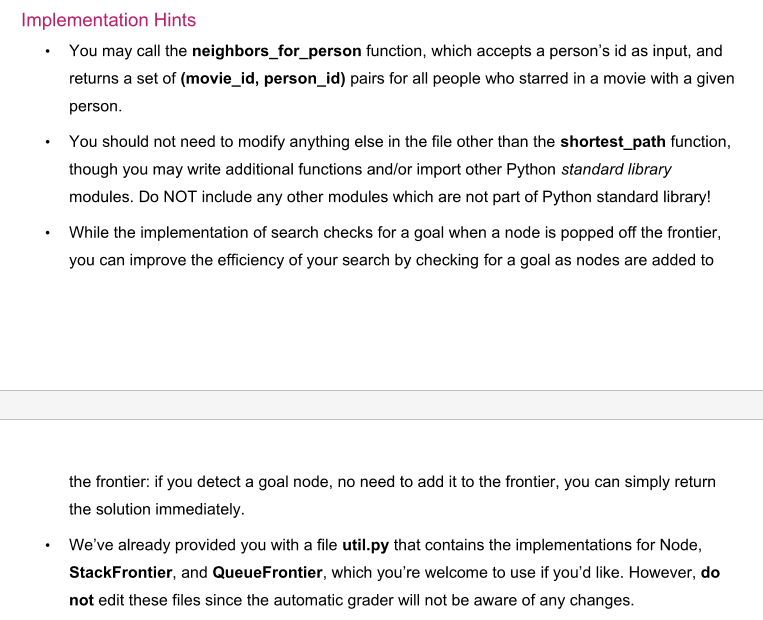
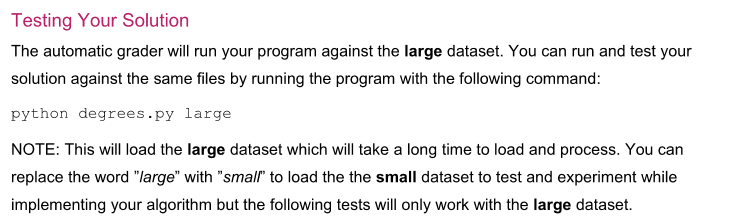
from queue import deque class Node: def __init__(self, state, parent, action): self.state = state self.parent = parent self.action = action class StackFrontier: def __init__(self): self.frontier = deque() def add(self, node): self.frontier.append(node) def contains_state(self, state): return any(node.state == state for node in self.frontier) def empty(self): return len(self.frontier) == 0 def remove(self): if self.empty(): raise Exception("empty frontier") else: node = self.frontier.pop() return node class QueueFrontier(StackFrontier): def remove(self): if self.empty(): raise Exception("empty frontier") else: node = self.frontier.popleft() return node Algorithms Review Recall that searches begin by visiting the root node of the search tree, given by the initial state. Among other book-keeping details, three major things happen in sequence in order to visit a node: 1. First, we remove a node from the frontier set. 2. Second, we check the state against the goal state to determine if a solution has been found. 3. Finally, if the result of the check is negative, we then expand the node. To expand a given node, we generate successor nodes adjacent to the current node, and add them to the frontier set. Note that if these successor nodes are already in the frontier, or have already been visited, then they should not be added to the frontier again. This describes the life-cycle of a visit, and is the basic order of operations for search agents in this assignment (1) remove, (2) check, and (3) expand. Please refer to lectures and Book for further details, and review the pseudocodes before you begin the assignments. Description Write a program that determines how many degrees of separation" apart two actors are. Introduction According to the Six Degrees of Kevin Bacon game, anyone in the Hollywood film industry can be connected to Kevin Bacon within six steps, where each step consists of finding a film that two actors both starred in. In this problem, we're interested in finding the shortest path between any two actors by choosing a sequence of movies that connects them. For example, the shortest path between Jennifer Lawrence and Tom Hanks is 2: Jennifer Lawrence is connected to Kevin Bacon by both starring in X-Men: First Class," and Kevin Bacon is connected to Tom Hanks by both starring in Apollo 13." We can frame this as a search problem: our states are people. Our actions are movies, which take us from one actor to another (it's true that a movie could take us to multiple different actors, but that's okay for this problem). Our initial state and goal state are defined by the two people we're trying to connect. By using breadth-first search, we can find the shortest path from one actor to another. Understanding The Environment The distribution code contains two sets of CSV data files: one set in the large directory and one set in the small directory. Each contains files with the same names, and the same structure, but small is a much smaller dataset for ease of testing and experimentation. Note that the large dataset is indeed very large and you should not try to open the files yourself. Each dataset consists of three CSV files. A CSV file, if unfamiliar, is just a way of organizing data in a text-based format: each row corresponds to one data entry, with commas in the row separating the values for that entry. Open up small/people.csv. You'll see that each person has a unique id, corresponding with their id in IMDb's database. They also have a name, and a birth year. Next, open up small/movies.csv. You'll see here that each movie also has a unique id, in addition to a title and the year in which the movie was released. Now, open up small/stars.csv. This file establishes a relationship between the people in people.csv and the movies in movies.csv. Each row is a pair of a person_id value and movie_id value. The first row (ignoring the header), for example, states that the person with id 102 starred in the movie with id 104257. Checking that against people.csv and movies.csv, you'll find that this line is saying that Kevin Bacon starred in the movie A Few Good Men." Next, take a look at degrees.py. At the top, several data structures are defined to store information from the CSV files. The "names dictionary is a way to look up a person by their name: it maps names to a set of corresponding ids (because it's possible that multiple actors have the same name). The people dictionary maps each person's id to another dictionary with values for the person's name, birth year, and the set of all the movies they have starred in. And the movies dictionary maps each movie's id to another dictionary with values for that movie's title, release year, and the set of all the movie's stars. The load_data function loads data from the CSV files into these data structures. The main function in this program first loads data into memory (the directory from which the data is loaded can be specified by a command-line argument). Then, the function prompts the user to type in two names. The person_id_for_name function retrieves the id for any person (and handles prompting the user to clarify, in the event that multiple people have the same name). The function then calls the shortest_path function to compute the shortest path between the two people, and prints out the path. The shortest_path function, however, is left unimplemented. That's where you come in! Task Specification Complete the implementation of the shortest_path function such that it returns the shortest path from the person with id source to the person with the id target. Assuming there is a path from the source to the target, your function should return a list, where each list item is the next (movie_id, person_id) pair in the path from the source to the target. Each pair should be a tuple of two ints. For example, if the return values of shortest_path were [(1, 2), (3, 4)], that would mean that the source starred in movie 1 with person 2, person 2 starred in movie 3 with person 4, and person 4 is the target. If there are multiple paths of minimum length from the source to the target, your function can return any of them. If there is no possible path between two actors, your function should return None. Important: Do NOT change any code outside the shortest_path function! Implementation Hints You may call the neighbors_for_person function, which accepts a person's id as input, and returns a set of (movie_id, person_id) pairs for all people who starred in a movie with a given person. You should not need to modify anything else in the file other than the shortest_path function, though you may write additional functions and/or import other Python standard library modules. Do NOT include any other modules which are not part of Python standard library! While the implementation of search checks for a goal when a node is popped off the frontier, you can improve the efficiency of your search by checking for a goal as nodes are added to the frontier: if you detect a goal node, no need to add it to the frontier, you can simply return the solution immediately. We've already provided you with a file util.py that contains the implementations for Node, StackFrontier, and Queue Frontier, which you're welcome to use if you'd like. However, do not edit these files since the automatic grader will not be aware of any changes. Testing Your Solution The automatic grader will run your program against the large dataset. You can run and test your solution against the same files by running the program with the following command: python degrees.py large NOTE: This will load the large dataset which will take a long time to load and process. You can replace the word "large" with "small" to load the the small dataset to test and experiment while implementing your algorithm but the following tests will only work with the large dataset
Step by Step Solution
There are 3 Steps involved in it

Get step-by-step solutions from verified subject matter experts
 Study Help