







Question: Deliverable 3 - Structured Requirements Overview The Structured Requirements document is the culmination of your research effort to understand the IS problem / opportunity at
Deliverable "Structured Requirements"
Overview
The Structured Requirements document is the culmination of your research effort to understand the IS problemopportunity at your field site. In it you present the findings from your interview observations and document reviews via a collection of modeling diagrams. These will form the basis for comparing alternative solutions to the problem Deliverable and the design of the optimal solution Deliverable Remember, this is for the current system only, not the new system you will recommend later.
Your deliverable must be well organized, with clear headings delineating the sections in the same order as presented below.
Details
Narrative: A thoughtful description of the work practices that is at the center of your project. Be certain that you detail the individuals involved, how they interact, what data are exchanged, etc. This narrative complements your subsequent models and assists in interpreting them. This should not be longer than one page singlespaced.
Specifically include control flow diagramming andor data flow diagramming andor conceptual data modeling andor dialogue diagramming. You will be able to use these techniques to:
produce a system architecture design and use the architecture to identify the components of the system to be designed.
produce useful and usable from the point of view of the customer designs for the input and output of a system.
plan an effective usability assessment to evaluate the system design.
Data Modeling in an entityrelationship diagram for the current system:
First identify all the entity types in your scoped study. These are things that the system keeps information about, not sources, sinks or users of that information.
Identify the attributes of each entity type.
Identify the nature of the relationships between these entities.
Identify the cardinality of these relationships.
Process Modeling, a coordinated set of data flow diagrams for the current system.
Produce a level diagram which covers the major processes.
If necessary, depending on the complexity of the system, continue expanding, creating child leveln diagrams, until the system is described in adequate detail.
If applicable, for important processes, create a current physical equivalent showing the details of the current physical implementation including what actions are manual or automated, the form of the data stores, types of data flows, individual
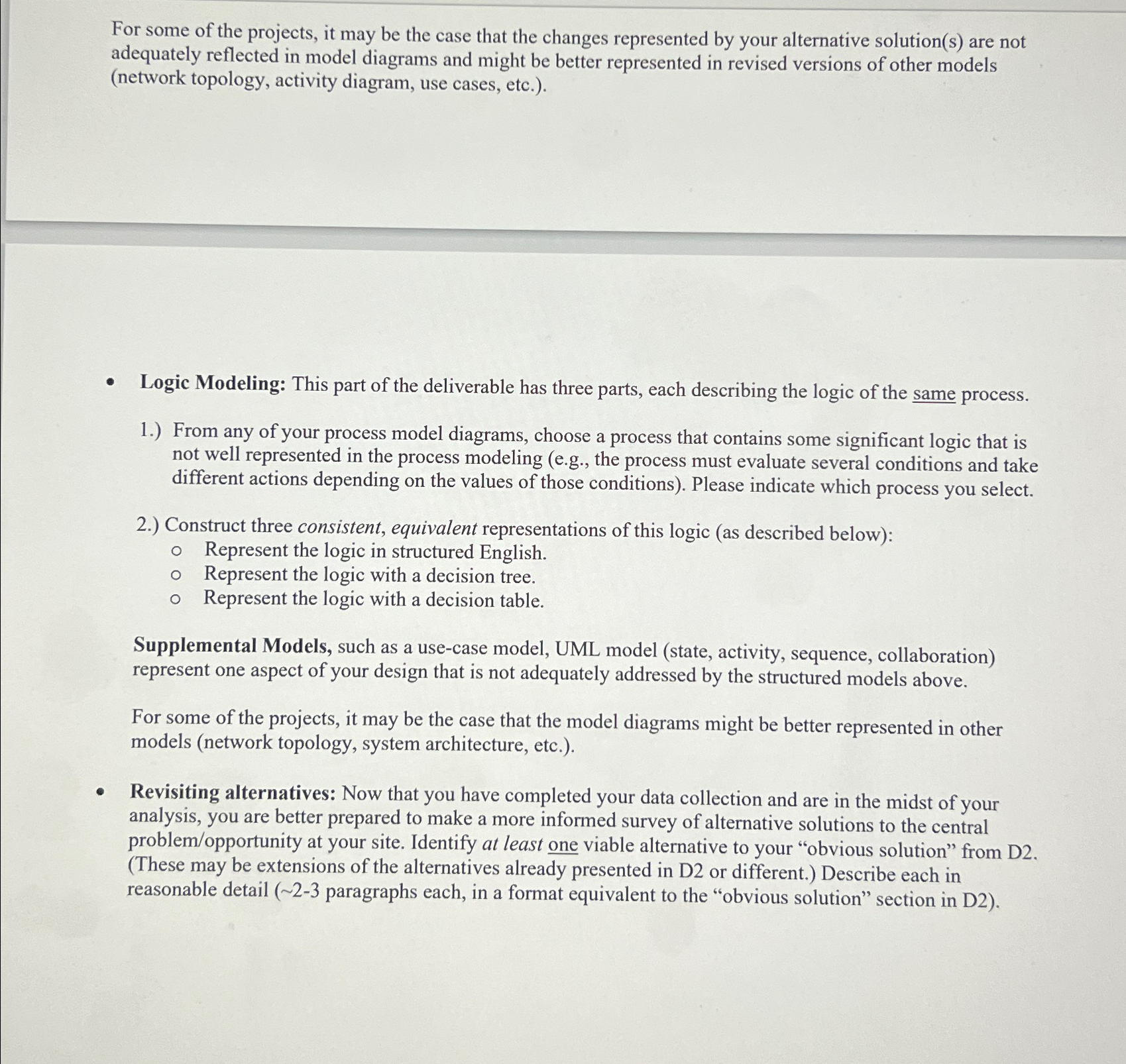
For some of the projects, it may be the case that the changes represented by your alternative solutions are not adequately reflected in model diagrams and might be better represented in revised versions of other models network topology, activity diagram, use cases, etc.
Logic Modeling: This part of the deliverable has three parts, each describing the logic of the same process.
From any of your process model diagrams, choose a process that contains some significant logic that is not well represented in the process modeling eg the process must evaluate several conditions and take different actions depending on the values of those conditions Please indicate which process you select.
Construct three consistent, equivalent representations of this logic as described below:
Represent the logic in structured English.
Represent the logic with a decision tree.
Represent the logic with a decision table.
Supplemental Models, such as a usecase model, UML model state activity, sequence, collaboration represent one aspect of your design that is not adequately addressed by the structured models above.
For some of the projects, it may be the case that the model diagrams might be better represented in other models network topology, system architecture, etc.
Revisiting alternatives: Now that you have completed your data collection and are in the midst of your analysis, you are better prepared to make a more informed survey of alternative solutions to the central problemopportunity at your site. Identify at least one viable alternative to your "obvious solution" from DThese may be extensions of the alternatives already presented in D or different. Describe each in reasonable detail paragraphs each, in a format equivalent to the "obvious solution" section in Dsroles involved, etc.
Step by Step Solution
There are 3 Steps involved in it
1 Expert Approved Answer
Step: 1 Unlock

Question Has Been Solved by an Expert!
Get step-by-step solutions from verified subject matter experts
Step: 2 Unlock
Step: 3 Unlock
 Study Help