







Question: Dependencies Problem 1 - Dependencies S1: a:- 7 S2: b :2; S4: read (d); a :- b + 2; S6: b :- a - 3;
Dependencies
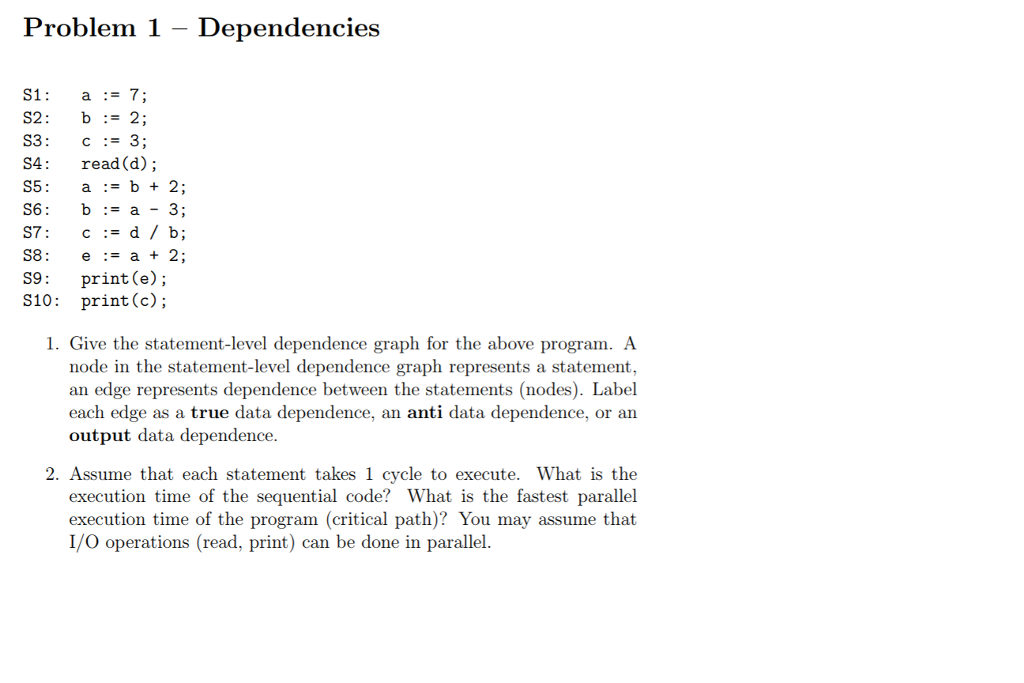
Problem 1 - Dependencies S1: a:- 7 S2: b :2; S4: read (d); a :- b + 2; S6: b :- a - 3; S7: c- d / b; S8: e:= a + 2 S9: print(e); S10: print (c); 1. Give the statement-level dependence graph for the above program. A node in the statement-level dependence graph represents a statement, an edge represents dependence between the statements (nodes). Label each edge as a true data dependence, an anti data dependence, or an output data dependence 2. Assume that each statement takes 1 cycle to execute. What is the execution time of the sequential code? What is the fastest parallel execution time of the program (critical path)? You may assume that I/O operations (read, print) can be done in parallel Problem 1 - Dependencies S1: a:- 7 S2: b :2; S4: read (d); a :- b + 2; S6: b :- a - 3; S7: c- d / b; S8: e:= a + 2 S9: print(e); S10: print (c); 1. Give the statement-level dependence graph for the above program. A node in the statement-level dependence graph represents a statement, an edge represents dependence between the statements (nodes). Label each edge as a true data dependence, an anti data dependence, or an output data dependence 2. Assume that each statement takes 1 cycle to execute. What is the execution time of the sequential code? What is the fastest parallel execution time of the program (critical path)? You may assume that I/O operations (read, print) can be done in parallel
Step by Step Solution
There are 3 Steps involved in it

Get step-by-step solutions from verified subject matter experts
 Study Help