





Question: Derivative Securities The case studies presented for the final project-The Bombay Stock Exchange: Liquidity Enhancement Incentive Programmes, Principal-Protected Equity-Linked Note (PP-ELNs), and Betting on Failure:
Derivative Securities The case studies presented
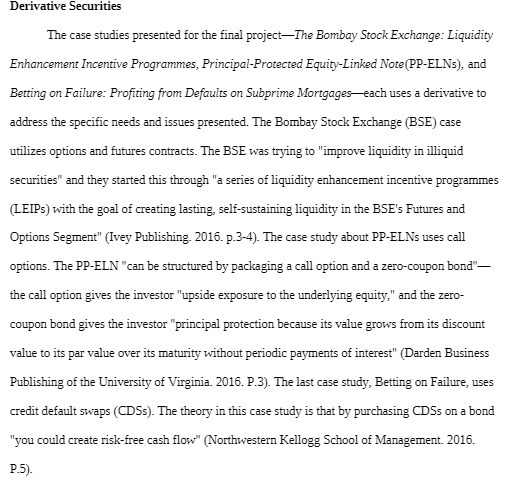
Derivative Securities The case studies presented for the final project-The Bombay Stock Exchange: Liquidity Enhancement Incentive Programmes, Principal-Protected Equity-Linked Note (PP-ELNs), and Betting on Failure: Profiting from Defaults on Subprime Mortgages-each uses a derivative to address the specific needs and issues presented. The Bombay Stock Exchange (BSE) case utilizes options and futures contracts. The BSE was trying to "improve liquidity in illiquid securities" and they started this through "a series of liquidity enhancement incentive programmes (LEIPs) with the goal of creating lasting self-sustaining liquidity in the BSE's Futures and Options Segment" (Ivey Publishing. 2016. p.3-4). The case study about PP-ELNs uses call options. The PP-ELN "can be structured by packaging a call option and a zero-coupon bond"- the call option gives the investor "upside exposure to the underlying equity," and the zero- coupon bond gives the investor "principal protection because its value grows from its discount value to its par value over its maturity without periodic payments of interest" (Darden Business Publishing of the University of Virginia. 2016. P.3). The last case study, Betting on Failure, uses credit default swaps (CDSs). The theory in this case study is that by purchasing CDSs on a bond "you could create risk-free cash flow" (Northwestern Kellogg School of Management. 2016. P.5)

Step by Step Solution

There are 3 Steps involved in it

1 Expert Approved Answer
Step: 1 Unlock blur-text-image

Question Has Been Solved by an Expert!

Get step-by-step solutions from verified subject matter experts

Step: 2 Unlock
Step: 3 Unlock

Students Have Also Explored These Related Accounting Questions!