







Question: Derive Eq . 4 3 7 ; state all your assumptions.Elliptical Orbits The circular orbit described above is a special case of the more general
Derive Eq; state all your assumptions.Elliptical Orbits
The circular orbit described above is a special case of the more general elliptical orbit
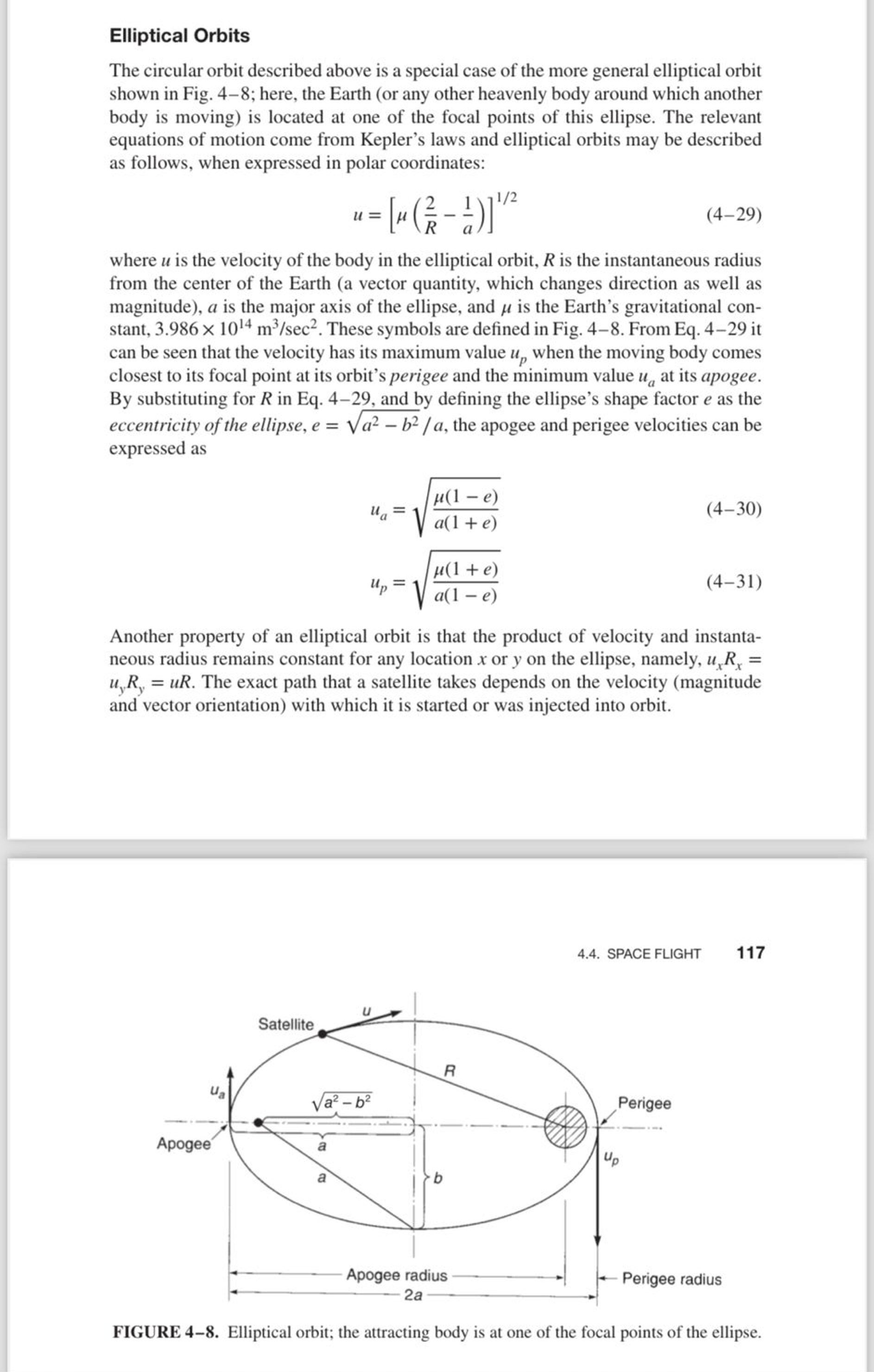
shown in Fig. ; here, the Earth or any other heavenly body around which another
body is moving is located at one of the focal points of this ellipse. The relevant
equations of motion come from Kepler's laws and elliptical orbits may be described
as follows, when expressed in polar coordinates:
where is the velocity of the body in the elliptical orbit, is the instantaneous radius
from the center of the Earth a vector quantity, which changes direction as well as
magnitude is the major axis of the ellipse, and is the Earth's gravitational con
stant, These symbols are defined in Fig. From Eq it
can be seen that the velocity has its maximum value when the moving body comes
closest to its focal point at its orbit's perigee and the minimum value at its apogee.
By substituting for in Eq and by defining the ellipse's shape factor as the
eccentricity of the ellipse, the apogee and perigee velocities can be
expressed as
Another property of an elliptical orbit is that the product of velocity and instanta
neous radius remains constant for any location or on the ellipse, namely,
The exact path that a satellite takes depends on the velocity magnitude
and vector orientation with which it is started or was injected into orbit.
FIGURE Elliptical orbit; the attracting body is at one of the focal points of the ellipse.
Step by Step Solution
There are 3 Steps involved in it
1 Expert Approved Answer
Step: 1 Unlock

Question Has Been Solved by an Expert!
Get step-by-step solutions from verified subject matter experts
Step: 2 Unlock
Step: 3 Unlock
 Study Help