







Question: derive eqution for case 2 table 2-3 i need to know how to get N in the table case 2 from the boundery cond. given
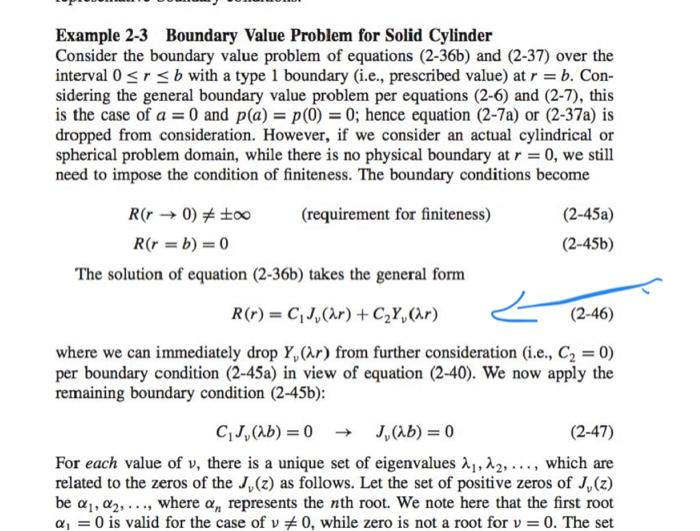
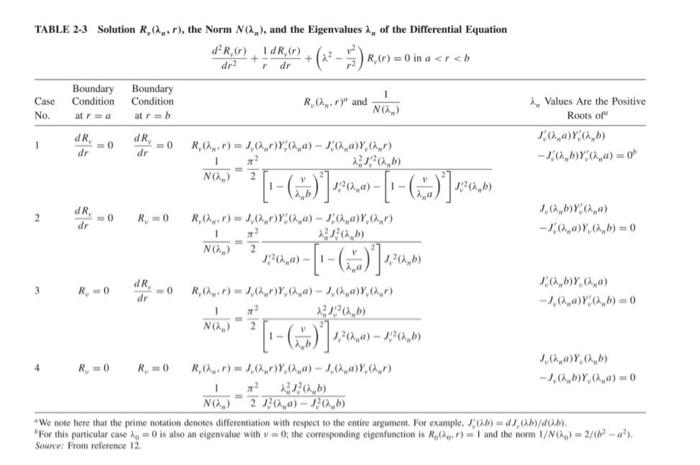
Example 2-3 Boundary Value Problem for Solid Cylinder Consider the boundary value problem of equations (2-36b) and (2-37) over the interval 0rb with a type 1 boundary (i.e., prescribed value) at r=b. Considering the general boundary value problem per equations (2-6) and (2-7), this is the case of a=0 and p(a)=p(0)=0; hence equation (2-7a) or (2-37a) is dropped from consideration. However, if we consider an actual cylindrical or spherical problem domain, while there is no physical boundary at r=0, we still need to impose the condition of finiteness. The boundary conditions become R(r0)=(requirementforfiniteness)R(r=b)=0 The solution of equation (2-36b) takes the general form R(r)=C1Jv(r)+C2Y(r) where we can immediately drop Y(r) from further consideration (i.e., C2=0 ) per boundary condition (2-45a) in view of equation (2-40). We now apply the remaining boundary condition (245b) : C1Jv(b)=0Jv(b)=0 For each value of v, there is a unique set of eigenvalues 1,2,, which are related to the zeros of the Jv(z) as follows. Let the set of positive zeros of Jv(z) be 1,2,, where n represents the nth root. We note here that the first root 1=0 is valid for the case of =0, while zero is not a root for =0. The set TABLE 2-3 Solution Rp(n,r), the Norm N(n), and the Eigenvalues n of the Differential Equation "For this particular ease 0=0 is alio an eigenvalue with v=0; the correspoding eigenfunction is R0(0,r)=I and the norm I/N(0)=2/(b2a2). Soure: From reference 12 Example 2-3 Boundary Value Problem for Solid Cylinder Consider the boundary value problem of equations (2-36b) and (2-37) over the interval 0rb with a type 1 boundary (i.e., prescribed value) at r=b. Considering the general boundary value problem per equations (2-6) and (2-7), this is the case of a=0 and p(a)=p(0)=0; hence equation (2-7a) or (2-37a) is dropped from consideration. However, if we consider an actual cylindrical or spherical problem domain, while there is no physical boundary at r=0, we still need to impose the condition of finiteness. The boundary conditions become R(r0)=(requirementforfiniteness)R(r=b)=0 The solution of equation (2-36b) takes the general form R(r)=C1Jv(r)+C2Y(r) where we can immediately drop Y(r) from further consideration (i.e., C2=0 ) per boundary condition (2-45a) in view of equation (2-40). We now apply the remaining boundary condition (245b) : C1Jv(b)=0Jv(b)=0 For each value of v, there is a unique set of eigenvalues 1,2,, which are related to the zeros of the Jv(z) as follows. Let the set of positive zeros of Jv(z) be 1,2,, where n represents the nth root. We note here that the first root 1=0 is valid for the case of =0, while zero is not a root for =0. The set TABLE 2-3 Solution Rp(n,r), the Norm N(n), and the Eigenvalues n of the Differential Equation "For this particular ease 0=0 is alio an eigenvalue with v=0; the correspoding eigenfunction is R0(0,r)=I and the norm I/N(0)=2/(b2a2). Soure: From reference 12
Step by Step Solution
There are 3 Steps involved in it

Get step-by-step solutions from verified subject matter experts
 Study Help