Question: Describe the two important principles derived from 1 Corinthians 9:19-23 that can be applied to apologetics. Though I am free and belong to no one,
Describe the two important principles derived from 1 Corinthians 9:19-23 that can be applied to apologetics.
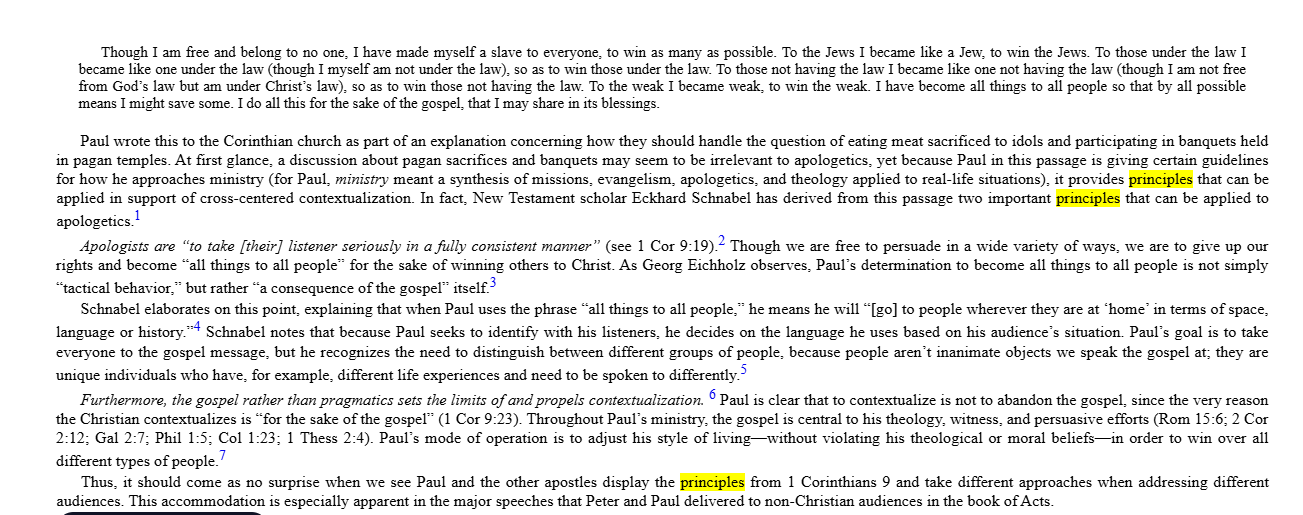
Though I am free and belong to no one, I have made myself a slave to everyone, to win as many as possible. To the Jews I became like a Jew, to win the Jews. To those under the law I became like one under the law (though I myself am not under the law), so as to win those under the law. To those not having the law I became like one not having the law (though I am not free from God's law but am under Christ's law), so as to win those not having the law. To the weak I became weak, to win the weak. I have become all things to all people so that by all possible means I might save some. I do all this for the sake of the gospel, that I may share in its blessings. Paul wrote this to the Corinthian church as part of an explanation concerning how they should handle the question of eating meat sacrificed to idols and participating in banquets held im pagan temples. At first glance, a discussion about pagan sacrifices and banquets may seem to be irrelevant to apologetics, yet because Paul in this passage is giving certain guidelines for how he approaches ministry (for Paul, ministry meant a synthesis of missions. evangelism, apologetics, and theology applied to real-life situations). it provides principles that can be applied in support of cross-centered contextualization. In fact, New Testament scholar Eckhard Schnabel has derived from this passage two important principles that can be applied to 1 apologetics. Apologists are \"to take [their] listener seriously in a fully consistent manner\" (see 1 Cor 9:19)? Though we are free to persuade in a wide variety of ways, we are to give up our tights and become \"all things to all people\" for the sake of winning others to Christ. As Georg Eichholz observes, Paul's determination to become all things to all people is not simply \"tactical behavior,\" but rather \"a consequence of the gospel\" itself? Schnabel elaborates on this point. explaining that when Paul uses the phrase \"all things to all people.\" he means he will \"[go] to people wherever they are at \"home\" in terms of space. language or history."* Schnabel notes that because Paul seeks to identify with his listeners, he decides on the language he uses based on his audience's situation. Paul's goal is to take everyone to the gospel message, but he recognizes the need to distinguish between different groups of people, because people aren't inanimate objects we speak the gospel at; they are unique individuals who have, for example, different life experiences and need to be spoken to differently Furthermore, the gospel rather than pragmatics sets the limits of and propeis contextwalization. Paul is clear that to contextualize is not to abandon the gospel, since the very reason the Christian contextualizes is \"for the sake of the gospel\" (1 Cor 9:23). Throughout Paul's ministry, the gospel is central to his theology, witness, and persuasive efforts (Rom 15-6; 2 Cor 2:12; Gal 2:7; Phil 1:5; Col 1:23; 1 Thess 2:4). Paul's mode of operation is to adjust his style of liwingwithout violatmg his theological or moral beliefsin order to win over all different types of people.' Thus, it should come as no surprise when we see Paul and the other apostles display the principles from 1 Corinthians 9 and take different approaches when addressing different audiences. This accommodation is especially apparent m the major speeches that Peter and Paul delivered to non-Christian audiences m the book of Acts