







Question: Description for the process steps is given for your study to prepare the current State and finally Future State Process value map for improving the
Description for the process steps is given for your study to prepare the current State and finally Future State Process value map for improving the process.
Patient Care Delivery at Rex Healthcare
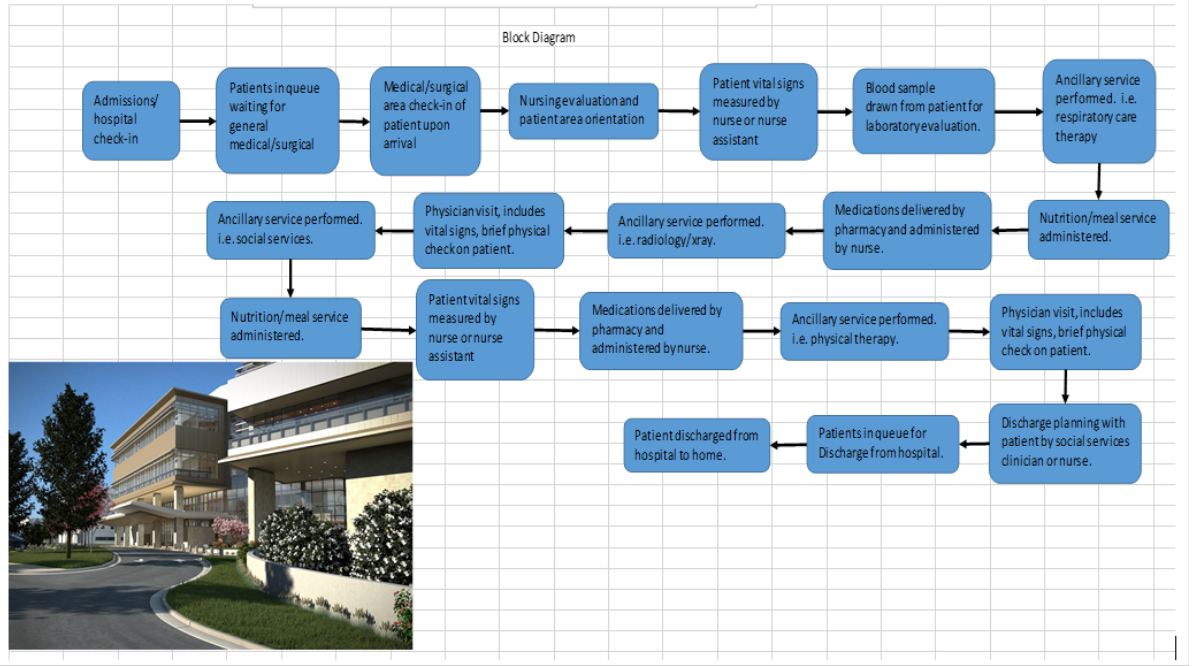
The journey of general patient care delivery begins with the arrival of the non-emergent patient at the admissions/check-in area. The admissions/check-in area is usually filled with patients registering as well as waiting on rooms/beds in their assigned units. A waiting time of 90 minutes is not unusual for a room to become ready after the arrival of a patient at the hospital. After the bed control unit of patient admissions secures a room for the patient in the medical/surgical unit, a patient transporter is summoned to transport the patient to the assigned medical unit. Typically, the patient is transported by wheelchair, and this journey takes about 10 minutes from the admissions/check-in area to the medical/surgical unit. Upon arrival at the medical/surgical unit, the patient is wheeled into the assigned room or may be redirected by a nurse or unit secretary, if the assigned room has been changed. After arrival in the room, the patient is welcomed by a nurse who verifies the identity of the patient and that he or she is in the correct room. This area check-in can be followed by a delay of up to 30 minutes before a nurse does an orientation of about 15 minutes. Another delay of 20 minutes usually follows before a nurse takes the patients vital signs and assists the patient in changing clothes. In about 30 minutes, a laboratory technician arrives to carefully draw blood from the patient which takes about 10 minutes. About 40 minutes later, the first ancillary department arrives to administer therapy such as respiratory care which last about 15 minutes. Thirty minutes later, the patient is favored with a meal from the food and nutrition department which is delivered quickly, and roughly allots about 30 minutes for the patient to consume the meal before the meal tray is retrieved. Approximately 40 minutes after the meal, the nurse arrives to deliver medication to the patient. Depending on the route of delivery, the medication administration could take up to 6 minutes. About 20 minutes later, the second ancillary service, a radiology technician, arrives to perform an x-ray on the afflicted body part. The x-ray is done in the patients room to expedite time and eliminate patient transport, but still takes about 20 minutes for setup and positioning. Around 40 minutes later, a doctor makes a visit to the patient for a 15-minute evaluation, and treatment discussion. Thirty minutes later, a case worker or social worker from that department shows up to discuss personal concerns, and care plans for the patient once he or she goes home. This discussion typically takes about 20 minutes. Twenty minutes later, the food and nutrition department arrive with a meal to be consumed by the patient in 30 or so minutes. About 30 minutes after the meal, a nurse or nursing assistant arrives at the patients room to record the patients vital signs. Twenty minutes after the patients vital signs are recorded, a nurse administers medication to the patient lasting 6 minutes in duration. In about 30 minutes, the ancillary service of physical therapy begins a 30-minute session with the patient. Thirty minutes later, a physician enters the patients room to do an assessment and update the patient on his or her course of treatment. Of course, this cycle of patient services would be completed over each day of the patients stay in the hospital. To forgo repetitiveness, I will expedite to the point where the patient has been cleared for discharge. Usually, 60 minutes after a patient discharge notification, the nurse brings the patient the news, and takes about 20 minutes to go over the discharge instructions for the patients care at home. Sometimes, there can be a longer delay in presenting the discharge instructions if a family member needs to be present for more complete understanding of the discharge instructions. Once the discharge instructions are completed, it is not uncommon to take 90 minutes or more to clear the discharge paperwork and obtain a patient transporter. Upon arrival, the patient transporter assists the patient in gathering her or his belongings and transports the patient to the hospital exit via wheelchair. The patient transporter takes about 15 minutes for this duty.
The patients care is highly dependent upon clinical professionals who deliver care directly to the patient who usually receives hospital care within the hospital room. There are several clinicians displayed in this project scenario. The patient transporter is an individual who is dispatched by the hospital bed control department to physically move the patient between locations in the hospital. Transporters are often centrally located near the patient admissions area for quick availability in transporting patients upon clearance from bed control. The current system of transporting patients is akin to FIFO for the transporters. Occasionally, during high admissions periods, all transporters will be occupied leaving no immediate availability to move newly admitted patients to their assigned hospital unit locations and rooms. Nurse and nurse assistants play vital roles in the processing of patients during their hospital stays. Nurses and nurse assistants are typically assigned to a set of patients. In medical-surgical areas, a nurse may have up to 12 patients assigned, thus, some minor delays in delivering nursing services may be experienced by those patients. Oftentimes, another available nurse may assist in preventing extraordinary delays in patient nursing care. Dietary technicians are dispatched from the hospital kitchen during set blocks of time for meals delivery to patients. Today, patients can select their meals allowed and arrival times via an in-room kiosk or the room telephone. The dietary technician allows about 30 minutes for a patient to consume a meal before she or he returns to the patients room to retrieve the meal tray. X-ray technicians are centrally located in the radiology department and are dispatched on an as needed basis to patients rooms. Portable x-ray equipment is positioned within the medical-surgical area. The x-ray technician arrives in the area, moves the portable x-ray equipment (on an electrically motorized dolly) to the patients room, and performs the x-ray on the body part as ordered. At times, an x-ray technician may request assistance from the nursing staff to position an immobile patient. Respiratory therapists are assigned areas of the hospital according to their experience and comfort levels working certain areas. The respiratory therapist assigned to the medical-surgical area usually only has that area of responsibility. Other therapists may help should the assigned respiratory therapist need assistance. Physical therapists are dispatched from a location in the same general region as the medical-surgical area. The proximity of the physical therapists to the medical-surgical area is to expedite PT services to this area of highest demand. Laboratory technicians/phlebotomists are dispatched from the main hospital lab or the auxiliary lab located one floor below which is nearest the intensive care units. The laboratory technicians are dispatched in a FIFO manner from their locations and are known for quick efficient responsiveness. Although these different, clinicians have multiple patients to provide service, careful scheduling can provide excellent patient services with few major delays in those services. The patient processing times shown on the value stream maps account for the actual patient service as rendered and not for travel times of the clinicians providing service. Such clinician travel times would be extremely difficult to calculate, and measure.
Block Diagram Admissions hospital check-in Patients in queue waiting for general medical/surgical Medical/surgical area check-in of patient upon arrival Nursingevaluation and patient area orientation Patient vital signs measured by nurse or nurse assistant Blood sample drawn from patient for laboratory evaluation Ancillary service perfomed. i.e. respiratory care therapy Ancillary service perfomed. i.e.social services Physician visit, includes vital signs, brief physical checkon patient. Ancillary service performed. i.e.radiology/xray. Medications delivered by pharmacy and administered by nurse. Nutrition/meal service administered. Nutrition/meal service administered Patient vital signs measured by nurse or nurse assistant Medications delivered by pharmacy and administered bynurse. Ancillary service perfomed. i.e physical therapy. Physician visit, includes vital signs, brief physical check on patient. TO Patient discharged from hospital to home. Patients in queue for Discharge from hospital Discharge planning with patient by social services dinician or nurseStep by Step Solution
There are 3 Steps involved in it

Get step-by-step solutions from verified subject matter experts
 Study Help