







Question: Description For this week's Module 6 Discussion Blog, please answer the following questions in at least 400 words minimum: 1) Compare/contrast how Boarding Schools and
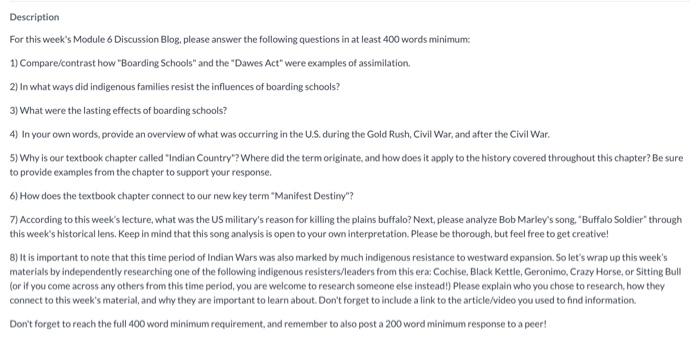
Description For this week's Module 6 Discussion Blog, please answer the following questions in at least 400 words minimum: 1) Compare/contrast how "Boarding Schools" and the "Dawes Act" were examples of assimilation. 2) In what ways did indigenous families resist the influences of boarding schools? 3) What were the lasting effects of boarding schools? 4) In your own words, provide an overview of what was occurring in the U.S. during the Gold Rush, Civil War, and after the Civil War. 5) Why is our textbook chapter called "Indian Country"? Where did the term originate, and how does it apply to the history covered throughout this chapter? Be sure : to provide examples from the chapter to support your response. 6) How does the textbook chapter connect to our new key term "Manifest Destiny"? 7) According to this week's lecture, what was the US military's reason for killing the plains buffalo? Next, please analyze Bob Marley's song, "Buffalo Soldier" through this week's historical lens. Keep in mind that this song analysis is open to your own interpretation. Please be thorough, but feel free to get creative! 8) It is important to note that this time period of Indian Wars was also marked by much indigenous resistance to westward expansion. So let's wrap up this week's materials by independently researching one of the following indigenous resisters/leaders from this era: Cochise, Black Kettle, Geronimo, Crazy Horse, or Sitting Bull (or if you come across any others from this time period, you are welcome to research someone else instead!) Please explain who you chose to research, how they connect to this week's material, and why they are important to learn about. Don't forget to include a link to the article/video you used to find information. Don't forget to reach the full 400 word minimum requirement. and remember to also post a 200 word minimum response to a peer
Step by Step Solution
There are 3 Steps involved in it

Get step-by-step solutions from verified subject matter experts
 Study Help