



Question: Descriptive and inferential statistics have distinct roles in the analysis of research results. It is essential for counselors to understand the purpose of both types
Descriptive and inferential statistics have distinct roles in the analysis of research results. It is essential for counselors to understand the purpose of both types of statistics and to identify the characteristics of each in research literature.
For this week's assignment, carefully read the article on group meaning-centered hope therapy.
Address the following in your paper:
Differentiate between descriptive and inferential statistics and briefly summarize the findings of the students using the descriptive characteristics. Did the study show any correlations between the variables? What is the level of significance, and how does it affect the findings of the research? Identify and explain the parametric or nonparametric inferential statistical procedures used in the study analysis.
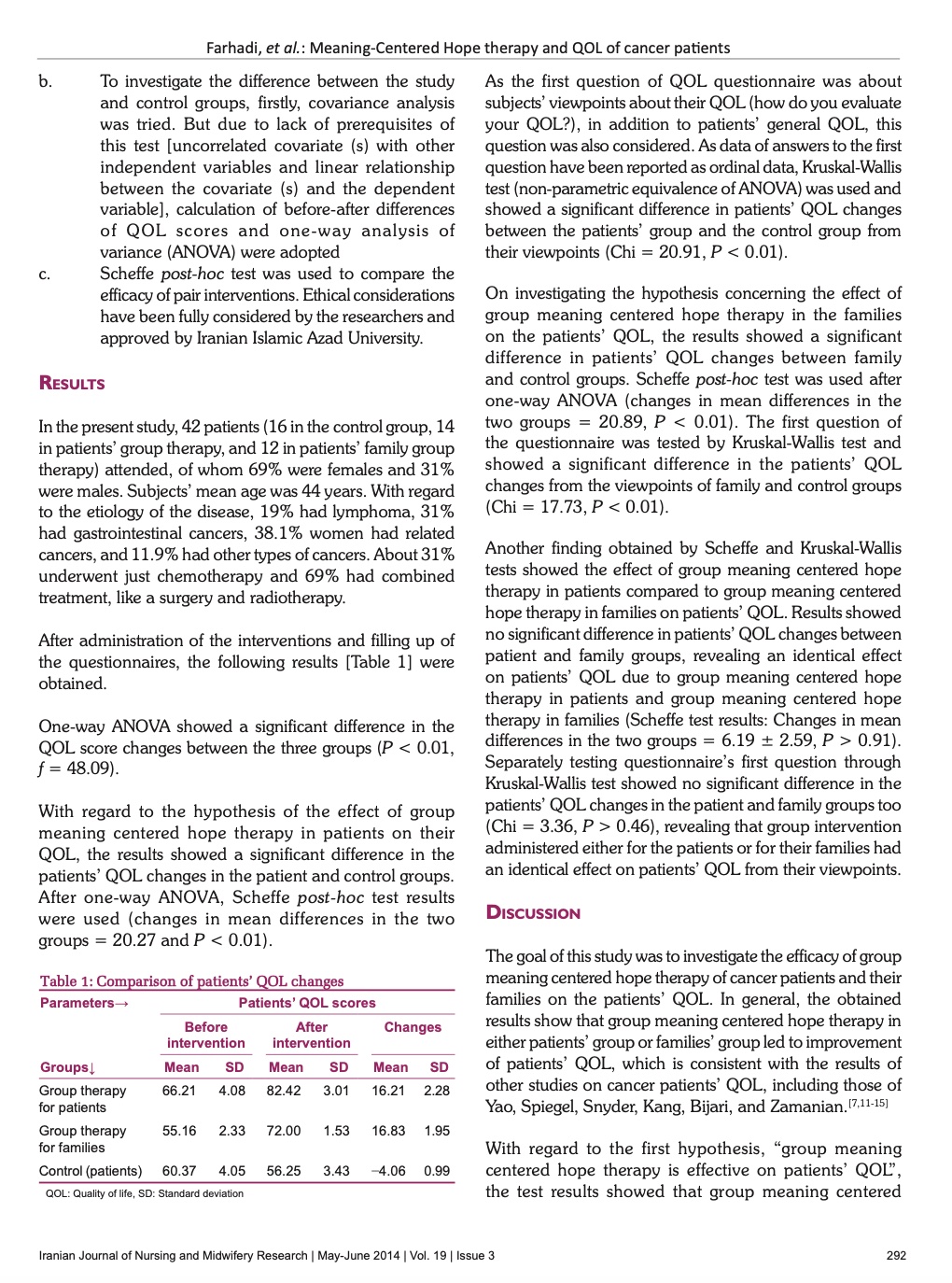
Efficacy of group meaning centered hope therapy of cancer patients and their families on patients' quality of life Mehran Farhadi', Negar Reisi-Dehkordi', Mehrdad Kalantari, Ali Zargham-Boroujeni' ABSTRACT Background: Quality of life (QOL) is a multidimensional concept which has nowadays turned to a supportive interventional goal in chronic diseases like cancer. Numerous interventions have been carried out to improve the QOL in patients with cancer, but the effect of indirect interventions on the patients' QOL has not been investigated yet. This study aimed to compare the efficacy of group meaning centered hope therapy of cancer patients and their families on the patients' QOL. Materials and Methods: This is a clinical trial conducted in three groups with a pre-test post-test design in which the effect of independent variable of meaning centered hope therapy on the dependent variable of QOL was investigated. The subjects were selected from the cancer patients who were aware of their diagnosis, were in primary stages of the disease, and had passed one period of chemotherapy. In this study, 42 patients (16 in control group, 14 in patients' group therapy, and 12 in patients' families' group therapy) were studied, and WHOQOL was adopted to investigate their QOL. Data were analyzed in two forms of descriptive and inferential statistical tests. Results: The results obtained showed that group meaning centered hope therapy of cancer patients and their families had a positive effect on patients' QOL compared to the control group. The notable finding of the present study was that holding group sessions either for the patients or for their families equally improved patients' QOL. Conclusion: QOL of the cancer patients can be improved by either group meaning centered hope therapy for patients or group meaning centered hope therapy for their families. This finding is important for therapists, as when the patients cannot attend group therapy sessions due to complications of chemotherapy, these sessions can be held for their families to improve patients' QOL. This conclusion is very helpful in nurses' interaction with the patients and their families. Key words: Cancer, caregivers, hope therapy, Iran, quality of life INTRODUCTION concept of satisfaction with life, physical health, social and familial health, hope, and mental health. [nvestigation of etting informed about the diagnosis of cancer is a miserable and unexpected experience for everybody. The psychological impact of cancer diagnosis and its physical complications negatively affects the quality of life (QOL) of the patients and their families.* QOL is a multidimensional concept including subjective and objective factors, and often refers to personal 'Department of Psychology, Bu-Ali University, Hamedan, Iran, \"Islamic Azad University, Hamedan Branch, Hamedan, Iran, 'Faculty of Psychologic and Education Science, University of Isfahan, Iran, 'Nursing and Midwifery Care Research Center, Faculty of Nursing and Midwifery, Isfahan University of Medical Sciences, Isfahan, Iran Address for correspondence: Ms. Negar Reisi, Department of Psychology, Islamic Azad University, Hamedan Branch, Hamedan, Iran. E-mail: nreisi@gmail.com QOL has changed to a variable associated with clinical care in the research.! There are numerous methods to improve the QOL among cancer patients, including group psychotherapy interventional methods. Psychotherapy methods resulting in promotion of hope among the patients lead to improvement of their QOL. Among these methods, hope therapy has the main goal of promoting hope among the patients.\" As these patients usually think that cancer equals death, they develop problems in understanding the meaning and values of their life. A mere solution-centered treatment does not seem to help these patients. Therefore, in order to promote hope therapy sessions and increase their efficacy, it is better to practice them with an existential approach like meaning therapy.\" Numerous studies have been already conducted to help cancer patients lower their disease-related complications. These studies include the effect of mindfulness on cancer patients' mood,\" the effect of combined psychotherapy on cancer patients' Iranian Journal of Nursing and Midwifery Research | May-June 2014 | Viol. 19 | Issue 3 290 Farhadi, et al.: Meaning-Centered Hope therapy and QOL of cancer patients QOL,"" the effect of spirituality, psychotherapy, and music in the palliative care of cancer patients, the effect of group meaning therapy on cancer patients' life expectancy, etc. Literature review revealed no study concerning the effect of group meaning centered hope therapy (combination of hope therapy and meaning therapy) on cancer patients and their families and comparison of this effect on patients' QOL. In most of the reviewed articles, patients' problems were investigated and not those of their families, although social support of the families has been reported very impressive on patients' recovery trend' in the existing references. In addition, when the patients are in the phase of denial or anger due to their disease, they may not cooperate enough with the treatment team, especially nurses. In these cases, if hope therapy on the patients' families can have an equal effect as patients' own hope therapy, psychological interventions on the family members can replace those of the patients. With regard to the above-mentioned challenges, the main goal of this study was to compare the effect of group meaning centered hope therapy in the families compared to the group meaning centered hope therapy in patients on the patients' QOL. MarteriaLs AND METHODS This is a clinical trial conducted to investigate the effect of the independent variable of meaning-centered hope therapy on the dependent variable of QOL. This is a three-group pre-test post-test design with a control group, in which group meaning centered hope therapy sessions were held for both the groups of patients and their families. In group 3 (control group), just conventional interventions were administered. In all three groups, patients' QOL was compared before and after the intervention. Research environment was Seyed Al-Shohada Hospital in Isfahan University of Medical Sciences, Iran, which is a professional center for cancer patients in Isfahan province. The subjects were the cancer patients referring to the research environment during Sept-Oct. 2012 who met the inclusion criteria including knowing about their diagnosis of cancer, being in primary stages of the disease, and having passed through at least one period of chemotherapy. Then, the patients and their family caregivers were randomly assigned to the control and study groups. Exclusion criteria were any diagnosed metastasis and patients affected by dementia and other psychotic conditions. Based on similar related researches and their sample sizes, and after consultation with one of the professors of statistics in the university, the sample size in this clinical trial study was calculated to be 16 subjects in each group to achieve an accuracy of 95%, a power of 0.8, and standard deviation (SD) of QOL score of 10. Data were collected by a personal characteristics questionnaire with eight questions and a World Health Organization's Quality Of Life questionnaire (WHOQOL) including 26 items scored with a five-point Likert's scale (scores 1-5), and were standardized in Iran by Yousefi et al.\" These questionnaires were given to the subjects before and after the group sessions, and the subjects were asked to fill them up and return to the researcher on the same day. Group meaning centered hope therapy was administered in eight 90-min weekly sessions for the patients and their families (n = 14 in patients group therapy and n = 12 in patients' family group therapy). This is a combination of hope therapy and meaning therapy sessions presented by Sotoudeh and Mehrabizadeh. In the first intervention session, the patients were familiarized with the principles of meaning-centered hope therapy and its application in daily life. Theoretical bases of QOL and cancer were described to the patients, and each subject was asked to tell the story of his/her disease with emphasis on the level and manner of its effect on his/her QOL, and then, the principle of free will was emphasized. In the second session, the association between patients' QOL on the one hand and hope, meaning, aftitude wvalues, experimental and innovative values on the other hand was emphasized. In the third and fourth sessions, experimental attitude and ethical values and their roles in the formation of hopeful thinking and finding the meaning were discussed in depth. In the fifth and sixth sessions, it was explained that as everybody is responsible for his/her past and future life, one should set goals with regard to the innovative values and plans to access them. In other words, three components of Schneider's theory (goals, factor, and pathways) should be considered. At this stage, patients were asked to state any example of hope from their life. Then, subjects' past success was used to detect and empower their hope components in life accordingly. The specifications of appropriate goal setting to improve patients' QOL were discussed, and the patients were asked to determine goals for each of the above-mentioned cases. In the seventh session, the formula of \"hope = goal + will power + patience + planning power + detection of obstacles in the achievement of goal + coping mechanisms\" was introduced. The patients were asked to practice and make imaginations about regulating and the way of achieving goals. In the last session, a feedback was taken from the group, and they were helped to conclude that we are responsible for the world we make, out of the conditions we are in.*'% Data were analyzed by deceptive and inferential statistical tests through SPSS . The statistical tests adopted in the present study were as follows: a. Statistical description of data including subjects' demographic characteristics, central statistical indexes (mean), and distribution including SD and differences in pre-test post-test scores 291 Iranian Journal of Nursing and Midwifery Research | May-June 2014 | Vol. 19 | Issue 3 Farhadi, et al.: Meaning-Centered Hope therapy and QOL of cancer patients b. To investigate the difference between the study and control groups, firstly, covariance analysis was tried. But due to lack of prerequisites of this test [uncorrelated covariate (s) with other independent variables and linear relationship between the covariate (s) and the dependent variable], calculation of before-after differences of QOL scores and one-way analysis of variance (ANOVA) were adopted C. Scheffe post-hoc test was used to compare the efficacy of pair interventions. Ethical considerations have been fully considered by the researchers and approved by Iranian Islamic Azad University. REesuLTs In the present study, 42 patients (16 in the control group, 14 in patients' group therapy, and 12 in patients' family group therapy) attended, of whom 69% were females and 31% were males. Subjects' mean age was 44 years. With regard to the etiology of the disease, 19% had lymphoma, 31% had gastrointestinal cancers, 38.1% women had related cancers, and 11.9% had other types of cancers. About 31% underwent just chemotherapy and 69% had combined treatment, like a surgery and radiotherapy. After administration of the interventions and filling up of the questionnaires, the following results [Table 1] were obtained. One-way ANOVA showed a significant difference in the QOL score changes between the three groups (P 0.91). Separately testing questionnaire's first question through Kruskal-Wallis test showed no significant difference in the patients' QOL changes in the patient and family groups too (Chi = 3.36, P > 0.46), revealing that group intervention administered either for the patients or for their families had an identical effect on patients' QOL from their viewpoints. DiscussioN The goal of this study was to investigate the efficacy of group meaning centered hope therapy of cancer patients and their families on the patients' QOL. In general, the obtained results show that group meaning centered hope therapy in either patients' group or families' group led to improvement of patients' QOL, which is consistent with the results of other studies on cancer patients' QOL, including those of Yao, Spiegel, Snyder, Kang, Bijari, and Zamanian. 115! With regard to the first hypothesis, \"group meaning centered hope therapy is effective on patients' QOL\Farhadi, et al.: Meaning-Centered Hope therapy and QOL of cancer patients hope therapy in patients led to promotion of patients' families), as no similar study has been found on this by QOL. Group meaning centered hope therapy was the researchers of the present study. conducted in none of the reviewed researches, but there were studies on other psychological interventions. In the CONCLUSION study of Haravi, the effect of group counseling program on the QOL of 164 breast cancer patients undergoing Cancer is one of the chronic diseases that affect the QOL chemotherapy was studied in two groups of study and of patients and their families. The obtained results showed control (n = 82, n = 82) and it was found that group that meaning centered hope therapy, if conducted either counseling promoted patients' QOL in all domains. [16] for the patients or for their families, can promote patients' Also, Sharif et al., "?) in a study on the effect of peer QOL. This finding is important in work therapy as in cases education on the QOL of breast cancer patients after when the patient cannot attend group therapy sessions due surgery, showed an increase in patients' QOL after the to chemotherapy or other treatment problems, the patients' intervention. 17 Blake-Mortimer et al., (18] in a literature QOL can be promoted by forming these sessions for the review study on the promotion of quality and quantity patients' families, and the results should be specifically of cancer patients' life (a review on the efficacy of group considered by nurses in their interaction with the patients psychotherapy), showed that group psychotherapy and their families. influenced not only the patients' QOL but also their quantity of life (years of life) and led to more survival REFERENCES of these patients, reduction of their pain, reduction of their mood disorders, and improvement of their QOL. 1 . Frost MH, Johnson ME, Atherton PJ, Petersen WO, Dose AM, In addition, the results of a pilot study showed that an Kasner MJ, et al. Spiritual well-being and quality of life of intervention like mindfulness-based stress reduction can women with ovarian cancer and their spouses. J Support Oncol result in an improvement of cancer patients' physical and 2012; 10:72-80 psychological status and QOL. (19) All the above-mentioned 2. Sotodeh-Asl N, Neshat-Dust HT, Kalantari M, Talebi H studies obtained results consistent with those of the Khosravi AR. Comparison of effectiveness of two methods of hope therapy and drug therapy on the quality of life in present study, although they were not methodologically the patients with essential hypertension. J Clin Psychol similar. 2010;2:27-34. 3. Ganz PA. Quality of life assessment in breast cancer: When does Test results of the second hypothesis revealed that group it add prognostic value for survival? Breast J 2011;7:569-70. meaning centered hope therapy led to improvement of 4. Snyder CR, Ritschel LA, Rand KL, Berg CJ. Balancing patients' QOL. In the reviewed studies, group meaning psychological assessments: Including strengths and hope in centered hope therapy had been administered, but a client reports. J Clin Psychol 2006;62:33-46. meta-analysis was conducted by Northouse et al. (20] on 5. Rawnsley MM. Brief psychotherapy for persons with recurrent cancer: A holistic practice model. ANS Adv Nurs Sci the social-psychological care among the caregivers of 1982;5:69-76. cancer patients and they found that caregivers' stress 6. Altschuler A, Rosenbaum E, Gordon P, Canales S, Avins AL. can result in sleep disorders and changes in their physical Audio recordings of mindfulness-based stress reduction health and immunity system function. Psychological training to improve cancer patients' mood and quality of life-a interventions presented in the research can relieve these pilot feasibility study. Support Care Cancer 2012;20:1291-7. 7 . Yao Y, Li H, Liu L, Zhao L, Xu L, Sun J. Study on the effect of feiji signs in the caregivers of cancer patients and other decoction for soothing the liver combined with psychotherapy chronic patients and improve their QOL. The authors on the quality of life for primary lung cancer patients. Zhongguo of the latter article reported that these interventions Fei Ai Za Zhi 2012;15:213-7. can positively affect the patients' signs and reduce their 8. Valeberg BT, Grov EK. Symptoms in the cancer patient: Of mortality, although they are practically less used. Their importance for their caregivers' quality of life and mental results are in line with the results of the present study, health? Eur J Oncol Nurs 2013; 17:46-51. which showed that group meaning centered hope 9 . Yousefy AR, Ghassemi GR, Sarrafzadegan N, Mallik S, Baghaei AM, Rabiei K. Psychometric Properties of the therapy in families is effective on patients' QOL. In WHOQOL-BREF in an Iranian Adult Sample. Community Ment 2012, a study conducted on the effects of lung cancer Health J 2010;46:139-47. complications on the patients and their caregivers showed 10. Hosseinian E, Soodani M, Mehrabi Honarmand M. Efficacy of that the patients, their caregivers, and their professional group logotherapy on cancer patients' life expectation. J Behav caregivers were all under the influence of cancer-related Sci 2010;3:287-92. complications, faced QOL reduction, and needed 11. Spiegel D, Morrow GR, Classen C, Raubertas R, Stott PB, Mudaliar N, Riggs G. (1999). Group psychotherapy for recently supportive interventions. 21) The present study seems to diagnosed breast cancer patients: A multicenter feasibility have worked on a new issue (the effect of a combined study. Clinical TrialMulticenter Study Research Support, intervention on QOL of the cancer patients and their Non-U.S. Gov't Research Support, U.S. Gov't, P.H.S. 293 Iranian Journal of Nursing and Midwifery Research | May-June 2014 | Vol. 19 | Issue 3
Step by Step Solution
There are 3 Steps involved in it

Get step-by-step solutions from verified subject matter experts