







Question: design a facility from you own using your own data A good set of goals ensures a successful facility design. Without goals, facilities planners are
design a facility from you own using your own data
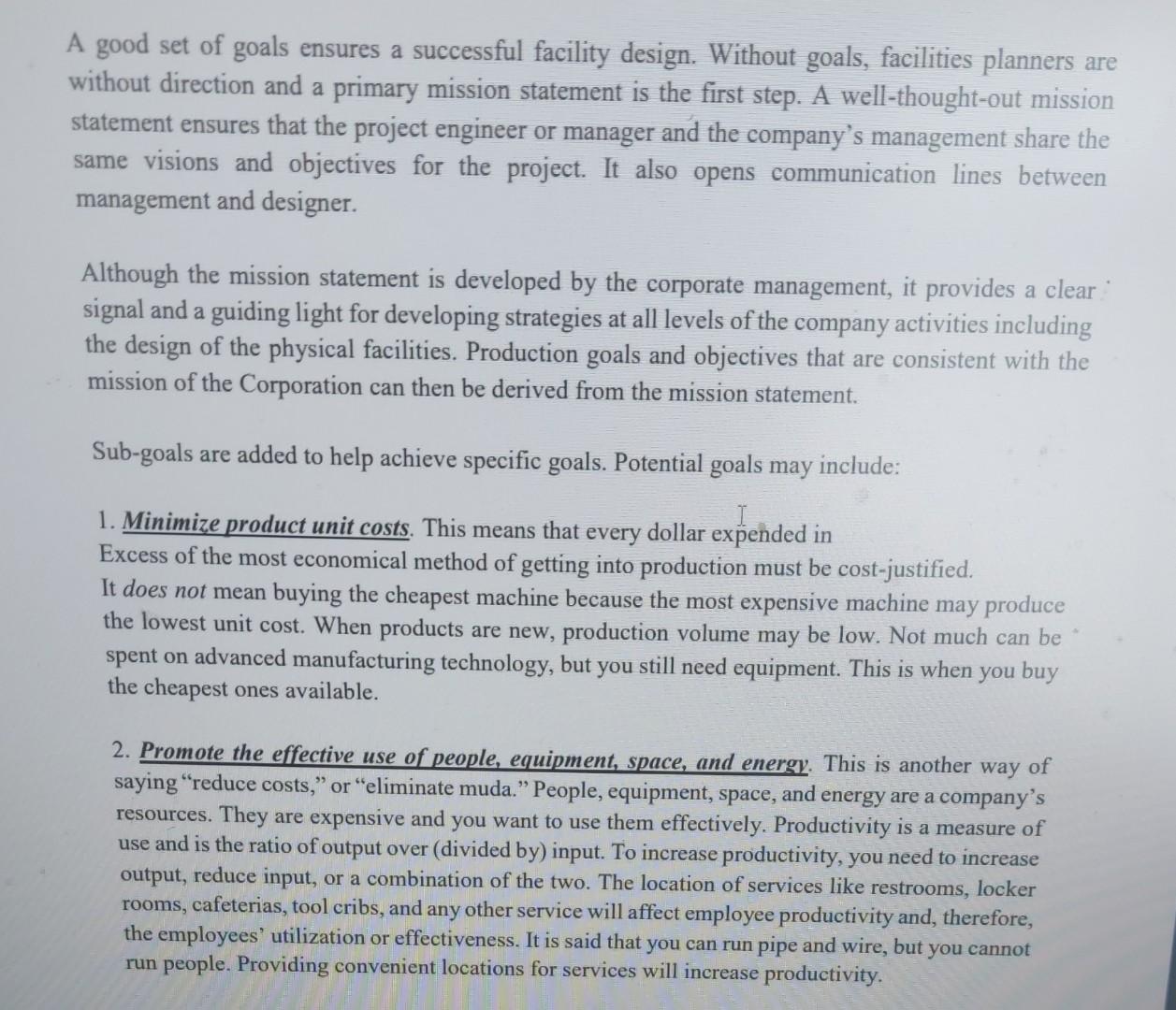
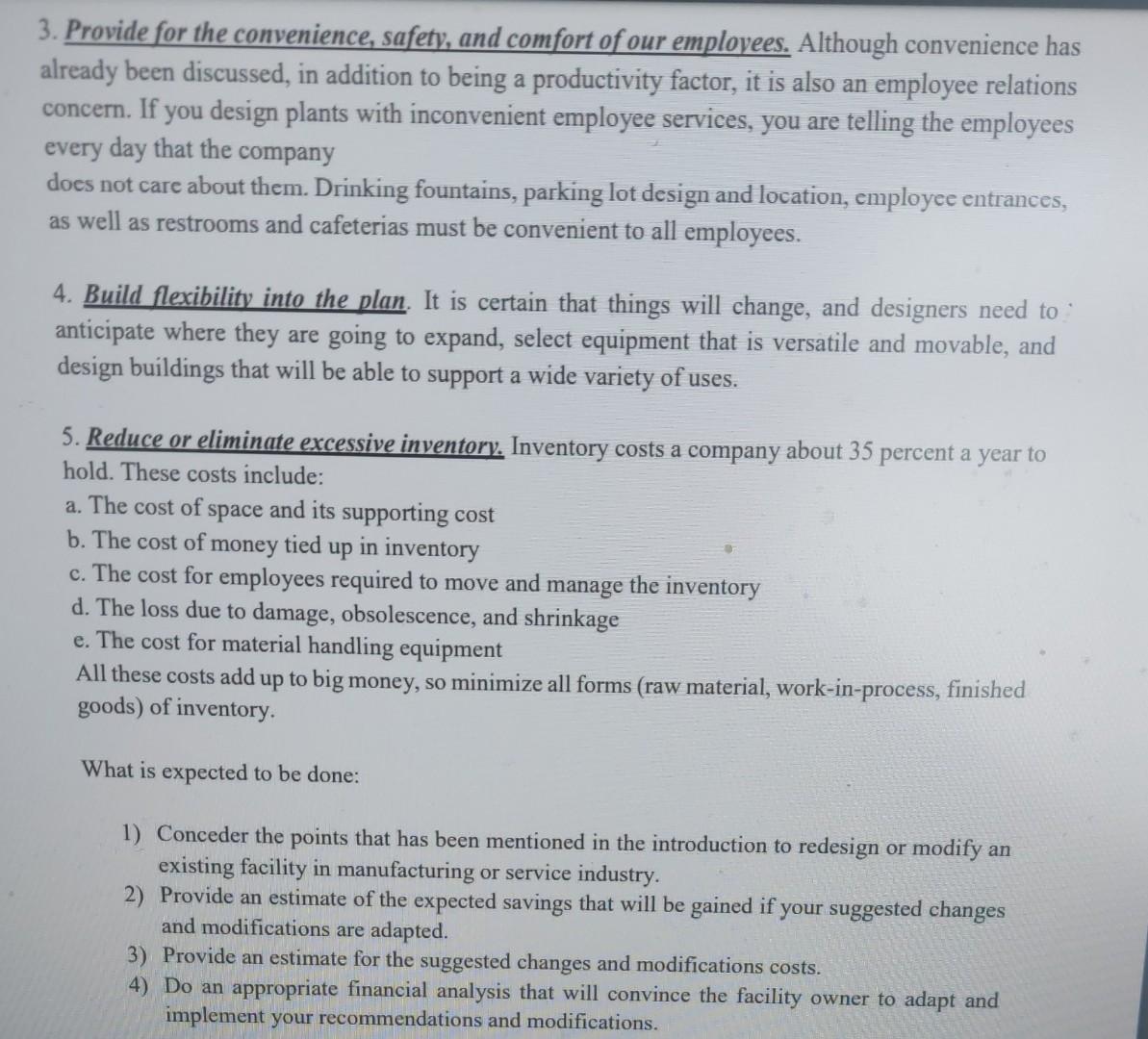
A good set of goals ensures a successful facility design. Without goals, facilities planners are without direction and a primary mission statement is the first step. A well-thought-out mission statement ensures that the project engineer or manager and the company's management share the same visions and objectives for the project. It also opens communication lines between management and designer. Although the mission statement is developed by the corporate management, it provides a clear signal and a guiding light for developing strategies at all levels of the company activities including the design of the physical facilities. Production goals and objectives that are consistent with the mission of the Corporation can then be derived from the mission statement. Sub-goals are added to help achieve specific goals. Potential goals may include: 1. Minimize product unit costs. This means that every dollar expended in Excess of the most economical method of getting into production must be cost-justified. It does not mean buying the cheapest machine because the most expensive machine may produce the lowest unit cost. When products are new, production volume may be low. Not much can be spent on advanced manufacturing technology, but you still need equipment. This is when you buy the cheapest ones available. 2. Promote the effective use of people, equipment, space, and energy. This is another way of saying "reduce costs," or "eliminate muda." People, equipment, space, and energy are a company's resources. They are expensive and you want to use them effectively. Productivity is a measure of use and is the ratio of output over (divided by) input. To increase productivity, you need to increase output, reduce input, or a combination of the two. The location of services like restrooms, locker rooms, cafeterias, tool cribs, and any other service will affect employee productivity and, therefore, the employees' utilization or effectiveness. It is said that you can run pipe and wire, but you cannot run people. Providing convenient locations for services will increase productivity. 3. Provide for the convenience, safetv, and comfort of our emplovees. Although convenience has already been discussed, in addition to being a productivity factor, it is also an employee relations concern. If you design plants with inconvenient employee services, you are telling the employees every day that the company does not care about them. Drinking fountains, parking lot design and location, employee entrances, as well as restrooms and cafeterias must be convenient to all employees. 4. Build flexibility into the plan. It is certain that things will change, and designers need to anticipate where they are going to expand, select equipment that is versatile and movable, and design buildings that will be able to support a wide variety of uses. 5. Reduce or eliminate excessive inventory. Inventory costs a company about 35 percent a year to hold. These costs include: a. The cost of space and its supporting cost b. The cost of money tied up in inventory c. The cost for employees required to move and manage the inventory d. The loss due to damage, obsolescence, and shrinkage e. The cost for material handling equipment All these costs add up to big money, so minimize all forms (raw material, work-in-process, finished goods) of inventory. A good set of goals ensures a successful facility design. Without goals, facilities planners are without direction and a primary mission statement is the first step. A well-thought-out mission statement ensures that the project engineer or manager and the company's management share the same visions and objectives for the project. It also opens communication lines between management and designer. Although the mission statement is developed by the corporate management, it provides a clear signal and a guiding light for developing strategies at all levels of the company activities including the design of the physical facilities. Production goals and objectives that are consistent with the mission of the Corporation can then be derived from the mission statement. Sub-goals are added to help achieve specific goals. Potential goals may include: 1. Minimize product unit costs. This means that every dollar expended in Excess of the most economical method of getting into production must be cost-justified. It does not mean buying the cheapest machine because the most expensive machine may produce the lowest unit cost. When products are new, production volume may be low. Not much can be spent on advanced manufacturing technology, but you still need equipment. This is when you buy the cheapest ones available. 2. Promote the effective use of people, equipment, space, and energy. This is another way of saying "reduce costs," or "eliminate muda." People, equipment, space, and energy are a company's resources. They are expensive and you want to use them effectively. Productivity is a measure of use and is the ratio of output over (divided by) input. To increase productivity, you need to increase output, reduce input, or a combination of the two. The location of services like restrooms, locker rooms, cafeterias, tool cribs, and any other service will affect employee productivity and, therefore, the employees' utilization or effectiveness. It is said that you can run pipe and wire, but you cannot run people. Providing convenient locations for services will increase productivity. 3. Provide for the convenience, safetv, and comfort of our emplovees. Although convenience has already been discussed, in addition to being a productivity factor, it is also an employee relations concern. If you design plants with inconvenient employee services, you are telling the employees every day that the company does not care about them. Drinking fountains, parking lot design and location, employee entrances, as well as restrooms and cafeterias must be convenient to all employees. 4. Build flexibility into the plan. It is certain that things will change, and designers need to anticipate where they are going to expand, select equipment that is versatile and movable, and design buildings that will be able to support a wide variety of uses. 5. Reduce or eliminate excessive inventory. Inventory costs a company about 35 percent a year to hold. These costs include: a. The cost of space and its supporting cost b. The cost of money tied up in inventory c. The cost for employees required to move and manage the inventory d. The loss due to damage, obsolescence, and shrinkage e. The cost for material handling equipment All these costs add up to big money, so minimize all forms (raw material, work-in-process, finished goods) of inventoryStep by Step Solution
There are 3 Steps involved in it
1 Expert Approved Answer
Step: 1 Unlock

Question Has Been Solved by an Expert!
Get step-by-step solutions from verified subject matter experts
Step: 2 Unlock
Step: 3 Unlock
 Study Help