







Question: Note: Students are required to clearly understand AQL, LTPD, producer's and consumer's risks as well as n, c, and table of acceptance probability. 1.
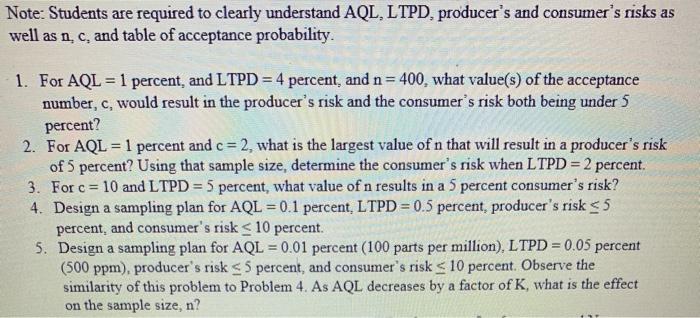
Note: Students are required to clearly understand AQL, LTPD, producer's and consumer's risks as well as n, c, and table of acceptance probability. 1. For AQL = 1 percent, and LTPD = 4 percent, and n = 400, what value(s) of the acceptance number, c, would result in the producer's risk and the consumer's risk both being under 5 percent? 2. For AQL = 1 percent and c = 2, what is the largest value of n that will result in a producer's risk of 5 percent? Using that sample size, determine the consumer's risk when LTPD = 2 percent. 3. For c= 10 and LTPD = 5 percent, what value of n results in a 5 percent consumer's risk? 4. Design a sampling plan for AQL = 0.1 percent, LTPD = 0.5 percent, producer's risk 5 percent, and consumer's risk 10 percent. 5. Design a sampling plan for AQL = 0.01 percent (100 parts per million), LTPD = 0.05 percent (500 ppm), producer's risk 5 percent, and consumer's risk 10 percent. Observe the similarity of this problem to Problem 4. As AQL decreases by a factor of K, what is the effect on the sample size, n?
Step by Step Solution
3.46 Rating (159 Votes )
There are 3 Steps involved in it
1 For AQL 1 percent and LTPD 4 percent and n 400 the value of the acceptance number ... View full answer

Get step-by-step solutions from verified subject matter experts
 Study Help