







Question: Design an algorithm to decide if there is a balanced walk in a Graph AS T sara many times army me Tecmures, nowadays, when we
Design an algorithm to decide if there is a balanced walk in a Graph
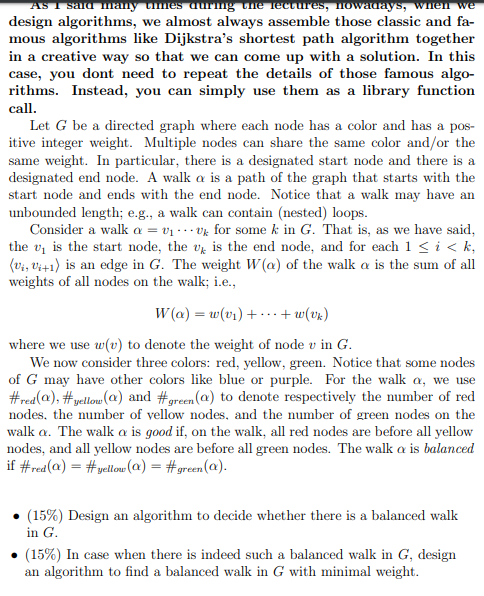
AS T sara many times army me Tecmures, nowadays, when we design algorithms, we almost always assemble those classic and fa- mous algorithms like Dijkstra's shortest path algorithm together in a creative way so that we can come up with a solution. In this case, you dont need to repeat the details of those famous algo- rithms. Instead, you can simply use them as a library function call. Let G be a directed graph where each node has a color and has a pos- itive integer weight. Multiple nodes can share the same color and/or the same weight. In particular, there is a designated start node and there is a designated end node. A walk a is a path of the graph that starts with the start node and ends with the end node. Notice that a walk may have an unbounded length; e.g., a walk can contain (nested) loops. Consider a walk a = 01.0k for some k in G. That is, as we have said, the v, is the start node, the Uk is the end node, and for each 1 Sick, (0, 0x+1) is an edge in G. The weight W a) of the walk a is the sum of all weights of all nodes on the walk; i.e., W(a) = (v1) + ... +w(UK) where we use w(v) to denote the weight of node v in G. We now consider three colors: red, yellow, green. Notice that some nodes of G may have other colors like blue or purple. For the walk a, we use #red(a), #yellow (a) and #green(a) to denote respectively the number of red nodes, the number of vellow nodes, and the number of green nodes on the walk a. The walk a is good if, on the walk, all red nodes are before all yellow nodes, and all yellow nodes are before all green nodes. The walk a is balanced if #red(a) = #yellow (a) = #green(a). (15%) Design an algorithm to decide whether there is a balanced walk in G. (15%) In case when there is indeed such a balanced walk in G, design an algorithm to find a balanced walk in G with minimal weight
Step by Step Solution
There are 3 Steps involved in it

Get step-by-step solutions from verified subject matter experts
 Study Help