



Question: what is the plausible future challenge from the case? Eral From a carpenter to ausiness Aloe logo -sout before social media but before computers and
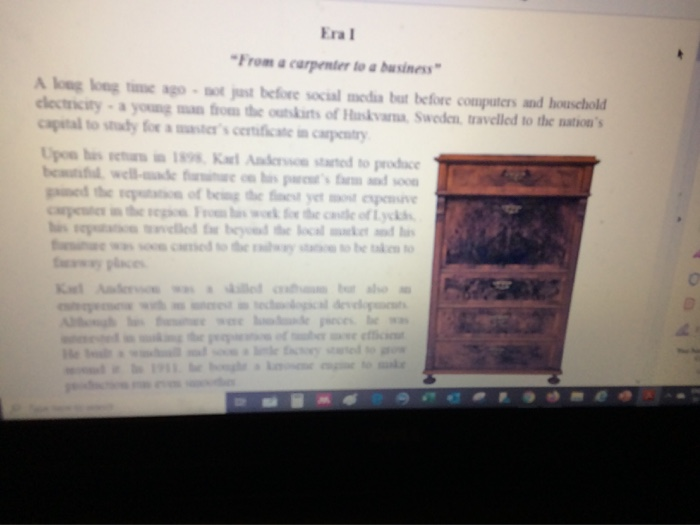
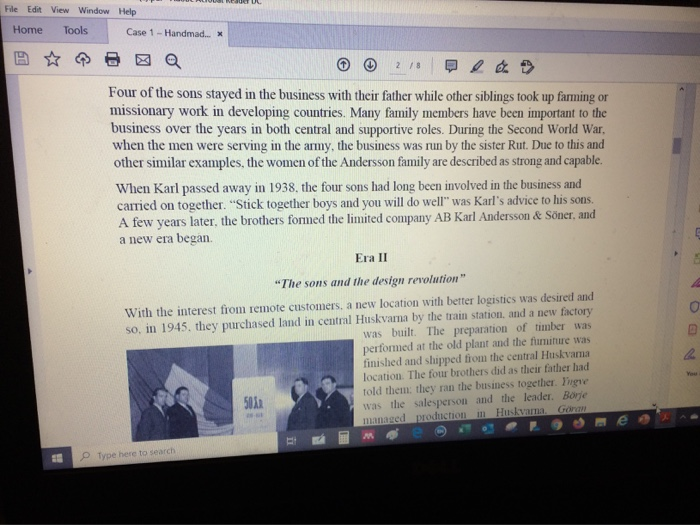
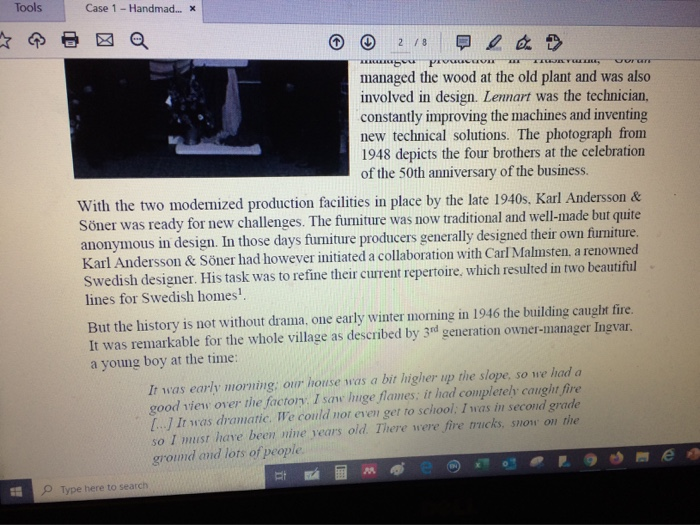
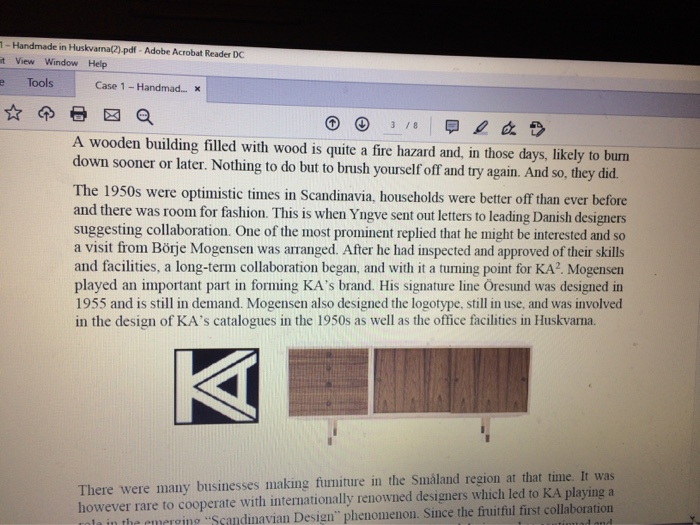
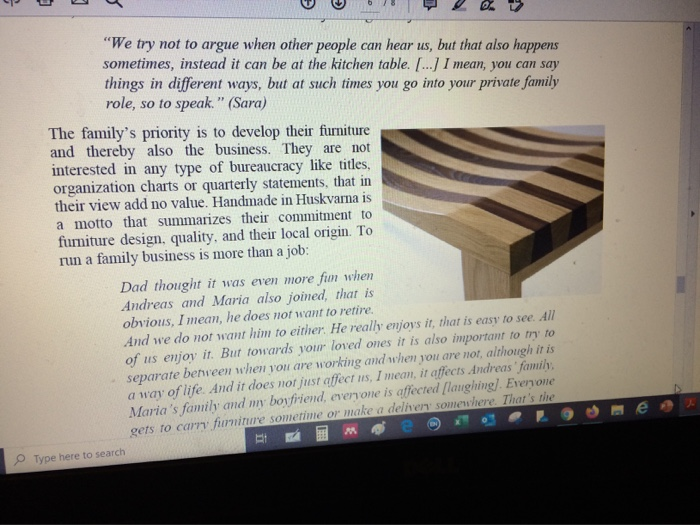
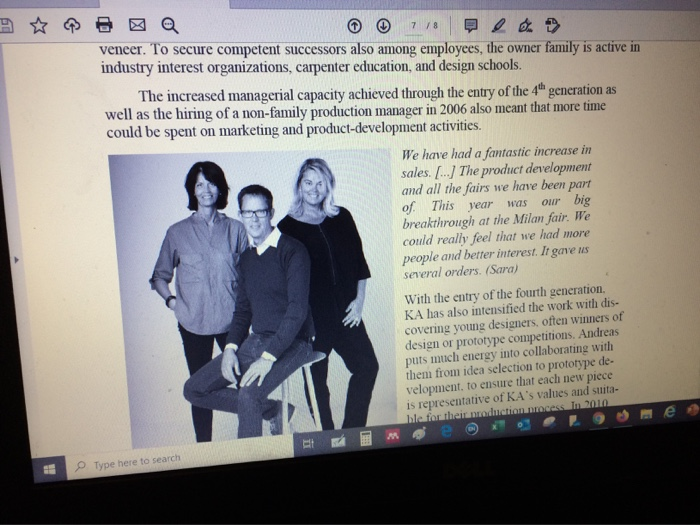
Eral "From a carpenter to ausiness Aloe logo -sout before social media but before computers and household checity - a young man from the outskirts of Husk Sweden, travelled to the nation's a lto y for certificate carpety po d ered to produce Case 1 - Handmad... X 118 ! Over the years, the business kept growing and so did the family. Karl and his wife Ida had 11 children and even took on a 12th foster son, caring for a child in need. Their family values were engrained by the protestant church, embracing solidarity, moderation and strong work ethics. As soon as the children were old enough, they helped out at the farm and in the workshop. making 25 years pass before the first non-family member was hired. One of the many challenges during World War One was the shortage of fuel and Karl, therefore, decided to invest in electricity. This was spectacular in the small village and an important step towards industrialized production. With increased capacity, the factory started to produce simpler furniture in series rather than single unique pieces. Even to this day, wood remains the principal material, a good choice considering that Sweden is to 70% covered by trees. The 1930s recession was tough everywhere and the business almost went bankrupt. Thanks to the resourcefulness of Karl's wife. Ida, they could survive on the farm she managed on top of caring for a family of 14. Ida is remembered as an extraordinary woman that. prior to having a family. travelled to America where she lived for several years and leamed to both speak and write in English. Another skill she picked up in America, well remembered by her children. was how to make ice cream. Type here to search F OCAL NESUTUL File Edit View Window Home Tools Help Case 1 - Handmad... * Four of the sons stayed in the business with their father while other siblings took up farming or missionary work in developing countries. Many family members have been important to the business over the years in both central and supportive roles. During the Second World War. when the men were serving in the army, the business was run by the sister Rut. Due to this and other similar examples, the women of the Andersson family are described as strong and capable When Karl passed away in 1938, the four sons had long been involved in the business and carried on together. "Stick together boys and you will do well" was Karl's advice to his sons. A few years later, the brothers formed the limited company AB Karl Andersson & Sner, and a new era began. Era II "The sons and the design revolution" With the interest from remote customers, a new location with better logistics was desired and so, in 1945. they purchased land in central Huskvarna by the train station, and a new factory was built. The preparation of timber was performed at the old plant and the fumiture was finished and shipped from the central Huskvama location. The four brothers did as their father had told them they ran the business together. Fige 5042 was the salesperson and the leader. Brje managed production in Huskvarna Gora Type here to search Tools Case 1 - Handmad... * 2.18 managed the wood at the old plant and was also involved in design. Lennart was the technician, constantly improving the machines and inventing new technical solutions. The photograph from 1948 depicts the four brothers at the celebration of the 50th anniversary of the business. With the two modernized production facilities in place by the late 1940s, Karl Andersson & Sner was ready for new challenges. The furniture was now traditional and well-made but quite anonymous in design. In those days furniture producers generally designed their own furniture. Karl Andersson & Sner had however initiated a collaboration with Carl Malmsten, a renowned Swedish designer. His task was to refine their current repertoire, which resulted in two beautiful lines for Swedish homes! But the history is not without drama, one early winter morning in 1946 the building caught fire. It was remarkable for the whole village as described by 3rd generation owner-manager Ingvar. a young boy at the time: It was early morning our house was a bit higher up the slope, so we had a good view over the factory. I saw hige flames; it had completely caught fire [...] It was dramatic. We could not even get to school: I was in second grade so I must have been aine vears old. There were fire trucks, show on the growd and lots of people. Type here to search 1 - Handmade in Huskvarna(2).pdf - Adobe Acrobat Reader DC at View Window Help e Tools Case 1 - Handmad. x A wooden building filled with wood is quite a fire hazard and, in those days, likely to bum down sooner or later. Nothing to do but to brush yourself off and try again. And so, they did. The 1950s were optimistic times in Scandinavia, households were better off than ever before and there was room for fashion. This is when Yngve sent out letters to leading Danish designers suggesting collaboration. One of the most prominent replied that he might be interested and so a visit from Brje Mogensen was arranged. After he had inspected and approved of their skills and facilities, a long-term collaboration began, and with it a turning point for KA?. Mogensen played an important part in forming KA's brand. His signature line resund was designed in 1955 and is still in demand. Mogensen also designed the logotype, still in use, and was involved in the design of KA's catalogues in the 1950s as well as the office facilities in Huskvarna. There were many businesses making furniture in the Smaland region at that time. It was however rare to cooperate with internationally renowned designers which led to KA playing a role in the emerging "Scandinavian Design" phenomenon. Since the fruitful first collaboration Case - Handmad... x 31 le role in the emerging "Scandinavian Design" phenomenon. Since the fruitful first collaboration with Carl Malmsten and Brje Mogensen, partnering with talented designers has continued and is still an important part of KA's way of working. The region is still a furniture district of Sweden with many furniture companies, IKEA being the most well-known, being based there. Nowadays it is very rare for those companies to produce the furniture locally because of high production costs; KA is again one of the few exceptions. Era III Back to basics and beyond" A main character of the third generation is Invar, one of the founder's grandsons. He grew up with the business and has worked there for over half a century: first with his uncles and later with his children. Ingvar has been interested in carpentry for as long as he can remember. At school. woodcraft lessons were his favorite subject. He went on to study engineering with a specialization in wood, at senior high school in Jnkping. After the obligatory year of military training. Ingvar went to work for a large furniture manufacturer in Germany. There he gained valuable business experience and command of the German language. Ingvar returned home in 1960 to work for Karl Andersson. At that time the Mogensen designs were booming and production was running as fast as possible. A level of demand they were unprepared for Type here to search There was no one to teach him about administration at Karl Andersson & Sner and there were no computers to keep track of things, as there are nowadays. Ingvar's education and experience from the large German factory really came in handy. He built up all the administrative functions and adjusted them to fit the way of working at Karl Andersson & Sner. It was important to make a system that really suited them without the unnecessary bureaucracy of large organizations. Keeping it nice and simple but in good order. When the 1970s saw a dip in the market the brothers were growing old and were indecisive of how to proceed. The company was mainly owned by them, but the other children had also inherited shares from the first succession, eventually resulting in ownership being shared between over forty siblings and cousins. Finally, an external CEO was hired while Ingvar managed production. During the 1980s Ingvar started to buy shares from cousins who were not involved in the business. He was very happy with the external CEO who sorted out many things and developed the business in a good way. Unfortunately, the CEO had to leave for family reasons in 1985 and Ingvar took over as CEO and continued on a path of growth. During the 1980s Ingvar initiated a new strategic direction for Karl Andersson & Sner: furniture for public spaces. New products were targeted towards businesses, public sectors. embassies and the like. Since then the company has served both the private and public markets. Several lines of office furniture were produced alongside pieces for the home environment. The qualities of KA did not go unnoticed and in 1988 they were courted by an investment group that was building a holding of a small number of handpicked furniture companies. Type here to search (Ingvar) The other owners who were not directly involved in the business liked the bid and Ingvar could not match it. When it was decided that Ingvar would stay on as CEO and run the business with a large influence he started to believe in the idea. They went for it and now Ingvar ran "his" business for someone else. It started out well but due to different reasons, the group got into financial trouble. The CEO of the business group was fired for misconduct and one by one the businesses were sold off. A new person was in charge and he asked Ingvar if he wanted to buy Karl Andersson & Sner back or if it should be liquidated. At least the company was left intact so there was nothing to do but to go to the bank and tell them that we wanted to buy it, me and Gummel. We put in our money and borrowed enough to get Karl Andersson & Sner back. (Ingvar) Type here to search Talumu... 518 Ingvar and his wife Gunnel acquired the business in 1992 after some turbulent years of, first, scattered family ownership, and then external ownership. Karl Andersson & Sner was now back with its original descendants both regarding ownership and leadership. The family tree was trimmed down to one branch and a simple corporate governance structure. Through this, the business went back to basics but also developed into several markets. The common denominator being products of the highest quality, whether it is a dining table for a home, a conference table for an office, or a lounge table for a hotel lobby. The collaboration with interesting designers continues and by the end of the last century, the fourth generation began to formally engage in era begins. Era IV "Renewal through tradition" Renewal through tradition" At the turn of the millennium, Ingvar's three children entered KA as the 4th generation in the family firm. In 1996, Sara started to work with sales and marketing, after a career in interior design in Stockholm. In 2000, Andreas quit his engineering position at a company in Gothenburg to join KA. In 2001, the third sibling, Maria joined KA, leaving the computer industry in Stockholm. In 2002, they together initiated a large expansion of the old facilities, in commitment to the future of the family firm. All three children of Ingvar and Gunnel now work for KA but their engagement dates back much further. Maria, Sara, and Andreas grew up with the business as part of their everyday life, occasionally spending time there as children. As teenagers, they eamed their pocket money from helping out after school and during the holidays. The business has always been an inherent part of their life, included in what is 'normal'. I've always been here a whole lot. It was not always that fim in the beginning. We were going now and then if something needed to be done. [...] I also cut wood samples and helped out with inventory, counting stuff and other simple tasks. And we have always been at the exhibitions and in Stockholm (at the furniture fair) and so on. I have always been there in one way or another. (Maria) Type here to search . Even if they have always been involved to some extent, all of them have also been away from the business and their hometown for education and individual careers. Since 2001, the four of them are running the business together. They have their own areas, but share overall responsibility for the whole business. They also share a passion for designer furniture and value the opportunity to work together to continue their family tradition. They run the business in a very informal manner, without regular meetings, and have no active board and no written statements of strategy or vision. Instead, they are in dialogue about everything, big and small, and deal with issues as they go along. They have the essence of Karl Andersson & Sner as a guiding star in everything they do and running the business together is their way of life. Their tradition does, however, include curiosity of technological advancements which is now seen for examplein investments in high-tech machinery and using advanced construction Type here to search Sner as a guiding star in everything they do and running the business together is their way of life. Their tradition does, however, include curiosity of technological advancements which is now seen for examplein investments in high-tech machinery and using advanced construction of the furniture as a safeguard against piracy as it makes their furniture too difficult to copy. The three children of the fourth generation are all dedicated to having the family history of furniture making continue into the future. The chance to work together is part of their driving force: "It is only positive! We feel that it is great to work together. You get really strong as a family, we are really strong together." (Maria) Even though they try to stick to their own areas, answering for someone else can be a quick and easy solution while other times it causes confusion. Another source of frustration is that people treat each other differently when they are not just colleagues, but also family: "Sometimes it can be a problem for the four of us to decide on things. Maybe it is typically Swedish, too, that everyone should agree all the time. Sometimes it would be nice if someone just said: Now we do like this and that is final! We are more like: Let's think about that. Let's wait and see." (Andreas) Also, conflicts are handled in a different way among family members: Type here to search "We try not to argue when other people can hear us, but that also happens sometimes, instead it can be at the kitchen table. [...] I mean, you can say things in different ways, but at such times you go into your private family role, so to speak." (Sara) The family's priority is to develop their furniture and thereby also the business. They are not interested in any type of bureaucracy like titles, organization charts or quarterly statements, that in their view add no value. Handmade in Huskvarna is a motto that summarizes their commitment to furniture design, quality, and their local origin. To run a family business is more than a job: Dad thought it was even more fun when Andreas and Maria also joined, that is obvious, I mean, he does not want to retire. And we do not want him to either. He really enjoys it, that is easy to see. All of us enjoy it. But towards your loved ones it is also important to try to separate benieen when you are working and when you are not, although it is a way of life. And it does not just affect is, I mean, it affects Andreas famil, Maria's family and my boyfriend, everyone is affected [laughing). Evenone gets to carry furniture sometime or make a delivery somewhere. That's the Type here to search U ! There is no fixed routine of formal meetings at Karl Anderson & Sner, apart from the required board meeting once a year. There is, however, no shortage of occasions when they meet and simply deal with issues as they go along. They meet at the office at the lunch table. in the car, at fairs, during family gatherings, during business trips and while travelling to such meetings. Their communication is constantly ongoing through daily encounters. Frequent interaction is a constant source of updating and sharing. It is effective and quick but also has its downsides. It is assumed that everyone knows everything. so there is little formal information Therefore, things are also missed. forgotten and misunderstood now and then. According to the employees, having accessible owners that you meet daily and can talk to easily is an appreciated part of working for a family business. Working for KA also gives the increasingly rare chance for carpenters to build furniture the right way and be proud of the craft. Many employees work their whole career with KA and are experts of certain techniques like the sewing of wood Type here to search 71 veneer. To secure competent successors also among employees, the owner family is active in le industry interest organizations, carpenter education, and design schools. The increased managerial capacity achieved through the entry of the 4th generation as well as the hiring of a non-family production manager in 2006 also meant that more time could be spent on marketing and product development activities. We have had a fantastic increase in sales. [...] The product development and all the fairs we have been part of This year was our big breakthrough at the Milan fair. We could really feel that we had more people and better interest. It gave us several orders. (Sara) With the entry of the fourth generation, KA has also intensified the work with dis- covering young designers, often winners of design or prototype competitions. Andreas puts much energy into collaborating with them from idea selection to prototype de- velopment to ensure that each new piece is representative of KA's values and suita- ble for theirdnation recess. In 2010 Type here to search Edit View Window Help me Tools Case 1 - Handmad... X 13 I prescrita VC VIN 3 varus aru sa- ble for their production process. In 2010, Andreas took over as CEO, but in practice, the four family members largely run KA as a team effort. Gradually Ingvar has cut down on his working hours and the daily operations are mainly managed by the three siblings together with the non-family production manager and a small salesforce. To- day, about 80% of sales come from furnishing public spaces and only 20% of sales are gener- ated from private customers. The turnover from 2018 was 40.283 336 SEK with 35 em- ployees. Although the business is small in size, they have maintained a role in their niche since the niche of Scandinavian design furniture took form in the early 1950s. They are happy to grow in terms of revenue and development but are cautious about what increase in turnover would imply: We do not want to grow too big or out of control. We want to keep production in Huskvarna and prosper here within the right scale. Be successful at what we do within our niche and develop, but in the right proportion. (Andreas) Type here to search 08785 On the question of the future continuation for the family business Maria reflects that it is still too early to know: But if any of them wanted to take over that would be great. Of course, one would encourage that. No one can be forced into it though. Carl, my oldest is a teenager. Andreas' children are even younger. But they are here now and then and some of them show interest in certain areas. And they work here sometimes. (Maria) The transitions between the eras are gradually ongoing. Ingvar has worked fulltime for KA in a managerial position since 1960 while he became CEO in 1985. And although Ingvar has been the majority owner since 1992. he was a minority owner from 1968 to 1989. The four sons of Karl Anderson did gradually start to run the business together with their father long before they formally took over after Karl's death in 1938. The joint family management seems to repeat itself. The four sons of the second generation did run the business together. first with their father and then the four of them in a similar manner as the third and fourth generation are doing today. At the topic of the fifth generation the tale is arriving at the present time. What the fifth era holds - only the future will tell. Type here to search
Step by Step Solution
There are 3 Steps involved in it

Get step-by-step solutions from verified subject matter experts