







Question: Design and develop a database of your choice that includes at least: Five entities. Structural Constraints a. At least two of the three cardinality constraints.
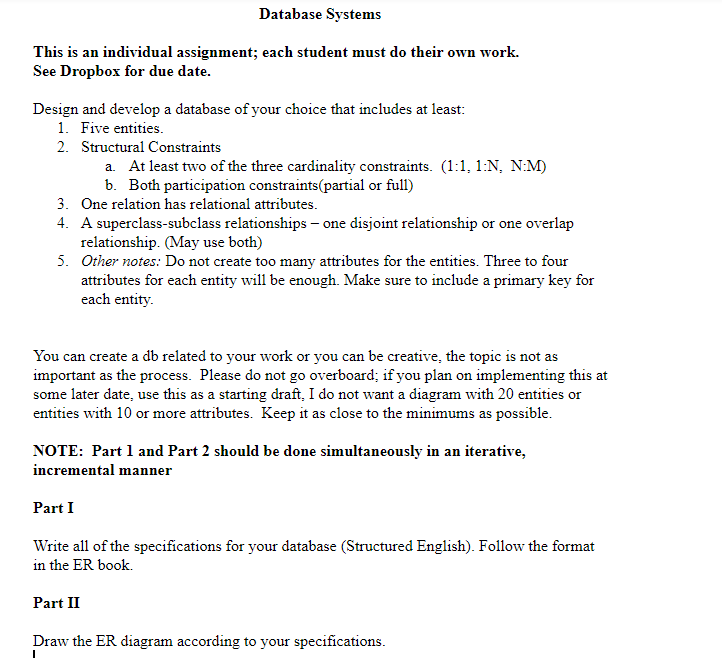
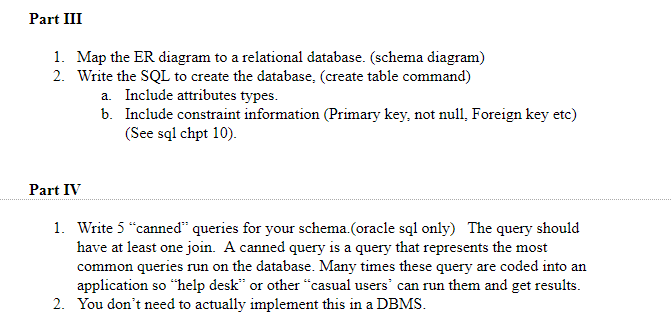
Design and develop a database of your choice that includes at least: Five entities. Structural Constraints a. At least two of the three cardinality constraints. (1: 1, 1: N, N: M) b. Both participation constraints (partial or full) One relation has relational attributes. A superclass-subclass relationships-one disjoint relationship or one overlap relationship. (May use both) Other notes: Do not create too many attributes for the entities. Three to four attributes for each entity will be enough. Make sure to include a primary key for each entity. You can create a db related to your work or you can be creative, the topic is not as important as the process. Please do not go overboard: if you plan on implementing this at some later date, use this as a starting draft, I do not want a diagram with 20 entities or entities with 10 or more attributes. Keep it as close to the minimums as possible. Write all of the specifications for your database (Structured English). Follow the format in the ER book. Draw the ER diagram according to your specifications. Map the ER diagram to a relational database, (schema diagram) Write the SQL to create the database, (create table command) a. Include attributes types. b. Include constraint information (Primary key, not null. Foreign key etc) (See sq1 chpt 10). Write 5 "canned'' queries for your schema.(oracle sq1 only) The query should have at least one join. A canned query is a query that represents the most common queries run on the database. Many times these query are coded into an application so "help desk" or other "casual users' can run them and get results. You don't need to actually implement this in a DBMS
Step by Step Solution
There are 3 Steps involved in it

Get step-by-step solutions from verified subject matter experts
 Study Help