







Question: Design and verify a communications interface. Often data sent over a data link are organized as packets of data, each packet containing some identification bits,
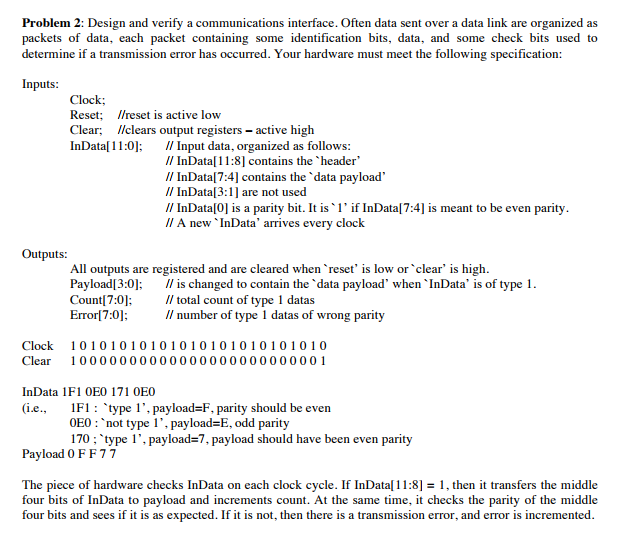
Design and verify a communications interface. Often data sent over a data link are organized as packets of data, each packet containing some identification bits, data, and some check bits used to determine if a transmission error has occurred. Your hardware must meet the following specification: Inputs: Clock: Reset: //reset is active low Clear: //clears output registers - active high InData[11: 0]: // Input data, organized as follows: // InData[11: 8] contains the 'header' // InData[7: 4] contains the 'data payload' // InData[3: 1] are not used // InData[0] is a parity bit. It is' 1 ' if InData[7: 4] is meant to be even parity. // A new' InData' arrives every clock Outputs: All outputs are registered and are cleared when 'reset' is low or 'clear' is high. Payload[3: 0]: // is changed to contain the 'data payload' when 'InData' is of type 1. Count[7: 0]: // total count of type 1 datas Error[7: 0]: // number of type 1 datas of wrong parity Clock 10101010101010101010101010 Clear 10000000000000000000000001 InData 1F1 0E0 171 0E0 (i.e., 1F1: 'type 1 '. payload = F, parity should be even 0E0: 'not type 1 '. payload = E, odd parity 170: 'type 1 ', payload = 7, payload should have been even parity Payload 0 F F 7 7 The piece of hardware checks InData on each clock cycle. If InData [11: 8] = 1, then it transfers the middle four bits of InData to payload and increments count. At the same time, it checks the parity of the middle four bits and sees if it is as expected. If it is not. then there is a transmission error, and error is incremented
Step by Step Solution
There are 3 Steps involved in it

Get step-by-step solutions from verified subject matter experts
 Study Help