







Question: Determine if each statement below is true or false and justify your answer (i.e. give a counterexample or show the statement is true in general).
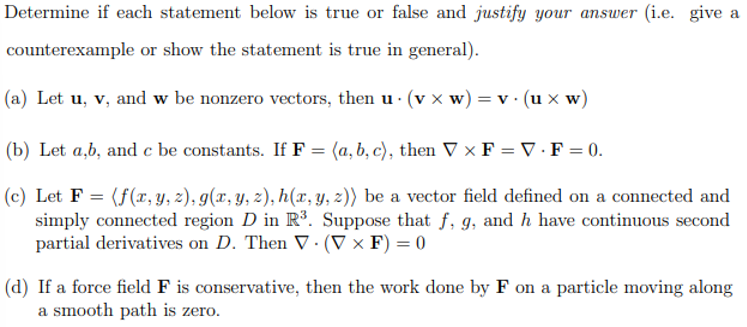
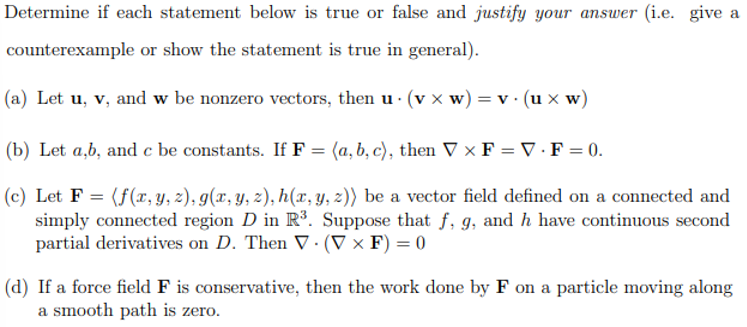
Determine if each statement below is true or false and justify your answer (i.e. give a counterexample or show the statement is true in general). (a) Let u, v, and w be nonzero vectors, then u . (v x w) = v . (ux w) (b) Let a,b, and c be constants. If F = (a, b, c), then V x F = V . F =0. (c) Let F = (f(x, y, z), g(x, y, z), h(x, y, z)) be a vector field defined on a connected and simply connected region D in R3. Suppose that f, g, and h have continuous second partial derivatives on D. Then V . (V x F) = 0 (d) If a force field F is conservative, then the work done by F on a particle moving along a smooth path is zero
Step by Step Solution
There are 3 Steps involved in it
1 Expert Approved Answer
Step: 1 Unlock

Question Has Been Solved by an Expert!
Get step-by-step solutions from verified subject matter experts
Step: 2 Unlock
Step: 3 Unlock
 Study Help