







Question: Determine whether each set in Exercises 1-5 is a function from 1, 2, 3, 4 to 1, 5 d. If it is a function, find
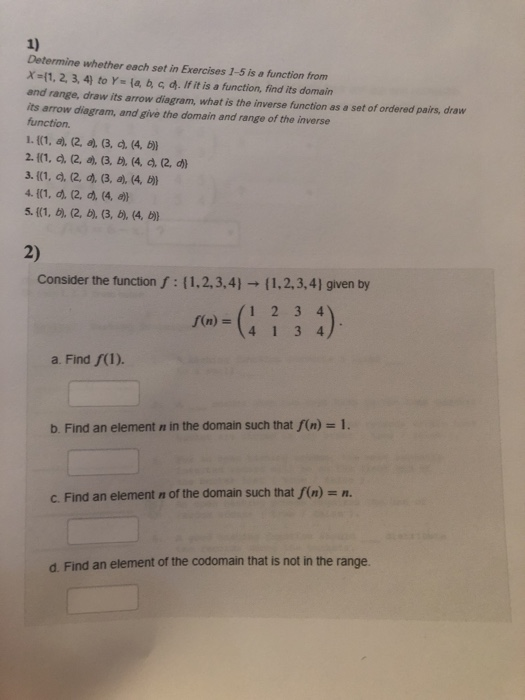
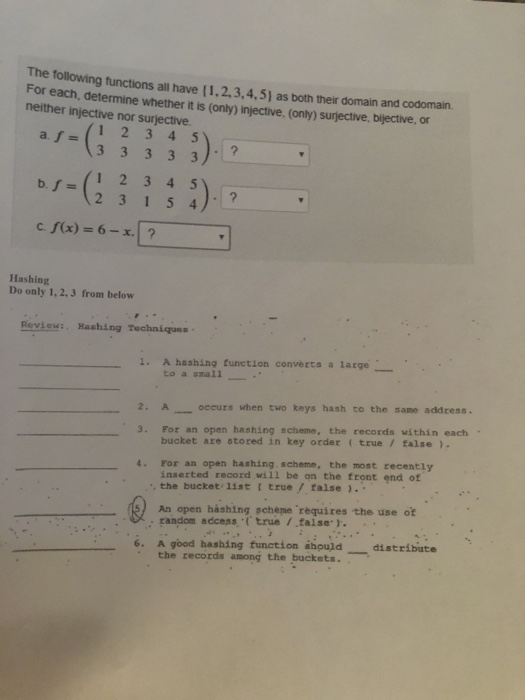
Determine whether each set in Exercises 1-5 is a function from 1, 2, 3, 4 to 1, 5 d. If it is a function, find its domain and range, draw its arrow diagram, what is the inverse function as a set of ordered pairs, draw its arrow diagram, and give the domain and range of the inverse function. 1. (1. a), (2.0), (3, 4). (4. b)] 2. {(1, 0, (2, 4), (3, b). (4. d. (2.0) 3. {(1, d. (2d), (3, 4), (4,)} 4. {(1, 0). (2, 4). ( 40) 5. {(1, b), (2, 6), (3, b), (4, b)} Consider the functions : [1,2,3,4) (1,2,3,4) given by No 1 2 3 4 - 4 1 3 4 a. Find S(1). b. Find an element in the domain such that (n) = 1. c. Find an element n of the domain such that f(n) = n. d. Find an element of the codomain that is not in the range. The following functions all have (1,2,3,4,5) as both their domain and codomain For each, determine whether it is (only) injective, (only) surjective, bijective, or neither injective nor surjective. as= (3 2 3 3 3 4 3 5 3 0.5=( c.5(x) = 6 - 1 : 2). ? Hashing Do only 1, 2, 3 from below Review: Hashing Techniques 1. A hashing function converts a large to a small 2. A occurs when two keys hash to the same address. 3. For an open hashing scheme, the records within each bucket are stored in key order ( true / false). 4. For an open hashing scheme, the most recently inserted record will be on the front end of the bucket list true / false). An open hashing scheme requires the use of random access' true / false). A good hashing function should distribute the records among the buckets
Step by Step Solution
There are 3 Steps involved in it

Get step-by-step solutions from verified subject matter experts
 Study Help