



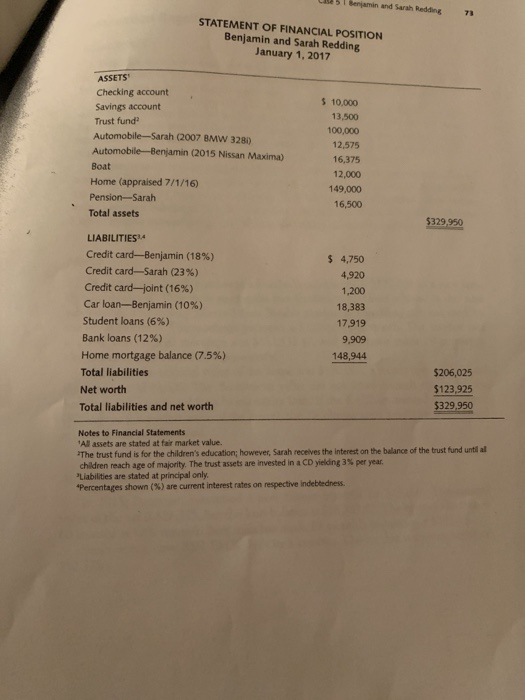
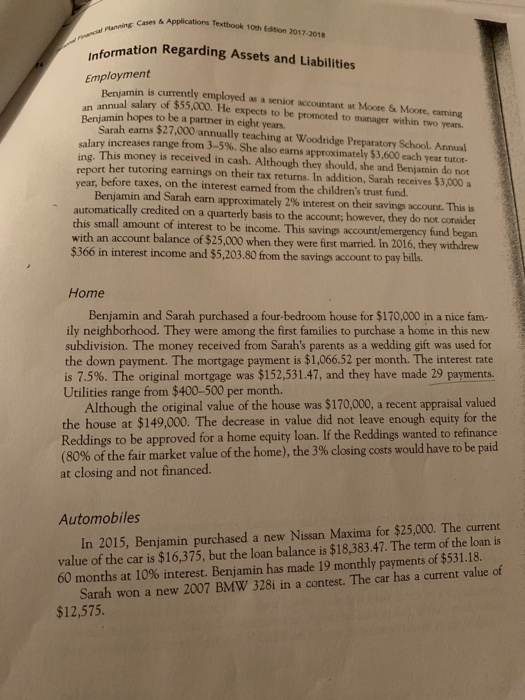
Question: Determine whether the Reddings will currently qualify to refinance their home. Is the house eligible for refinancing by a lender requiring a maximum loan-to-value ratio
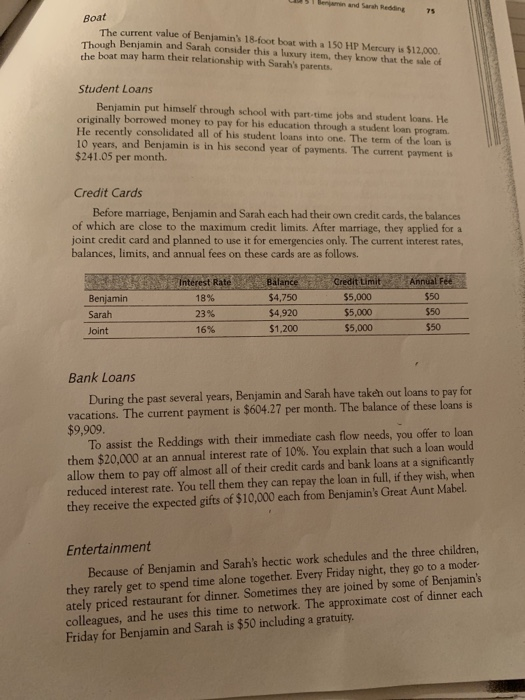
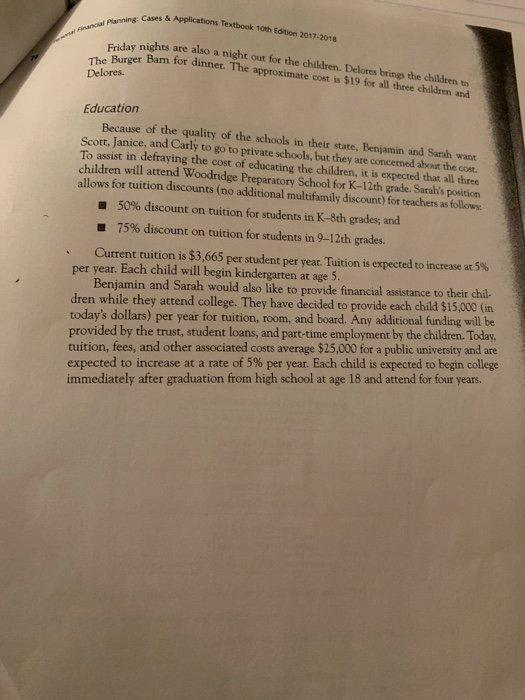
Determine whether the Reddings will currently qualify to refinance their home. Is the house eligible for refinancing by a lender requiring a maximum loan-to-value ratio of 80%? How much cash would the Reddings need if they refinance?
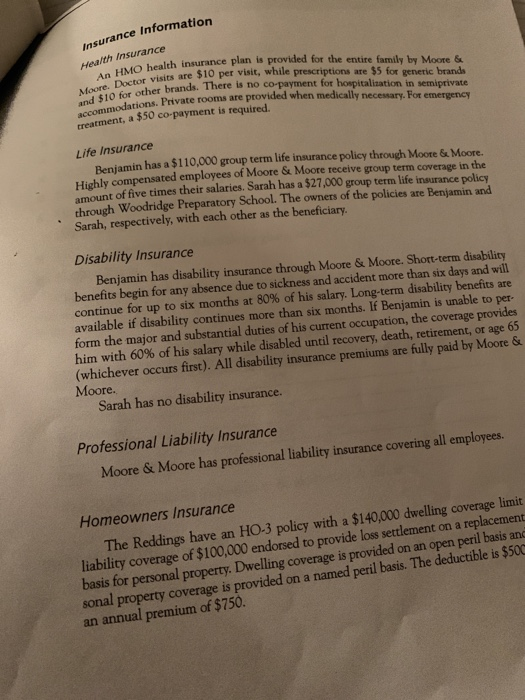
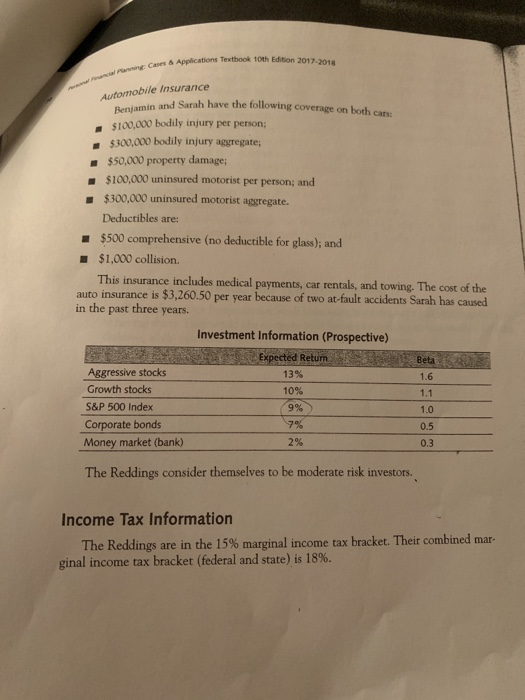
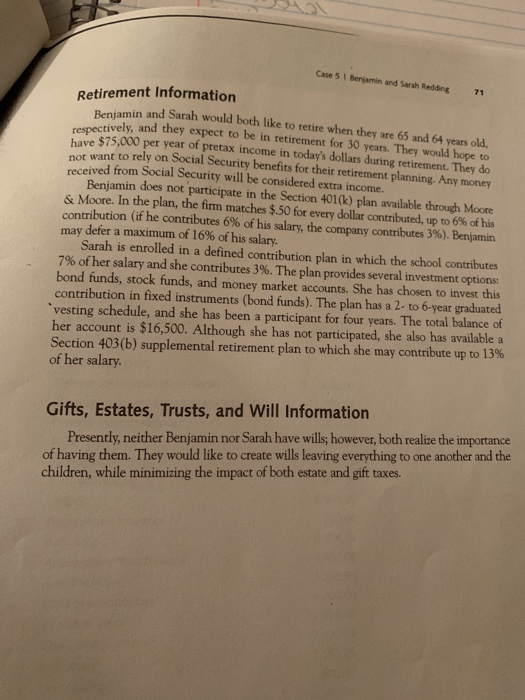
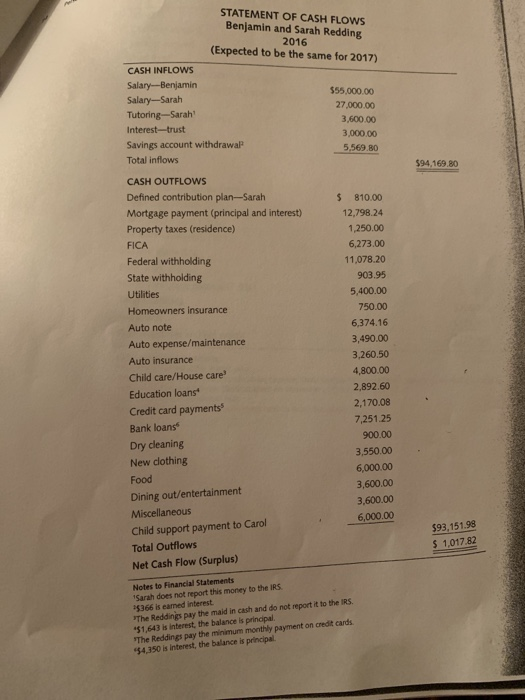
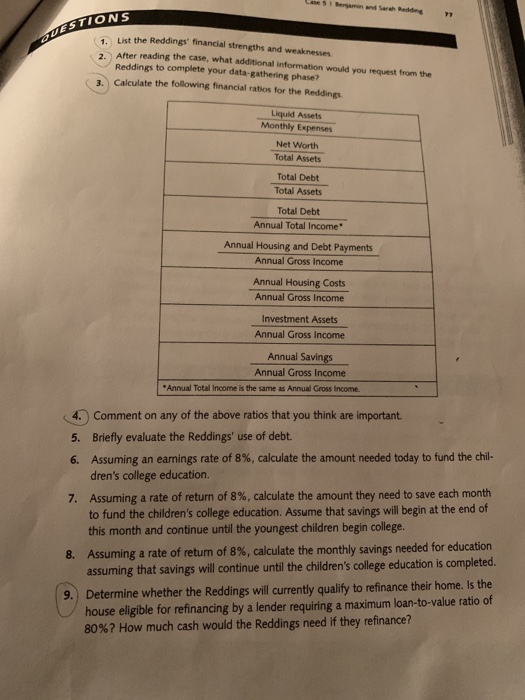
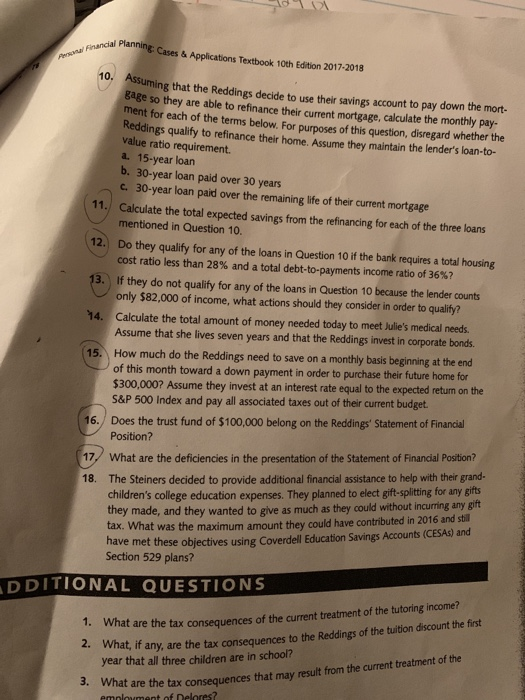
nsurance Information Health Insurance health insurance plan is provided for the entire family by Moore & visits are $10 per visit, while prescriptions are $5 for generic brands 4n HMO and $10 creatment, a $50 co-payment is required. Mooro for other brands. There is no co-payment for hospitalization in semiprivate dations. Private rooms are provided when medically necessary. For emergency Life Insurance Benjamin has a $110,000 group term life insurance policy through Moore &Moore. of five times their salaries. Sarah has a $27,000 group term life insurance policy Highly compensated employees of Moore & Moore receive group term coverage in the amount through Woodridge Preparatory School. The owners of the policies are Benjamin and Sarah, respectively, with each other as the beneficiary Disability Insurance Benjamin has disability insurance through Moore & Moore. Short-term disability benefits begin for any absence due to sickness and accident more than sizx days and wvill continue for up to six months at 80% of his salary. Long-term disability benefits are available if disability continues more than six months. If Benjamin is unable to per form the major and substantial duties of his current occupation, the coverage provides him with 60% of his salary while disabled until recovery, death, retirement, or age 65 (whichever occurs first). All disability insurance premiums are fully paid by Moore & Moore. Sarah has no disability insurance. Professional Liability Insurance Moore & Moore has professional liability insurance covering all employees Homeowners Insurance The Reddings have an HO-3 policy with a $140,000 dwelling coverage limit liability coverage of $100,000 endorsed to provide loss settlement on a replacement basis for personal property. Dwelling coverage is provided on an open peril basis and coverage is provided on a named peril basis. The deductible is $500 an annual premium of $750. s Applications Textbook 10th Edition 2017-2018 Cases & Automobile Insurance and Sarah have the following coverage on both cars: $100.00 bodily injury per person; $300,000 bodily injury aggregate $50,000 property damage; $100,000 uninsured motorist per person; and $300,000 uninsured motorist aggregate. Deductibles are: $500 comprehensive (no deductible for glass); and $1, collision This insurance includes medical payments, car rentals, and towing. The cost of the auto insurance is $3,260.50 per year because of two at-fault accidents Sarah has caused in the past three years. Investment Information (Prospective) Expected Return Beta Aggressive stocks Growth stocks S&P 500 Index Corporate bonds Money market (bank) 13% 10% 9% 1.6 1.0 0.5 0.3 2% The Reddings consider themselves to be moderate risk investors. Income Tax Information The Reddings are in the 15% marginal income tax bracket. Their combined mar- ginal income tax bracket (federal and state) is 18%. Case 5 1 Benjamin and Sarah Redding 71 Retirement Information Reniamin and Sarah would both like to retire when they are 65 and 64 years old, respectively, and they expect to be in retirement for 30 years. They would hope to have $75,000 per year of pretax income in todays dollars during retirement. They do twant to rely on Social Security benefits for their retirement planning. Any money not ived from Social Security will be considered extra income. Benjamin does not participate in the Section 401(0k) plan available through Moore & Moore. In the plan, the firm matches $.50 for every dollar contributed, up to6% of his contribution (if he contributes 6% of his salary, the company contributes 3%), Benjamin may defer a maximum of 16% of his salary. Sarah is enrolled in a defined contribution plan in which the school contributes 7% of her salary and she contributes 3%. The plan provides several investment options: bond funds, stock funds, and money market accounts. She has chosen to invest this contribution in fixed instruments (bond funds). The plan has a 2- to 6-year graduated vesting schedule, and she has been a participant for four years. The total balance of her account is $16,500. Although she has not participated, she also has available a Section 403 (b) supplemental retirement plan to which she may contribute up to 13% of her salary. Gifts, Estates, Trusts, and Will Information Presently, neither Benjamin nor Sarah have wills however, both realize the importance of having them. They would like to create wills leaving everything to one another and the children, while minimizing the impact of both estate and gift taxes. STATEMENT OF CASH FLOWS Benjamin and Sarah Redding 2016 (Expected to be the same for 2017) CASH INFLOws Salary-Benjamin Salary-Sarah Tutoring-Sarah $55,000.00 27,000.00 3,600.00 3,000.00 5,569.80 Savings account withdrawa Total inflows CASH OUTFLOWS Defined contribution plan-Sarah Mortgage payment (principal and interest Property taxes (residence) 94.169.80 $ 810.00 12,798.24 1,250.00 6,273.00 11,078.20 903.95 5,400.00 750.00 6,374.16 3,490.00 3,260.50 4,800.00 2,892.60 2,170.08 7,251.25 900.00 3,550.00 6,000.00 3,600.00 3,600.00 6,000.00 Federal withholding State withholding Utilities Auto note Auto expense/maintenance Auto insurance Child care/House care Education loans Credit card payments Bank loans Dry cleaning New clothing Dining out/entertainment Miscellaneous Child support payment to Carol Total Outflows Net Cash Flow (Surplus) $93,151.98 s 1,017.82 Notes to Financial Statements Sarah does not report this money to the IRS $366 is eamed interest The Reddings pay the maid in cash and do not report it to the IRS. $1,643 is interest, the balance is principal. The Reddings pay the minimum monthly payment on credit cards $4,350 is interest, the balance is principal. T Benjamin and Sarah Redding 3 STATEMENT OF FINANCIAL POSITION Benjamin and Sarah Redding January 1, 2017 ASSETS Checking account 5 10,000 13,500 100,000 12,575 16,375 12,000 149,000 16,500 Savings account Trust fund Automobile-Sarah (2007 8MW 328) Automobile-Benjamin (2015 Nissan Maxima) Boat Home (appraised 7/1/16) Pension-Sarah Total assets 5329,950 LIABILITIES3 Credit card Benjamin (18 %) Credit card-Sarah (23 %) Credit card-joint (16%) Car loan-Benjamin (10%) Student loans (6%) Bank loans (12%) Home mortgage balance (7.5%) Total liabilities Net worth Total liabilities and net worth s 4,750 4,920 1,200 18,383 17,919 9,909 148,944 $206,025 $123,925 $329,950 Notes to Financial Statements All assets are stated at fair market value. The trust fund is for the children's education; however, Sarah receives children reach age of majority. The trust assets are invested in a CD yieldng 3% per year. Liabilities are stated at principal only percentages shown (%) are current interest rates on respective indebtedness. the interest on the balance of the trust fund until al Cases & Applications textbook 10th Edition 2017-2018 mation Regarding Assets and Liabilities Informati nin is currently employed as a senior accountant at Moore &Moore, eaming nnual salary of $55,000. He expects to be promoted to manager within two years. Reniamin hopes to be a partner in eight years. Sarah eans $27,000 annually teaching at Woodridge Preparatory School. Annual salary increases range from 3-5%. She also earns approximately $3000 each year tutor- ing. This money is received in cash. Although they should, she and Benjamin do not report her tutoring earnings on their tax returns. In addition, Sarah receives $3,000 a year, before taxes, on the interest earned from the children's trust fund. Benjamin and Sarah earn approximately 2% interest on their savings account. This is automatically credited on a quarterly basis to the account, however, they do not consider this small amount of interest to be income. This savings accountlemergency fund began with an account balance of $25,000 when they were first married. In 2016, they withdrew $366 in interest income and $5,203.80 from the savings account to pay Home Benjamin and Sarah purchased a four-bedroom house for $170,000 in a nice fam- ily neighborhood. They were among the first families to purchase a home in this new subdivision. The money received from Sarah's parents as a wedding gift was used for the down payment. The mortgage payment is $1,066.52 per month. The interest rate is 7.5%. The original mortgage was $152,531.47, and they have made 29 payments. Utilities range from $400-500 per month. Although the original value of the house was $170,000, a recent appraisal valued the house at $149,000. The decrease in value did not leave enough equity for the Reddings to be approved for a home equity loan. If the Reddings wanted to refinance (80% of the fair market value of the home), the 3% closing costs would have to be paid at closing and not financed. Automobiles In 2015, Benjamin purchased a new Nissan Maxima for $25,000. The current value of the car is $16,375, but the loan balance is $18,383.47. The term of the loan is 60 months at l 0% interest. Benjamin has made 19 monthly payments of $531. 18. Sarah won a new 2007 BMW 328i in a contest. The car has a current value of $12,575 enernin and Sarh Reding 7 Boat The current value of Benjamin's 18-foot boat with a 150 HP Mercury is $12,000. Though Benjamin and Sarah consider this a luxury item, they know that the sale of the boat may harm their relationship with Sarah's parents Student Loans Benjamin put himself through school with part-time jobs and student loans. He originally borrowed money to pay for his education through a student loan program He recently consolidated all of his student loans into one. The term of the loan is 10 years, and Benjamin is in his second year of payments. The current payment is $241.05 per month Credit Cards Before marriage, Benjamin and Sarah each had their own credit cards, the balances of which are close to the maximum credit limits. After marriage, they applied for a joint credit card and planned to use it for emergencies only. The current interest rates, balances, limits, and annual fees on these cards are as follows. , Balance-' $4,750 $4,920 $1,200 "Annual Fee $50 $50 $50 Interest Rate 18% 23% 16% Credit tmit $5,000 $5,000 $5,000 Benjamin Sarah Joint Bank Loans During the past several years, Benjamin and Sarah have takeh out loans to pay for vacations. The current payment is $604.27 per month. The balance of these loans is To assist the Reddings with their immediate cash flow needs, you offer to loan them $20,000 at an annual interest rate of 10%. You explain that such a loan would allow them to pay off almost all of their credit cards and bank loans at a significantly reduced interest rate. You tell them they can repay the loan in full, if they wish, when they receive the expected gifts of $10,000 each from Benjamin's Great Aunt Mabel. $9,909 Because of Benjamin and Sarah's hectic work schedules and the three children, they rarely get to spend time alone togethet. Every Friday night, they go to a moder- ately priced restaurant for dinner. Sometimes they are joined by some of Benjamin's colleagues, and he uses this time to network. The approximate cost of dinner each Friday for Benjamin and Sarah is $50 including a gratuity. Entertainment tions Textbook 10th Edition 2017-2018 planning: Cases & Applications Friday nights are also a night out for the children. Delores bring the children to Barn for dinner. The approximate cost is $19 for all three children and Delores Education Because of the quality of the schools in their state, Benjamin and Sarah want Scott, Janice, and Carly to go to private schools, but they are concened about the cos. To assist in defraying the cost of educating the children, it is expected that all three children will attend Woodridge Preparatory School for K-12th grade. Sarah's position lows for tuition discounts (no additional multifamily discount) for teachers as follow: 50% discount on tuition for students in K-8th grades, and 75% discount on tuition for students in 9-12th grades. Current tuition is $3,665 per student per year. Tuition is expected to increase at 5% per year. Each child will begin kindergarten at age 5. Benjamin and Sarah would also like to provide financial assistance to their chil. to provide each child $15,00 (in ldren. Today, n while they attend college. T today's dollars) per year for tuition, room, and board. Any additional funding will be provided by the trust, student loans, and part-time employment by the chi tuition, fees, and other associated costs average $25,000 for a public university and are expected to increase at a rate of 5% per year. Each child is expected to begin college immediately after graduation from high school at age 18 and attend for four years. Lase 5 1 Berjamin and Sarah Redding ESTIONS List the Reddlings financial strengths and weaknesses After reading the case, what additional information would you request from the Reddings to complete your data-gathering phase? 1. 2.) 3. Calculate the following financial ratios for the Reddings Liquid Assets Monthly Expenses Net Worth Total Assets Total Debt Total Assets Total Debt Annual Total Income Annual Housing and Debt Payments Annual Gross Income Annual Housing Costs Annual Gross Income Investment Assets Annual Gross Income Annual Savings Annual Gross Income Annual Total Income is the same as Annual Gross Income 4. Comment on any of the above ratios that you think are important. 5. Briefly evaluate the Reddings' use of debt 6. Assuming an earnings rate of 8%, calculate the amount needed today to fund the chil- dren's college education. Assuming a rate of return of 8%, calculate the amount they need to save each month to fund the children's college education. Assume that savings will begin at the end of this month and continue until the youngest children begin college. 7, Assuming a rate of return of 8%, calculate the monthly savings needed for education assuming that savings will continue until the children's college education is completed. 8, 9.) Determine whether the Reddings will currently qualify to refinance their home. Is the house eligible for refinancing by a lender requiring a maximum loan-to-value ratio of 80%? How much cash would the Reddings need if they refinance? fnsncal Planning Cases&Applications Textbook 10th Edition 2017-2018 o. Assuming that the Reddings decide to use their savings account to pay down the mort- 10. Bage so they are able to refinance their current mortgage, calculate the monthly pay- ment for each of the terms below. For purposes of this question, disregard whether the Reddings qualify to refinance their home. Assume they maintain the lender's loan-to- value ratio requirement. a. 15-year loan b. 30-year loan paid over 30 years . 30-year loan paid over the remaining life of their current mortgage 11. Calculate the total expected savings from the refinancing for each of the three loans 12. Do they qualify for any of the loans in Question 10 if the bank requires a total housing 3. If they do not qualify for any of the loans in Question 10 because the lender counts 14. Calculate the total amount of money needed today to meet Julie's medical needs. 15. How much do the Reddings need to save on a monthly basis beginning at the end mentioned in Question 10. cost ratio less than 28% and a total debt-to-payments income ratio of 36%? only $82,000 of income, what actions should they consider in order to qualify? Assume that she lives seven years and that the Reddings invest in corporate bonds of this month toward a down payment in order to purchase their future home for $300,000? Assume they invest at an interest rate equal to the expected retun on the S&P 500 Index and pay all associated taxes out of their current budget 6. Does the trust fund of $100,000 belong on the Reddings Statement of Financial Position? 17 What are the deficiencies in the presentation of the Statement of Financial Position? 18. The Steiners decided to provide additional financial assistance to help with their grand- children's college education expenses. They planned to elect gift-splitting for any gifts they made, and they wanted to give as much as they could without incurring any gift What was the maximum amount they could have contributed in 2016 and stil objectives using Coverdell Education Savings Accounts (CESAS) and tax. have met these Section 529 plans? DDITIONAL QUESTIONS what, if any, are the tax consequences to the Reddings of the tuition discount the first year that all three children are in school? 1. What are the tax consequences of the current treatment of the tutoring income? 3. Wha t are the tax consequences that may result from the current treatment of the nsurance Information Health Insurance health insurance plan is provided for the entire family by Moore & visits are $10 per visit, while prescriptions are $5 for generic brands 4n HMO and $10 creatment, a $50 co-payment is required. Mooro for other brands. There is no co-payment for hospitalization in semiprivate dations. Private rooms are provided when medically necessary. For emergency Life Insurance Benjamin has a $110,000 group term life insurance policy through Moore &Moore. of five times their salaries. Sarah has a $27,000 group term life insurance policy Highly compensated employees of Moore & Moore receive group term coverage in the amount through Woodridge Preparatory School. The owners of the policies are Benjamin and Sarah, respectively, with each other as the beneficiary Disability Insurance Benjamin has disability insurance through Moore & Moore. Short-term disability benefits begin for any absence due to sickness and accident more than sizx days and wvill continue for up to six months at 80% of his salary. Long-term disability benefits are available if disability continues more than six months. If Benjamin is unable to per form the major and substantial duties of his current occupation, the coverage provides him with 60% of his salary while disabled until recovery, death, retirement, or age 65 (whichever occurs first). All disability insurance premiums are fully paid by Moore & Moore. Sarah has no disability insurance. Professional Liability Insurance Moore & Moore has professional liability insurance covering all employees Homeowners Insurance The Reddings have an HO-3 policy with a $140,000 dwelling coverage limit liability coverage of $100,000 endorsed to provide loss settlement on a replacement basis for personal property. Dwelling coverage is provided on an open peril basis and coverage is provided on a named peril basis. The deductible is $500 an annual premium of $750. s Applications Textbook 10th Edition 2017-2018 Cases & Automobile Insurance and Sarah have the following coverage on both cars: $100.00 bodily injury per person; $300,000 bodily injury aggregate $50,000 property damage; $100,000 uninsured motorist per person; and $300,000 uninsured motorist aggregate. Deductibles are: $500 comprehensive (no deductible for glass); and $1, collision This insurance includes medical payments, car rentals, and towing. The cost of the auto insurance is $3,260.50 per year because of two at-fault accidents Sarah has caused in the past three years. Investment Information (Prospective) Expected Return Beta Aggressive stocks Growth stocks S&P 500 Index Corporate bonds Money market (bank) 13% 10% 9% 1.6 1.0 0.5 0.3 2% The Reddings consider themselves to be moderate risk investors. Income Tax Information The Reddings are in the 15% marginal income tax bracket. Their combined mar- ginal income tax bracket (federal and state) is 18%. Case 5 1 Benjamin and Sarah Redding 71 Retirement Information Reniamin and Sarah would both like to retire when they are 65 and 64 years old, respectively, and they expect to be in retirement for 30 years. They would hope to have $75,000 per year of pretax income in todays dollars during retirement. They do twant to rely on Social Security benefits for their retirement planning. Any money not ived from Social Security will be considered extra income. Benjamin does not participate in the Section 401(0k) plan available through Moore & Moore. In the plan, the firm matches $.50 for every dollar contributed, up to6% of his contribution (if he contributes 6% of his salary, the company contributes 3%), Benjamin may defer a maximum of 16% of his salary. Sarah is enrolled in a defined contribution plan in which the school contributes 7% of her salary and she contributes 3%. The plan provides several investment options: bond funds, stock funds, and money market accounts. She has chosen to invest this contribution in fixed instruments (bond funds). The plan has a 2- to 6-year graduated vesting schedule, and she has been a participant for four years. The total balance of her account is $16,500. Although she has not participated, she also has available a Section 403 (b) supplemental retirement plan to which she may contribute up to 13% of her salary. Gifts, Estates, Trusts, and Will Information Presently, neither Benjamin nor Sarah have wills however, both realize the importance of having them. They would like to create wills leaving everything to one another and the children, while minimizing the impact of both estate and gift taxes. STATEMENT OF CASH FLOWS Benjamin and Sarah Redding 2016 (Expected to be the same for 2017) CASH INFLOws Salary-Benjamin Salary-Sarah Tutoring-Sarah $55,000.00 27,000.00 3,600.00 3,000.00 5,569.80 Savings account withdrawa Total inflows CASH OUTFLOWS Defined contribution plan-Sarah Mortgage payment (principal and interest Property taxes (residence) 94.169.80 $ 810.00 12,798.24 1,250.00 6,273.00 11,078.20 903.95 5,400.00 750.00 6,374.16 3,490.00 3,260.50 4,800.00 2,892.60 2,170.08 7,251.25 900.00 3,550.00 6,000.00 3,600.00 3,600.00 6,000.00 Federal withholding State withholding Utilities Auto note Auto expense/maintenance Auto insurance Child care/House care Education loans Credit card payments Bank loans Dry cleaning New clothing Dining out/entertainment Miscellaneous Child support payment to Carol Total Outflows Net Cash Flow (Surplus) $93,151.98 s 1,017.82 Notes to Financial Statements Sarah does not report this money to the IRS $366 is eamed interest The Reddings pay the maid in cash and do not report it to the IRS. $1,643 is interest, the balance is principal. The Reddings pay the minimum monthly payment on credit cards $4,350 is interest, the balance is principal. T Benjamin and Sarah Redding 3 STATEMENT OF FINANCIAL POSITION Benjamin and Sarah Redding January 1, 2017 ASSETS Checking account 5 10,000 13,500 100,000 12,575 16,375 12,000 149,000 16,500 Savings account Trust fund Automobile-Sarah (2007 8MW 328) Automobile-Benjamin (2015 Nissan Maxima) Boat Home (appraised 7/1/16) Pension-Sarah Total assets 5329,950 LIABILITIES3 Credit card Benjamin (18 %) Credit card-Sarah (23 %) Credit card-joint (16%) Car loan-Benjamin (10%) Student loans (6%) Bank loans (12%) Home mortgage balance (7.5%) Total liabilities Net worth Total liabilities and net worth s 4,750 4,920 1,200 18,383 17,919 9,909 148,944 $206,025 $123,925 $329,950 Notes to Financial Statements All assets are stated at fair market value. The trust fund is for the children's education; however, Sarah receives children reach age of majority. The trust assets are invested in a CD yieldng 3% per year. Liabilities are stated at principal only percentages shown (%) are current interest rates on respective indebtedness. the interest on the balance of the trust fund until al Cases & Applications textbook 10th Edition 2017-2018 mation Regarding Assets and Liabilities Informati nin is currently employed as a senior accountant at Moore &Moore, eaming nnual salary of $55,000. He expects to be promoted to manager within two years. Reniamin hopes to be a partner in eight years. Sarah eans $27,000 annually teaching at Woodridge Preparatory School. Annual salary increases range from 3-5%. She also earns approximately $3000 each year tutor- ing. This money is received in cash. Although they should, she and Benjamin do not report her tutoring earnings on their tax returns. In addition, Sarah receives $3,000 a year, before taxes, on the interest earned from the children's trust fund. Benjamin and Sarah earn approximately 2% interest on their savings account. This is automatically credited on a quarterly basis to the account, however, they do not consider this small amount of interest to be income. This savings accountlemergency fund began with an account balance of $25,000 when they were first married. In 2016, they withdrew $366 in interest income and $5,203.80 from the savings account to pay Home Benjamin and Sarah purchased a four-bedroom house for $170,000 in a nice fam- ily neighborhood. They were among the first families to purchase a home in this new subdivision. The money received from Sarah's parents as a wedding gift was used for the down payment. The mortgage payment is $1,066.52 per month. The interest rate is 7.5%. The original mortgage was $152,531.47, and they have made 29 payments. Utilities range from $400-500 per month. Although the original value of the house was $170,000, a recent appraisal valued the house at $149,000. The decrease in value did not leave enough equity for the Reddings to be approved for a home equity loan. If the Reddings wanted to refinance (80% of the fair market value of the home), the 3% closing costs would have to be paid at closing and not financed. Automobiles In 2015, Benjamin purchased a new Nissan Maxima for $25,000. The current value of the car is $16,375, but the loan balance is $18,383.47. The term of the loan is 60 months at l 0% interest. Benjamin has made 19 monthly payments of $531. 18. Sarah won a new 2007 BMW 328i in a contest. The car has a current value of $12,575 enernin and Sarh Reding 7 Boat The current value of Benjamin's 18-foot boat with a 150 HP Mercury is $12,000. Though Benjamin and Sarah consider this a luxury item, they know that the sale of the boat may harm their relationship with Sarah's parents Student Loans Benjamin put himself through school with part-time jobs and student loans. He originally borrowed money to pay for his education through a student loan program He recently consolidated all of his student loans into one. The term of the loan is 10 years, and Benjamin is in his second year of payments. The current payment is $241.05 per month Credit Cards Before marriage, Benjamin and Sarah each had their own credit cards, the balances of which are close to the maximum credit limits. After marriage, they applied for a joint credit card and planned to use it for emergencies only. The current interest rates, balances, limits, and annual fees on these cards are as follows. , Balance-' $4,750 $4,920 $1,200 "Annual Fee $50 $50 $50 Interest Rate 18% 23% 16% Credit tmit $5,000 $5,000 $5,000 Benjamin Sarah Joint Bank Loans During the past several years, Benjamin and Sarah have takeh out loans to pay for vacations. The current payment is $604.27 per month. The balance of these loans is To assist the Reddings with their immediate cash flow needs, you offer to loan them $20,000 at an annual interest rate of 10%. You explain that such a loan would allow them to pay off almost all of their credit cards and bank loans at a significantly reduced interest rate. You tell them they can repay the loan in full, if they wish, when they receive the expected gifts of $10,000 each from Benjamin's Great Aunt Mabel. $9,909 Because of Benjamin and Sarah's hectic work schedules and the three children, they rarely get to spend time alone togethet. Every Friday night, they go to a moder- ately priced restaurant for dinner. Sometimes they are joined by some of Benjamin's colleagues, and he uses this time to network. The approximate cost of dinner each Friday for Benjamin and Sarah is $50 including a gratuity. Entertainment tions Textbook 10th Edition 2017-2018 planning: Cases & Applications Friday nights are also a night out for the children. Delores bring the children to Barn for dinner. The approximate cost is $19 for all three children and Delores Education Because of the quality of the schools in their state, Benjamin and Sarah want Scott, Janice, and Carly to go to private schools, but they are concened about the cos. To assist in defraying the cost of educating the children, it is expected that all three children will attend Woodridge Preparatory School for K-12th grade. Sarah's position lows for tuition discounts (no additional multifamily discount) for teachers as follow: 50% discount on tuition for students in K-8th grades, and 75% discount on tuition for students in 9-12th grades. Current tuition is $3,665 per student per year. Tuition is expected to increase at 5% per year. Each child will begin kindergarten at age 5. Benjamin and Sarah would also like to provide financial assistance to their chil. to provide each child $15,00 (in ldren. Today, n while they attend college. T today's dollars) per year for tuition, room, and board. Any additional funding will be provided by the trust, student loans, and part-time employment by the chi tuition, fees, and other associated costs average $25,000 for a public university and are expected to increase at a rate of 5% per year. Each child is expected to begin college immediately after graduation from high school at age 18 and attend for four years. Lase 5 1 Berjamin and Sarah Redding ESTIONS List the Reddlings financial strengths and weaknesses After reading the case, what additional information would you request from the Reddings to complete your data-gathering phase? 1. 2.) 3. Calculate the following financial ratios for the Reddings Liquid Assets Monthly Expenses Net Worth Total Assets Total Debt Total Assets Total Debt Annual Total Income Annual Housing and Debt Payments Annual Gross Income Annual Housing Costs Annual Gross Income Investment Assets Annual Gross Income Annual Savings Annual Gross Income Annual Total Income is the same as Annual Gross Income 4. Comment on any of the above ratios that you think are important. 5. Briefly evaluate the Reddings' use of debt 6. Assuming an earnings rate of 8%, calculate the amount needed today to fund the chil- dren's college education. Assuming a rate of return of 8%, calculate the amount they need to save each month to fund the children's college education. Assume that savings will begin at the end of this month and continue until the youngest children begin college. 7, Assuming a rate of return of 8%, calculate the monthly savings needed for education assuming that savings will continue until the children's college education is completed. 8, 9.) Determine whether the Reddings will currently qualify to refinance their home. Is the house eligible for refinancing by a lender requiring a maximum loan-to-value ratio of 80%? How much cash would the Reddings need if they refinance? fnsncal Planning Cases&Applications Textbook 10th Edition 2017-2018 o. Assuming that the Reddings decide to use their savings account to pay down the mort- 10. Bage so they are able to refinance their current mortgage, calculate the monthly pay- ment for each of the terms below. For purposes of this question, disregard whether the Reddings qualify to refinance their home. Assume they maintain the lender's loan-to- value ratio requirement. a. 15-year loan b. 30-year loan paid over 30 years . 30-year loan paid over the remaining life of their current mortgage 11. Calculate the total expected savings from the refinancing for each of the three loans 12. Do they qualify for any of the loans in Question 10 if the bank requires a total housing 3. If they do not qualify for any of the loans in Question 10 because the lender counts 14. Calculate the total amount of money needed today to meet Julie's medical needs. 15. How much do the Reddings need to save on a monthly basis beginning at the end mentioned in Question 10. cost ratio less than 28% and a total debt-to-payments income ratio of 36%? only $82,000 of income, what actions should they consider in order to qualify? Assume that she lives seven years and that the Reddings invest in corporate bonds of this month toward a down payment in order to purchase their future home for $300,000? Assume they invest at an interest rate equal to the expected retun on the S&P 500 Index and pay all associated taxes out of their current budget 6. Does the trust fund of $100,000 belong on the Reddings Statement of Financial Position? 17 What are the deficiencies in the presentation of the Statement of Financial Position? 18. The Steiners decided to provide additional financial assistance to help with their grand- children's college education expenses. They planned to elect gift-splitting for any gifts they made, and they wanted to give as much as they could without incurring any gift What was the maximum amount they could have contributed in 2016 and stil objectives using Coverdell Education Savings Accounts (CESAS) and tax. have met these Section 529 plans? DDITIONAL QUESTIONS what, if any, are the tax consequences to the Reddings of the tuition discount the first year that all three children are in school? 1. What are the tax consequences of the current treatment of the tutoring income? 3. Wha t are the tax consequences that may result from the current treatment of the
Step by Step Solution
There are 3 Steps involved in it

Get step-by-step solutions from verified subject matter experts