



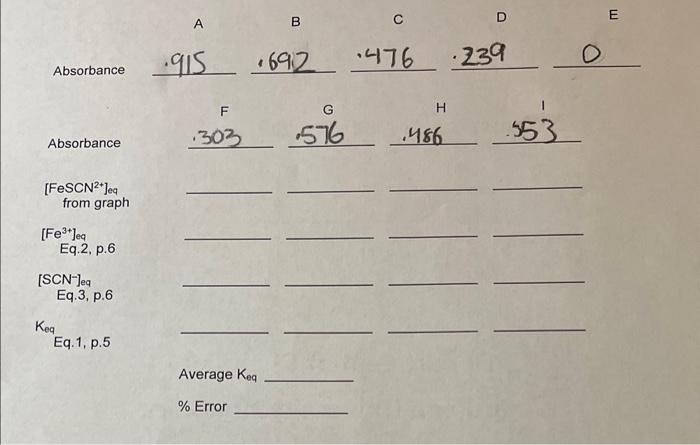
Question: Determining an Equilibrium constant fill in the blanks and explain how the answer is gotten Prepare a graph with Absorbance on the y-axis and [FeSCN?']
![[FeSCN?'] on the x-axis. Turn the graph paper sideways so that the](https://dsd5zvtm8ll6.cloudfront.net/si.experts.images/questions/2024/09/66fa2c220e613_32966fa2c218b6e9.jpg)
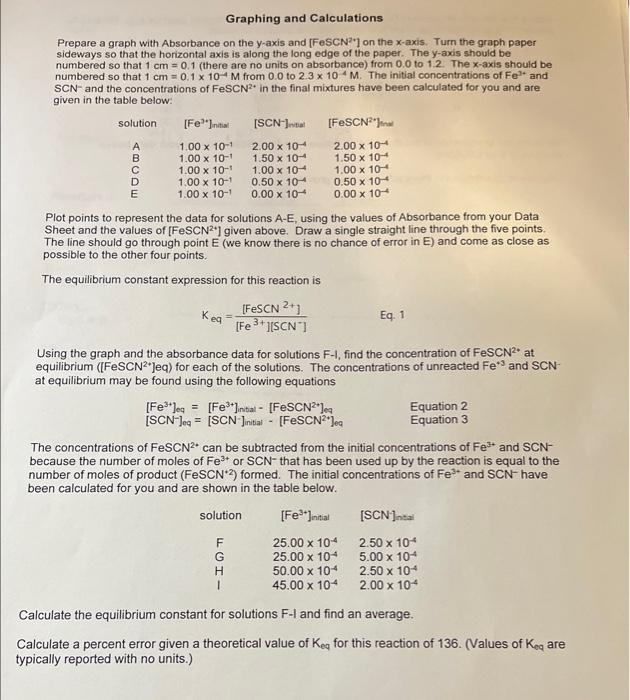
Prepare a graph with Absorbance on the y-axis and [FeSCN?'] on the x-axis. Turn the graph paper sideways so that the horizontal axis is along the long edge of the paper. The y-axis should be numbered so that 1cm=0.1 (there are no units on absorbance) from 0.0 to 1.2. The x-axis should be numbered so that 1cm=0.1104M from 0.0 to 2.3104M. The initial concentrations of Fe3+ and SCNand the concentrations of FeSCN2+ in the final mixtures have been calculated for you and are given in the table below: Plot points to represent the data for solutions A-E, using the values of Absorbance from your Data Sheet and the values of [FeSCN 2+ ] given above. Draw a single straight line through the five points. The line should go through point E (we know there is no chance of error in E ) and come as close as possible to the other four points. The equilibrium constant expression for this reaction is Keq=[Fe3+][SCN][FeSCN2+] Using the graph and the absorbance data for solutions F-1, find the concentration of FeSCN at equilibrium ([FeSCN2+] eq) for each of the solutions. The concentrations of unreacted Fe3 and SCN at equilibrium may be found using the following equations [Fe3+]eq=[Fe3+]intial[FeSCN2+]eq[SCN]eq=[SCN]inital[FeSCN2+]eqEquation2Equation3 The concentrations of FeSCN2 can be subtracted from the initial concentrations of Fe3+ and SCN because the number of moles of Fe3+ or SCNthat has been used up by the reaction is equal to the number of moles of product (FeSCN+2) formed. The initial concentrations of Fe3+ and SCNhave been calculated for you and are shown in the table below. Calculate the equilibrium constant for solutions F-I and find an average. Calculate a percent error given a theoretical value of Keq for this reaction of 136. (Values of Keq are typically reported with no units.) Post-Laboratory Questions Determining an Equilibrium Constant 1. In terms of LeChatlier's principle, explain why solution G has a higher concentration of product than solution F. 2. Briefly describe the process that allowed you to determine the product concentrations in your solutions. 3. Why is it not possible to measure the concentration of the equilibrium solutions by performing a titration? 4. Calculate the initial Fe3 concentration in solution H and show that it is the same as the concentration given in the table on p. 7. You must show all your calculations here. You can find the original volume and concentration and the final volume in the procedure. (This is a simple dilution problem.) 5. At the top of page 6, it says the final [FeSCNF] has been calculated for you and the numbers are shown in the table. How was it possible to calculate the [FeSCN*.] in solutions AE, but not in solutions F-1? Prepare a graph with Absorbance on the y-axis and [FeSCN?'] on the x-axis. Turn the graph paper sideways so that the horizontal axis is along the long edge of the paper. The y-axis should be numbered so that 1cm=0.1 (there are no units on absorbance) from 0.0 to 1.2. The x-axis should be numbered so that 1cm=0.1104M from 0.0 to 2.3104M. The initial concentrations of Fe3+ and SCNand the concentrations of FeSCN2+ in the final mixtures have been calculated for you and are given in the table below: Plot points to represent the data for solutions A-E, using the values of Absorbance from your Data Sheet and the values of [FeSCN 2+ ] given above. Draw a single straight line through the five points. The line should go through point E (we know there is no chance of error in E ) and come as close as possible to the other four points. The equilibrium constant expression for this reaction is Keq=[Fe3+][SCN][FeSCN2+] Using the graph and the absorbance data for solutions F-1, find the concentration of FeSCN at equilibrium ([FeSCN2+] eq) for each of the solutions. The concentrations of unreacted Fe3 and SCN at equilibrium may be found using the following equations [Fe3+]eq=[Fe3+]intial[FeSCN2+]eq[SCN]eq=[SCN]inital[FeSCN2+]eqEquation2Equation3 The concentrations of FeSCN2 can be subtracted from the initial concentrations of Fe3+ and SCN because the number of moles of Fe3+ or SCNthat has been used up by the reaction is equal to the number of moles of product (FeSCN+2) formed. The initial concentrations of Fe3+ and SCNhave been calculated for you and are shown in the table below. Calculate the equilibrium constant for solutions F-I and find an average. Calculate a percent error given a theoretical value of Keq for this reaction of 136. (Values of Keq are typically reported with no units.) Post-Laboratory Questions Determining an Equilibrium Constant 1. In terms of LeChatlier's principle, explain why solution G has a higher concentration of product than solution F. 2. Briefly describe the process that allowed you to determine the product concentrations in your solutions. 3. Why is it not possible to measure the concentration of the equilibrium solutions by performing a titration? 4. Calculate the initial Fe3 concentration in solution H and show that it is the same as the concentration given in the table on p. 7. You must show all your calculations here. You can find the original volume and concentration and the final volume in the procedure. (This is a simple dilution problem.) 5. At the top of page 6, it says the final [FeSCNF] has been calculated for you and the numbers are shown in the table. How was it possible to calculate the [FeSCN*.] in solutions AE, but not in solutions F-1
Step by Step Solution
There are 3 Steps involved in it

Get step-by-step solutions from verified subject matter experts