







Question: Develop a brief snapshot that you could give to a colleague traveling to these countries outlining the key cultural differences and similarities between Australia and
- Develop a brief snapshot that you could give to a colleague traveling to these countries outlining the key cultural differences and similarities between Australia and Japan. In what ways might these differences reduce message clarity in the exchange between the visitors and their hosts?
- Using the AIA model of interpersonal communication from chapter 5, explore the communication behaviors between the Australian visitors and their Japanese hosts. What special role did Takeshi play in these dynamics?
- Based on your assessment of this case, what were the primary clashes in cultures, customs, and expectations between the two groups?
- While hierarchy was clearly evident among the Japanese executives, it was not among the Australians. How do you think the Japanese made sense out of this? Explain.
- What cultural assumptions, if any, did each side make about the other in their approach to communicating? Were these assumptions accurate?
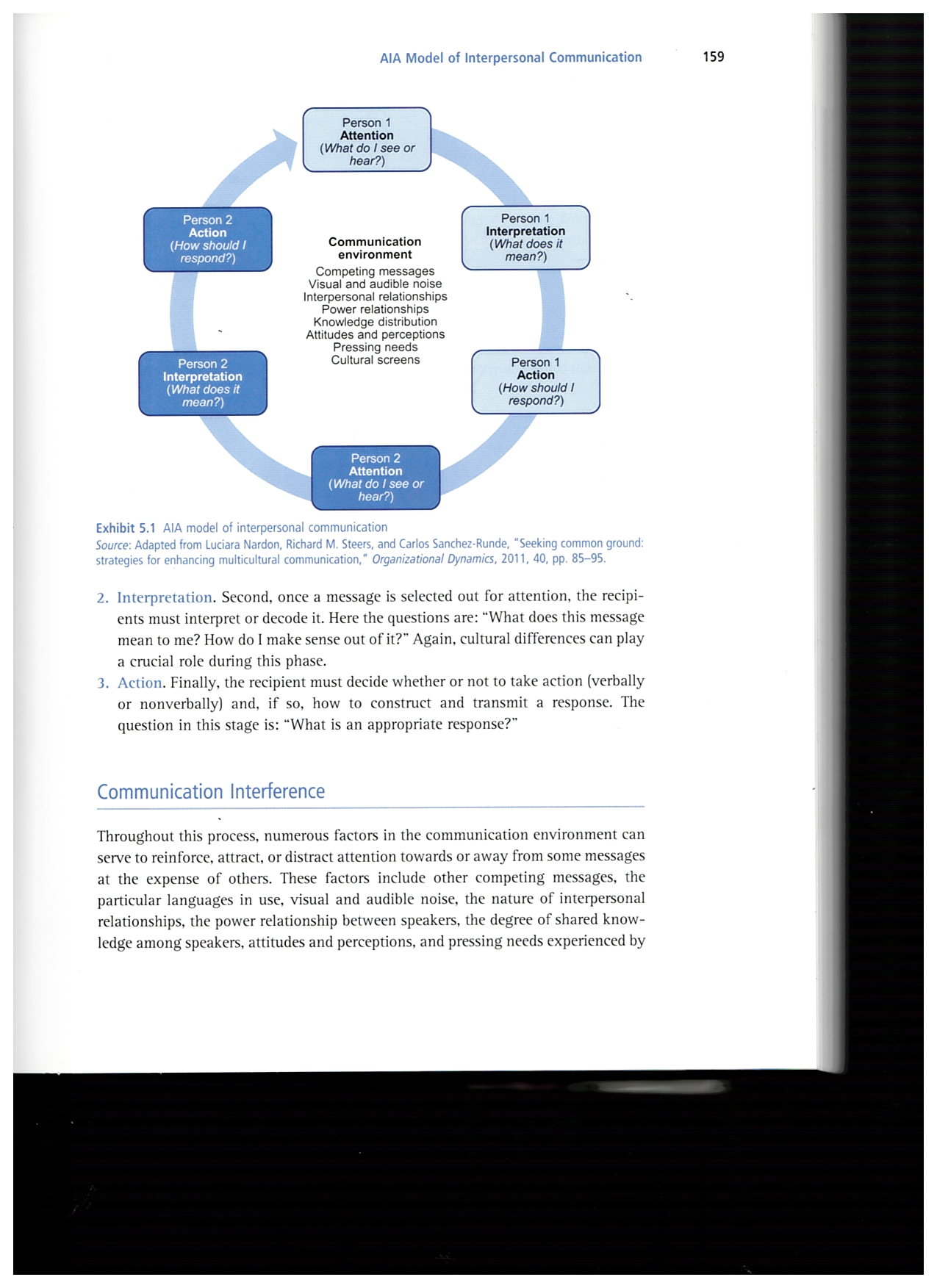
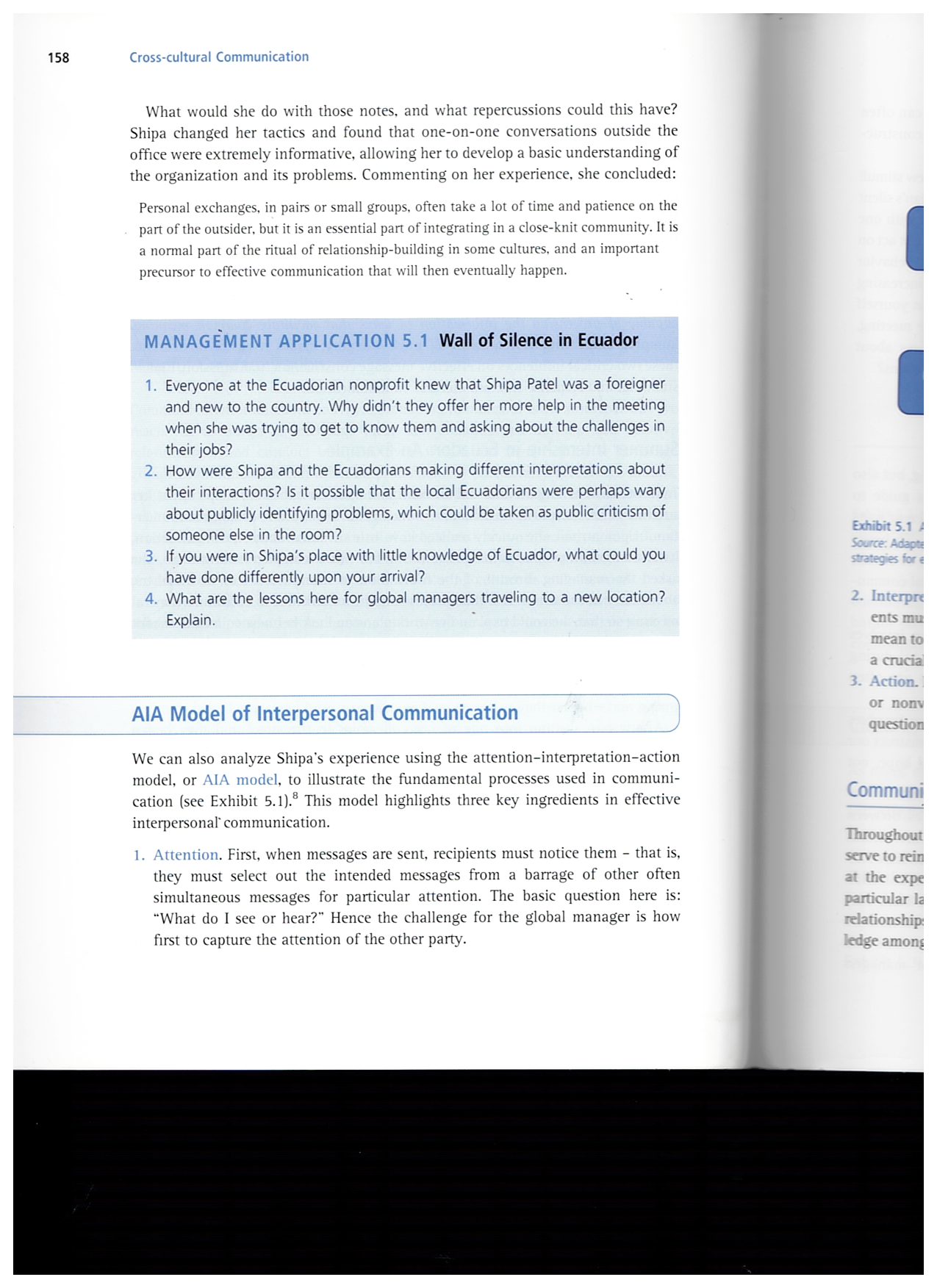
AIA Model of Interpersonal Communication Person 1 Attention (Whetdolseeor -f_;,__. - Person 2 Person 1 Action . ' interpretation (How should i Communication (What does it respond?) environment Competing messages Visual and audible noise __ Interpersonal relationships '_ Power relationships ; Knowledge distribution . Attitudes and perceptions - Pressing needs person 2 Cultural screens Interpretation mean?) (What does it mean?) Person 2 Attention (What do i see or hear?) Exhibit 5.1 AIA model of interpersonal communication Source: Adapted lrom Luciara Nardon, Richard M. Steers, and Carlos Sanchez-Ronda, \"Seeking common ground: strategies lor enhancing multicultural communication," Organizational Dynamics, 2011, 40. pp. 3595. 2. Interpretation. Second, once a message is selected out for attention, the recipi- ents must interpret or decode it. Here the questions are: \"What does this message mean to me? How do I make Sense out of it?" Again, cultural differences can play a crucial role during this phase. 3. Action. Finally. the recipient must decide whether or not to take action (verbally or nonverbally] and, if so, how to construct and transmit a response. The question in this stage is: \"What is an appropriate response?" Communication Interference Throughout this process, numerous factors in the communication environment can serve to reinforce. attract, or distract attention towards or away from some messages at the expense of others. These factors include other competing messages, the particular languages in use, visual and audible noise, the nature of interpersonal relationships. the power relationship between speakers, the degree of shared know- ledge among speakers, attitudes and perceptions. and pressing needs experienced by 159 1S8 Cross-cultural Communication What would she do with those notes. and what repercussions could this have? Shipa changed her tactics and found that one-onone conversations outside the ofce were extremely informative, allowing her to develop a basic understanding of the organization and its problems. Commenting on her experience. she concluded: Personal exchanges. in pairs or small groups. often take a lot oftime and patience on the part of the outsider. but it is an essential part of integrating in a close-knit community. It is a normal part of the ritual of relationship-building in some cultures. and an important precursor to effective communication that will then eventually happen. MANAGEMENT APPLICATION 5.1 Wall of Silence. in Ecuador 1. Everyone at the Ecuadorian nonprofit knew that Shipa Patel was a foreigner and new to the country. Why didn't they offer her more help in the meeting when she was trying to get to know them and asking about the challenges in their jobs? 2. How were Shipa and the Ecuadorians making different interpretations about their interactions? Is it possible that the local Ecuadorians were perhaps wary about publicly identifying problems, which could be taken as public criticism of someone else in the room? 3. If you were in Shipa's place with little knowledge of Ecuador. what could you have done differently upon your arrivai? 4. What are the lessons here for global managers traveling to a new location? Expiain. ' AIA Model of Interpersonal Communication We can also analyze Shipa's experience using the attentioninterpretationAaction model, or AIA model. to illustrate the fundamental processes used in communi cation {see Exhibit 5.1}.8 This model highlights three key ingredients in effective interpersonal communication. I. Attention. First. when messages are sent. recipients musr notice them - that is. they must select out the intended messages from a barrage of other often simultaneous messages for particular attention. The basic question here is: \"What do 1 see or hear?\" Hence the challenge for the global manager is how rst to capture the attention of the other party
Step by Step Solution
There are 3 Steps involved in it

Get step-by-step solutions from verified subject matter experts
 Study Help