







Question: Develop a Forrester diagram, based on the schematic below, for blood pressure homeostasis. You should consider at least four state variables. Keep in mind that
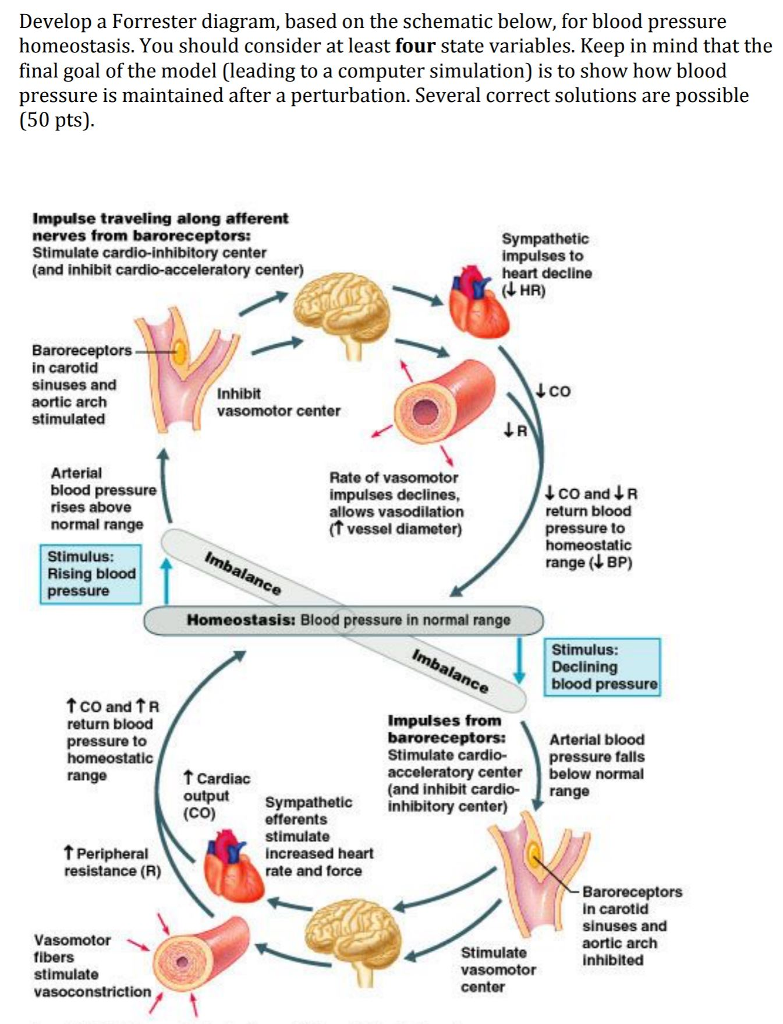
Develop a Forrester diagram, based on the schematic below, for blood pressure homeostasis. You should consider at least four state variables. Keep in mind that the final goal of the model (leading to a computer simulation) is to show how blood pressure is maintained after a perturbation. Several correct solutions are possible (50 pts) Impulse traveling along afferent nerves from baroreceptors: Stimulate cardio-inhibitory center (and inhibit cardio-acceleratory center) Sympathetic impulses to heart decline ( HR) Baroreceptors in carotid sinuses and aortic arch stimulated 4 co Inhibit vasomotor center Arterial blood pressure rises above normal range Rate of vasomotor impulses declines, allows vasodilation (f vessel diameter) co and R return blood pressure to homeostatic range ( BP) Stimulus: Rising blood pressure Imbalance Homeostasis: Blood pressure in normal range Stimulus Declining blood pressure Imbalance co and TR return blood pressure to homeostatic range Impulses from baroreceptors: Stimulate cardio- acceleratory center (and inhibit cardio- Arterial blood pressure falls below normal range T Cardiac output Sympathetic nhibitory center) (co) t Peripheral resistance (R) efferents stimulate increased heart rate and force Baroreceptors in carotid sinuses and aortic arch inhibited Vasomotor fibers stimulate vasoconstriction Stimulate vasomotor center Develop a Forrester diagram, based on the schematic below, for blood pressure homeostasis. You should consider at least four state variables. Keep in mind that the final goal of the model (leading to a computer simulation) is to show how blood pressure is maintained after a perturbation. Several correct solutions are possible (50 pts) Impulse traveling along afferent nerves from baroreceptors: Stimulate cardio-inhibitory center (and inhibit cardio-acceleratory center) Sympathetic impulses to heart decline ( HR) Baroreceptors in carotid sinuses and aortic arch stimulated 4 co Inhibit vasomotor center Arterial blood pressure rises above normal range Rate of vasomotor impulses declines, allows vasodilation (f vessel diameter) co and R return blood pressure to homeostatic range ( BP) Stimulus: Rising blood pressure Imbalance Homeostasis: Blood pressure in normal range Stimulus Declining blood pressure Imbalance co and TR return blood pressure to homeostatic range Impulses from baroreceptors: Stimulate cardio- acceleratory center (and inhibit cardio- Arterial blood pressure falls below normal range T Cardiac output Sympathetic nhibitory center) (co) t Peripheral resistance (R) efferents stimulate increased heart rate and force Baroreceptors in carotid sinuses and aortic arch inhibited Vasomotor fibers stimulate vasoconstriction Stimulate vasomotor center
Step by Step Solution
There are 3 Steps involved in it

Get step-by-step solutions from verified subject matter experts
 Study Help