







Question: develop a scaling system to determine if each time unit is accurately represented in terms of the length that has been allocated for it. ERA
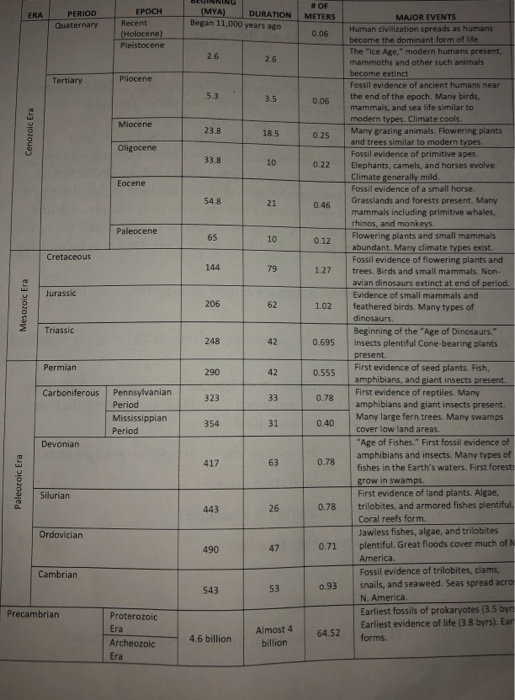
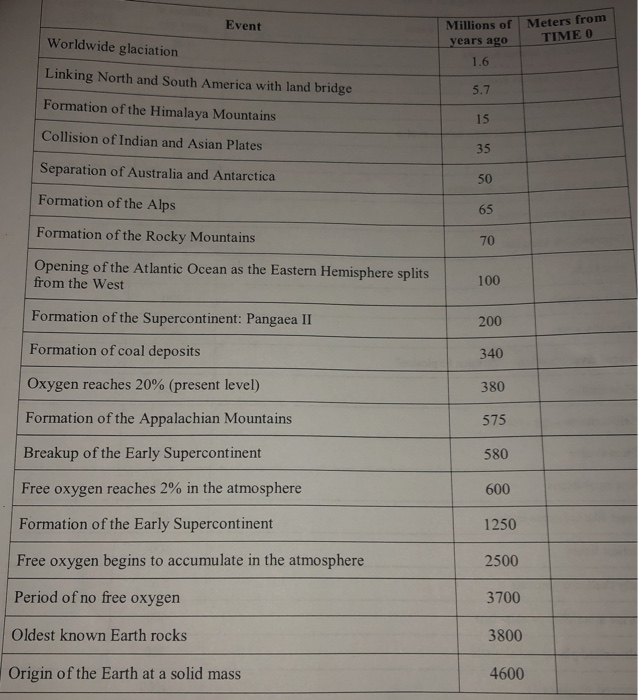
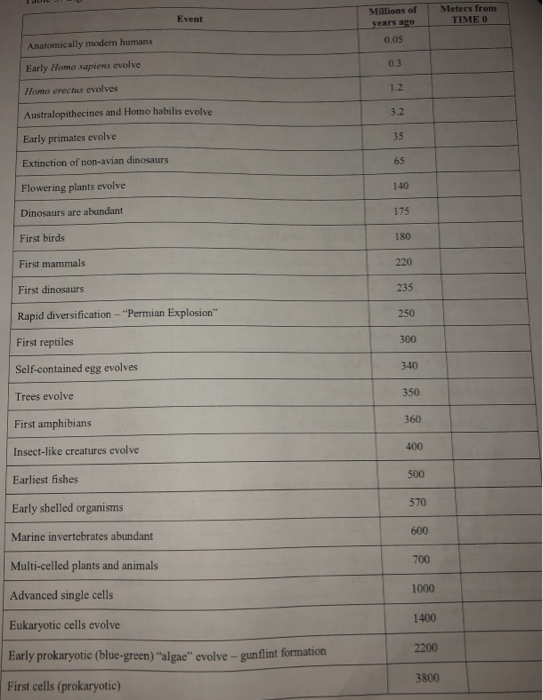
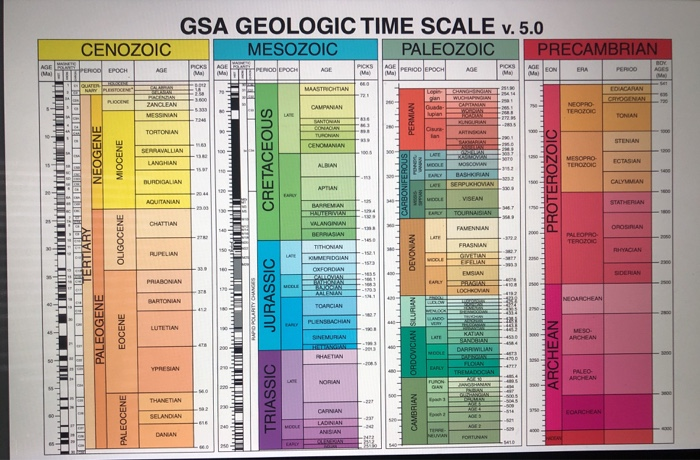
ERA PERIOD Quaternary # OF METERS EPOCH Recent (Holocene) Pleistocene NING (MYA) DURATION Began 11,000 years ago 0.06 2.6 2.6 Tertiary Pliocene 5.3 3.5 0.06 Miocene Cenozoic Era 23.8 18.5 0.25 Oligocene 33.8 10 0.22 Eocene 548 21 0.46 Paleocene 65 10 0.12 Cretaceous 144 79 1.27 Jurassic Mesozoic Era 206 62 1.02 Triassic MAJOR EVENTS Human civilization spreads as humans become the dominant form of life The "Ice Age, modern humans present, mammoths and other such animals become extinct Fossil evidence of ancient humans near the end of the epoch. Many birds, mammals, and sea life similar to modern types. Climate cools. Many grazing animals. Flowering plants and trees similar to modern types Fossil evidence of primitive apes. Elephants, camels, and horses evolve Climate generally mild Fossil evidence of a small horse. Grasslands and forests present. Many mammals including primitive whales, rhinos, and monkeys Flowering plants and small mammals abundant. Many climate types exist. Fossil evidence of flowering plants and trees. Birds and small mammals. Non- avian dinosaurs extinct at end of period Evidence of small mammals and feathered birds. Many types of dinosaurs. Beginning of the Age of Dinosaurs." Insects plentiful Cone-bearing plants present First evidence of seed plants. Fish, amphibians, and giant insects present First evidence of reptiles. Many amphibians and giant insects present Many large fern trees. Many swamps cover low land areas. "Age of Fishes. First fossil evidence of amphibians and insects. Many types of fishes in the Earth's waters. First forest grow in swamps. First evidence of land plants. Algae, trilobites, and armored fishes plentiful, Coral reefs form Jawless fishes, algae, and trilobites plentiful. Great floods cover much of America Fossil evidence of trilobites, clams, snails, and seaweed. Seas spread acro N. America Earliest fossils of prokaryotes (3.5 byr Earliest evidence of life 3.8 byrs). Ear forms 248 42 0.595 Permian 290 42 0.555 Carboniferous 323 33 0.78 Pennsylvanian Period Mississippian Period 354 31 0.40 Devonian 417 63 0.78 Paleozoic Era Silurian 443 26 0.78 Ordovician 490 47 0.71 Cambrian 543 53 0.93 Precambrian Proterozoic Era Archeozoic Era 4.6 billion Almost 4 billion 64.52 Event Millions of years ago 1.6 Meters from TIME O Worldwide glaciation Linking North and South America with land bridge 5.7 Formation of the Himalaya Mountains 15 Collision of Indian and Asian Plates 35 Separation of Australia and Antarctica 50 Formation of the Alps 65 Formation of the Rocky Mountains 70 Opening of the Atlantic Ocean as the Eastern Hemisphere splits from the West 100 Formation of the Supercontinent: Pangaea II 200 Formation of coal deposits 340 Oxygen reaches 20% (present level) 380 Formation of the Appalachian Mountains 575 Breakup of the Early Supercontinent 580 Free oxygen reaches 2% in the atmosphere 600 Formation of the Early Supercontinent 1250 Free oxygen begins to accumulate in the atmosphere 2500 Period of no free oxygen 3700 Oldest known Earth rocks 3800 Origin of the Earth at a solid mass 4600 Meters from TIMEO Event Millions of years ago 0.05 Anatomically modern humans 03 Early Homo sapiens evolve 1.2 Homo erectus evolves Australopithecines and Homo habilis evolve 3.2 35 Early primates evolve Extinction of non-avian dinosaurs 65 140 Flowering plants evolve Dinosaurs are abundant 175 First birds 180 First mammals 220 First dinosaurs 235 Rapid diversification - "Permian Explosion" 250 300 First reptiles Self-contained egg evolves 340 350 Trees evolve 360 First amphibians 400 Insect-like creatures evolve 500 Earliest fishes 570 Early shelled organisms 600 Marine invertebrates abundant 700 Multi-celled plants and animals 1000 Advanced single cells Eukaryotic cells evolve 1400 2200 Early prokaryotic (blue-green)"algae" evolve - gunflint formation 3800 First cells (prokaryotic) GSA GEOLOGIC TIME SCALE v.5.0 CENOZOIC MESOZOIC PALEOZOIC PRECAMBRIAN AGE M POS PERO EPOCH ALE PACKS Mai AGE IMA PERO POCH AGE PROKS Me AGE PERIODEPOCH AGE AGE CON Mai ERA PEROO OUTER NANY PLOCENT MAASTRICHTIAN Les 14 DACARAN CRYOGENAN RENE ZANCLEAN MESSINIAN CAMPANIAN Guade uplan NEOPRO TEROZOIC TONIAN WANTO PERMIAN TORTONIAN ARTISAN - TURCHIN CENOMANIAN STENIAN NEOGENE MIOCENE SERRAVALLIAN LANGAN CRETACEOUS TO ALLAN MESOPRO TEROID ECTASAN ST MOSCOVAN BASILAN SERPUCOVIAN BURDIGALIAN CALYAN APTIAN PROTEROZO VISEAN AQUITANIAN STATHERIAN BARREMAN TAN WALANGINAN TOURNAISIAN CHATTIAN FAMENNIAN OROSLAN BERRIASIAN LATE PALEOPO TEROZOIC OLIGOCENE TUITHONIAN FRASNIAN TERTIARY RUYADAN 1111111 RUPELIAN KIMMERIDGIAN OXFORDAN DEVONIAN USB FIFFLUAN EMESIAN PRIBONIAN EARLY CELE VOIR TALENIAN LOCKOVIAN BARTONIAN JURASSIC 183 327 29 . NEOARCHEN TOANCIAN WOTROLIY MANGES LANDO PALEOGENE PLENSBACHIAN EOCENE LUTETAN SINEMURAN ORDOVICIAN SILURIAN MESO ARCHEAN KATAN 44 DARRIWILIAN PHAETIAN ARCHEAN YPRESIAN TREMADOCIAN PALEO ARDEAN TRAN THANETIAN TRIASSIC 11 CARNAN SELANDUAN PALEOCENE FOARCIA CAMBRIAN DANAN LADNAN ANSAN EL ERA PERIOD Quaternary # OF METERS EPOCH Recent (Holocene) Pleistocene NING (MYA) DURATION Began 11,000 years ago 0.06 2.6 2.6 Tertiary Pliocene 5.3 3.5 0.06 Miocene Cenozoic Era 23.8 18.5 0.25 Oligocene 33.8 10 0.22 Eocene 548 21 0.46 Paleocene 65 10 0.12 Cretaceous 144 79 1.27 Jurassic Mesozoic Era 206 62 1.02 Triassic MAJOR EVENTS Human civilization spreads as humans become the dominant form of life The "Ice Age, modern humans present, mammoths and other such animals become extinct Fossil evidence of ancient humans near the end of the epoch. Many birds, mammals, and sea life similar to modern types. Climate cools. Many grazing animals. Flowering plants and trees similar to modern types Fossil evidence of primitive apes. Elephants, camels, and horses evolve Climate generally mild Fossil evidence of a small horse. Grasslands and forests present. Many mammals including primitive whales, rhinos, and monkeys Flowering plants and small mammals abundant. Many climate types exist. Fossil evidence of flowering plants and trees. Birds and small mammals. Non- avian dinosaurs extinct at end of period Evidence of small mammals and feathered birds. Many types of dinosaurs. Beginning of the Age of Dinosaurs." Insects plentiful Cone-bearing plants present First evidence of seed plants. Fish, amphibians, and giant insects present First evidence of reptiles. Many amphibians and giant insects present Many large fern trees. Many swamps cover low land areas. "Age of Fishes. First fossil evidence of amphibians and insects. Many types of fishes in the Earth's waters. First forest grow in swamps. First evidence of land plants. Algae, trilobites, and armored fishes plentiful, Coral reefs form Jawless fishes, algae, and trilobites plentiful. Great floods cover much of America Fossil evidence of trilobites, clams, snails, and seaweed. Seas spread acro N. America Earliest fossils of prokaryotes (3.5 byr Earliest evidence of life 3.8 byrs). Ear forms 248 42 0.595 Permian 290 42 0.555 Carboniferous 323 33 0.78 Pennsylvanian Period Mississippian Period 354 31 0.40 Devonian 417 63 0.78 Paleozoic Era Silurian 443 26 0.78 Ordovician 490 47 0.71 Cambrian 543 53 0.93 Precambrian Proterozoic Era Archeozoic Era 4.6 billion Almost 4 billion 64.52 Event Millions of years ago 1.6 Meters from TIME O Worldwide glaciation Linking North and South America with land bridge 5.7 Formation of the Himalaya Mountains 15 Collision of Indian and Asian Plates 35 Separation of Australia and Antarctica 50 Formation of the Alps 65 Formation of the Rocky Mountains 70 Opening of the Atlantic Ocean as the Eastern Hemisphere splits from the West 100 Formation of the Supercontinent: Pangaea II 200 Formation of coal deposits 340 Oxygen reaches 20% (present level) 380 Formation of the Appalachian Mountains 575 Breakup of the Early Supercontinent 580 Free oxygen reaches 2% in the atmosphere 600 Formation of the Early Supercontinent 1250 Free oxygen begins to accumulate in the atmosphere 2500 Period of no free oxygen 3700 Oldest known Earth rocks 3800 Origin of the Earth at a solid mass 4600 Meters from TIMEO Event Millions of years ago 0.05 Anatomically modern humans 03 Early Homo sapiens evolve 1.2 Homo erectus evolves Australopithecines and Homo habilis evolve 3.2 35 Early primates evolve Extinction of non-avian dinosaurs 65 140 Flowering plants evolve Dinosaurs are abundant 175 First birds 180 First mammals 220 First dinosaurs 235 Rapid diversification - "Permian Explosion" 250 300 First reptiles Self-contained egg evolves 340 350 Trees evolve 360 First amphibians 400 Insect-like creatures evolve 500 Earliest fishes 570 Early shelled organisms 600 Marine invertebrates abundant 700 Multi-celled plants and animals 1000 Advanced single cells Eukaryotic cells evolve 1400 2200 Early prokaryotic (blue-green)"algae" evolve - gunflint formation 3800 First cells (prokaryotic) GSA GEOLOGIC TIME SCALE v.5.0 CENOZOIC MESOZOIC PALEOZOIC PRECAMBRIAN AGE M POS PERO EPOCH ALE PACKS Mai AGE IMA PERO POCH AGE PROKS Me AGE PERIODEPOCH AGE AGE CON Mai ERA PEROO OUTER NANY PLOCENT MAASTRICHTIAN Les 14 DACARAN CRYOGENAN RENE ZANCLEAN MESSINIAN CAMPANIAN Guade uplan NEOPRO TEROZOIC TONIAN WANTO PERMIAN TORTONIAN ARTISAN - TURCHIN CENOMANIAN STENIAN NEOGENE MIOCENE SERRAVALLIAN LANGAN CRETACEOUS TO ALLAN MESOPRO TEROID ECTASAN ST MOSCOVAN BASILAN SERPUCOVIAN BURDIGALIAN CALYAN APTIAN PROTEROZO VISEAN AQUITANIAN STATHERIAN BARREMAN TAN WALANGINAN TOURNAISIAN CHATTIAN FAMENNIAN OROSLAN BERRIASIAN LATE PALEOPO TEROZOIC OLIGOCENE TUITHONIAN FRASNIAN TERTIARY RUYADAN 1111111 RUPELIAN KIMMERIDGIAN OXFORDAN DEVONIAN USB FIFFLUAN EMESIAN PRIBONIAN EARLY CELE VOIR TALENIAN LOCKOVIAN BARTONIAN JURASSIC 183 327 29 . NEOARCHEN TOANCIAN WOTROLIY MANGES LANDO PALEOGENE PLENSBACHIAN EOCENE LUTETAN SINEMURAN ORDOVICIAN SILURIAN MESO ARCHEAN KATAN 44 DARRIWILIAN PHAETIAN ARCHEAN YPRESIAN TREMADOCIAN PALEO ARDEAN TRAN THANETIAN TRIASSIC 11 CARNAN SELANDUAN PALEOCENE FOARCIA CAMBRIAN DANAN LADNAN ANSAN EL
Step by Step Solution
There are 3 Steps involved in it

Get step-by-step solutions from verified subject matter experts
 Study Help