







Question: Develop a simio model base on these informations. Thanks. A machine shop processes two job types. The shop has two identical machines. A job is
Develop a simio model base on these informations. Thanks.
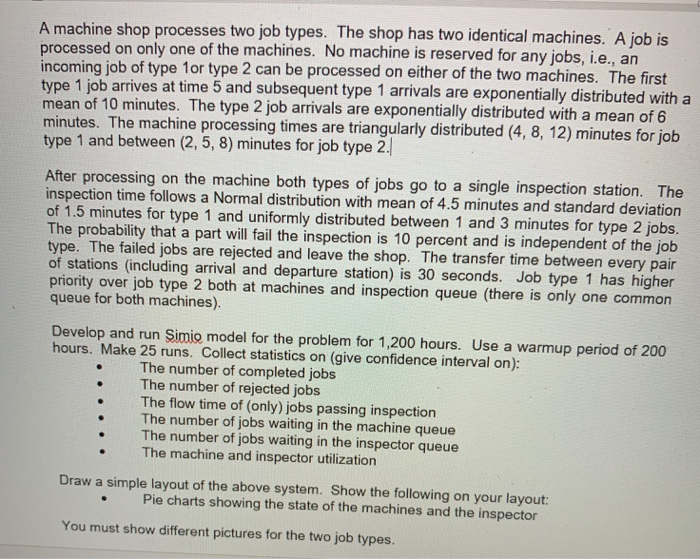
A machine shop processes two job types. The shop has two identical machines. A job is processed on only one of the machines. No machine is reserved for any jobs, i.e., an incoming job of type 1or type 2 can be processed on either of the two machines. The first type 1 job arrives at time 5 and subsequent type 1 arrivals are exponentially distributed with a mean of 10 minutes. The type 2 job arrivals are exponentially distributed with a mean of 6 minutes. The machine processing times are triangularly distributed (4, 8, 12) minutes for job type 1 and between (2, 5, 8) minutes for job type 2. After processing on the machine both types of jobs go to a single inspection station. The inspection time follows a Normal distribution with mean of 4.5 minutes and standard deviation of 1.5 minutes for type 1 and uniformly distributed between 1 and 3 minutes for type 2 jobs. The probability that a part will fail the inspection is 10 percent and is independent of the job type. The failed jobs are rejected and leave the shop. The transfer time between every pair of stations (including arrival and departure station) is 30 seconds. Job type 1 has higher priority over job type 2 both at machines and inspection queue (there is only one common queue for both machines). Develop and run Simio model for the problem for 1,200 hours. Use a warmup period of 200 hours. Make 25 runs. Collect statistics on (give confidence interval on): The number of completed jobs The number of rejected jobs The flow time of (only) jobs passing inspection The number of jobs waiting in the machine queue The number of jobs waiting in the inspector queue The machine and inspector utilization Draw a simple layout of the above system. Show the following on your layout: Pie charts showing the state of the machines and the inspector You must show different pictures for the two job types. A machine shop processes two job types. The shop has two identical machines. A job is processed on only one of the machines. No machine is reserved for any jobs, i.e., an incoming job of type 1or type 2 can be processed on either of the two machines. The first type 1 job arrives at time 5 and subsequent type 1 arrivals are exponentially distributed with a mean of 10 minutes. The type 2 job arrivals are exponentially distributed with a mean of 6 minutes. The machine processing times are triangularly distributed (4, 8, 12) minutes for job type 1 and between (2, 5, 8) minutes for job type 2. After processing on the machine both types of jobs go to a single inspection station. The inspection time follows a Normal distribution with mean of 4.5 minutes and standard deviation of 1.5 minutes for type 1 and uniformly distributed between 1 and 3 minutes for type 2 jobs. The probability that a part will fail the inspection is 10 percent and is independent of the job type. The failed jobs are rejected and leave the shop. The transfer time between every pair of stations (including arrival and departure station) is 30 seconds. Job type 1 has higher priority over job type 2 both at machines and inspection queue (there is only one common queue for both machines). Develop and run Simio model for the problem for 1,200 hours. Use a warmup period of 200 hours. Make 25 runs. Collect statistics on (give confidence interval on): The number of completed jobs The number of rejected jobs The flow time of (only) jobs passing inspection The number of jobs waiting in the machine queue The number of jobs waiting in the inspector queue The machine and inspector utilization Draw a simple layout of the above system. Show the following on your layout: Pie charts showing the state of the machines and the inspector You must show different pictures for the two job types Step by Step Solution
There are 3 Steps involved in it
1 Expert Approved Answer
Step: 1 Unlock

Question Has Been Solved by an Expert!
Get step-by-step solutions from verified subject matter experts
Step: 2 Unlock
Step: 3 Unlock
 Study Help