







Question: develop an aggregate plan for a single and separate facilities. also quantify any cost-related and employee-related advantages offered by the single factory Case Study Kloss
develop an aggregate plan for a single and separate facilities. also quantify any cost-related and employee-related advantages offered by the single factory 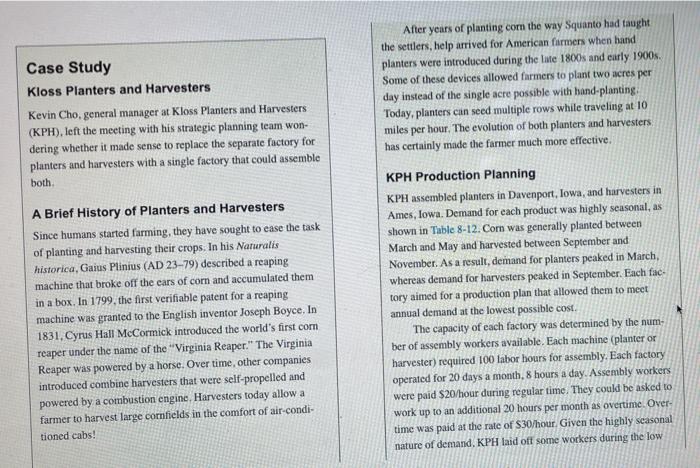
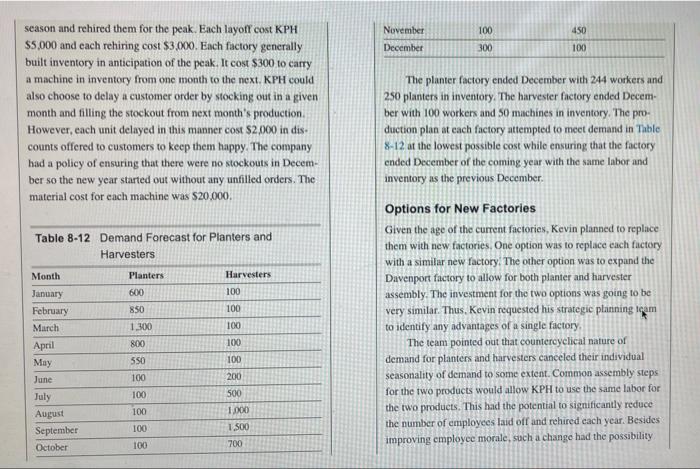
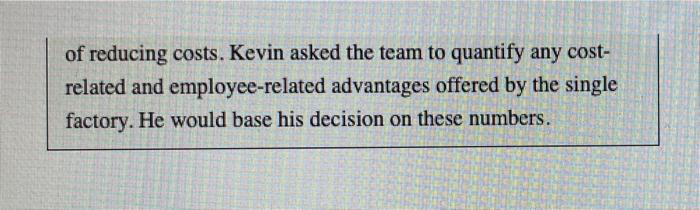
Case Study Kloss Planters and Harvesters Kevin Cho, general manager at Kloss Planters and Harvesters (KPH), left the meeting with his strategic planning team won- dering whether it made sense to replace the separate factory for planters and harvesters with a single factory that could assemble both After years of planting com the way Squanto had taught the settlers, help arrived for American farmers when hand planters were introduced during the late 1800s and early 1900s. Some of these devices allowed farmers to plant two acres per day instead of the single acre possible with hand-planting Today, planters can seed multiple rows while traveling at 10 miles per hour. The evolution of both planters and harvesters has certainly made the farmer much more effective. a a A Brief History of Planters and Harvesters Since humans started farming, they have sought to ease the task of planting and harvesting their crops. In his Naturalis historica, Gaius Plinius (AD 23-79) described a reaping machine that broke off the cars of com and accumulated them in a box. In 1799, the first verifiable patent for a reaping machine was granted to the English inventor Joseph Boyce, In 1831. Cyrus Hall McCormick introduced the world's first com Teaper under the name of the "Virginia Reaper." The Virginia Reaper was powered by a horse. Over time, other companies introduced combine harvesters that were self-propelled and powered by a combustion engine. Harvesters today allow a farmer to harvest large cornfields in the comfort of air-condi- tioned cabs! KPH Production Planning KPH assembled planters in Davenport, Iowa, and harvesters in Ames, Iowa. Demand for each product was highly seasonal, as shown in Table 8-12. Corn was generally planted between March and May and harvested between September and November. As a result, demand for planters peaked in March, whereas demand for harvesters peaked in September. Each fac- tory aimed for a production plan that allowed them to meet annual demand at the lowest possible cost The capacity of each factory was determined by the num- ber of assembly workers available. Each machine (planter or harvester) required 100 labor hours for assembly. Each factory operated for 20 days a month, 8 hours a day. Assembly workers were paid $20/hour during regular time. They could be asked to work up an additional 20 hours per month as overtime. Over- time was paid at the rate of S30/hour. Given the highly seasonal nature of demand, KPH laid off some workers during the low November 450 100 300 December 100 season and rehired them for the peak. Each layoff cost KPH $5,000 and each rehiring cost $3,000. Each factory generally built inventory in anticipation of the peak. It cost $300 to carry a machine in inventory from one month to the next. KPH could also choose to delay a customer order by stocking out in a given month and filling the stockout from next month's production However, each unit delayed in this manner cost $2.000 in dis- counts offered to customers to keep them happy. The company had a policy of ensuring that there were no stockouts in Decem- ber so the new year started out without any unfilled orders. The material cost for each machine was $20.000 The planter factory ended December with 244 workers and 250 planters in inventory. The harvester factory ended Decem ber with 100 workers and 50 machines in inventory. The pro- duction plan at each factory attempted to meet demand in Table 8-12 at the lowest possible cost while ensuring that the factory ended December of the coming year with the same labor and inventory as the previous December Table 8-12 Demand Forecast for Planters and Harvesters Planters Harvesters 600 100 Month January February March 850 100 100 Options for New Factories Given the age of the current factories, Kevin planned to replace them with new factories. One option was to replace cach factory with a similar new factory. The other option was to expand the Davenport factory to allow for both planter and harvester assembly. The investment for the two options was going to be very similar. Thus, Kevin requested his strategic planning team to identify any advantages of a single factory The team pointed out that countercyclical nature of demand for planters and harvesters canceled their individual seasonality of demand to some extent. Common assembly steps for the two products would allow KPH to use the same labor for the two products. This had the potential to significantly reduce the number of employees laid off and rehired each year. Besides improving employee morale, such a change had the possibility 1.300 800 550 April 100 100 100 100 May June July August September October 200 500 1.000 1.500 100 100 100 700 of reducing costs. Kevin asked the team to quantify any cost- related and employee-related advantages offered by the single factory. He would base his decision on these numbers
Step by Step Solution
There are 3 Steps involved in it
1 Expert Approved Answer
Step: 1 Unlock

Question Has Been Solved by an Expert!
Get step-by-step solutions from verified subject matter experts
Step: 2 Unlock
Step: 3 Unlock
 Study Help