Question: Develop an E-R Diagram. 1. Develop an E-R Diagram for the following situation. Be sure to tag each attribute with its optionality. Our regional Oracle
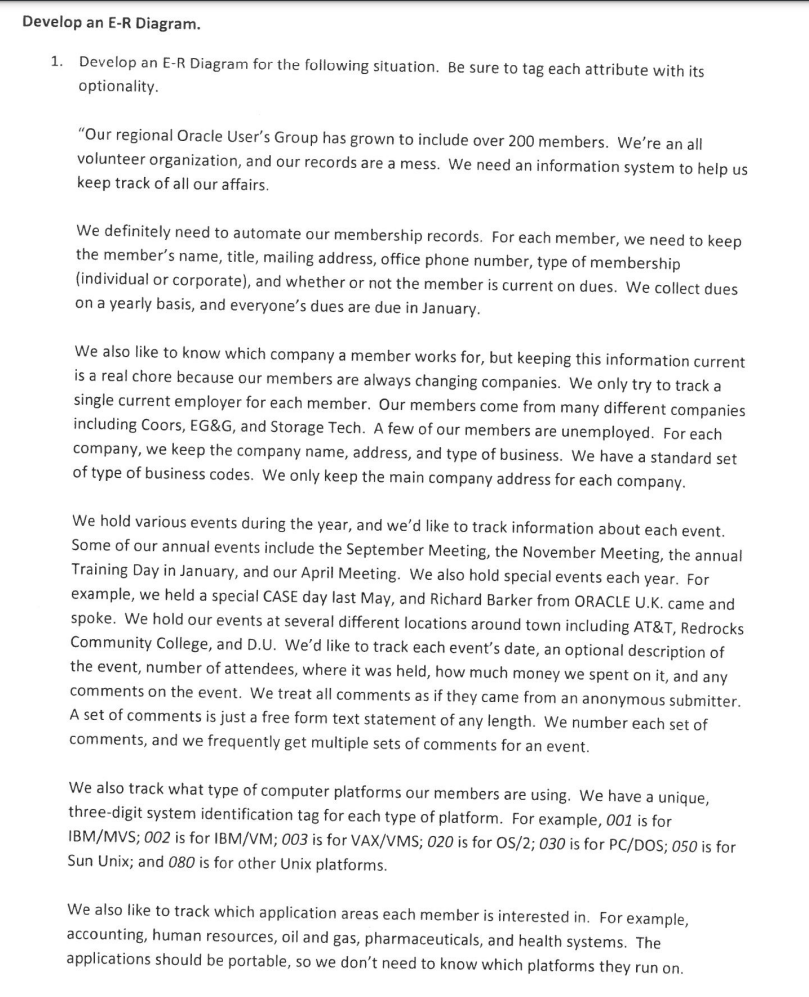
Develop an E-R Diagram. 1. Develop an E-R Diagram for the following situation. Be sure to tag each attribute with its optionality. "Our regional Oracle User's Group has grown to include over 200 members. We're an all volunteer organization, and our records are a mess. We need an information system to help us keep track of all our affairs. We definitely need to automate our membership records. For each member, we need to keep the member's name, title, mailing address, office phone number, type of membership (individual or corporate), and whether or not the member is current on dues. We collect dues on a yearly basis, and everyone's dues are due in January. We also like to know which company a member works for, but keeping this information current is a real chore because our members are always changing companies. We only try to track a single current employer for each member. Our members come from many different companies including Coors, EG&G, and Storage Tech. A few of our members are unemployed. For each company, we keep the company name, address, and type of business. We have a standard set of type of business codes. We only keep the main company address for each company. We hold various events during the year, and we'd like to track information about each event. Some of our annual events include the September Meeting, the November Meeting, the annual Training Day in January, and our April Meeting. We also hold special events each year. For example, we held a special CASE day last May, and Richard Barker from ORACLE U.K. came and spoke. We hold our events at several different locations around town including AT&T, Redrocks Community College, and D.U. We'd like to track each event's date, an optional description of the event, number of attendees, where it was held, how much money we spent on it, and any comments on the event. We treat all comments as if they came from an anonymous submitter. A set of comments is just a free form text statement of any length. We number each set of comments, and we frequently get multiple sets of comments for an event. We also track what type of computer platforms our members are using. We have a unique, three-digit system identification tag for each type of platform. For example, 001 is for IBM/MVS; 002 is for IBM/VM; 003 is for VAX/VMS; 020 is for OS/2; 030 is for PC/DOS; 050 is for Sun Unix; and 080 is for other Unix platforms. We also like to track which application areas each member is interested in. For example, accounting, human resources, oil and gas, pharmaceuticals, and health systems. The applications should be portable, so we don't need to know which platforms they run on









 Study Help