







Question: Develop your own Team Agreement as shared in an example for the following: 1. Review the Team's Mission and Context 2. Discuss the Desired Climate
Develop your own Team Agreement as shared in an example for the following: 1. Review the Team's Mission and Context 2. Discuss the Desired Climate 3. Brainstorm Suggestion and Ideas for Creating the Desired Climate 4. Combine Similar Suggestions 5. Prioritize Suggestions 6. Behaviorize" the Remaining Items 7.Record and Distribute the Resulting List for Review 8. Review and Finalize Agreements
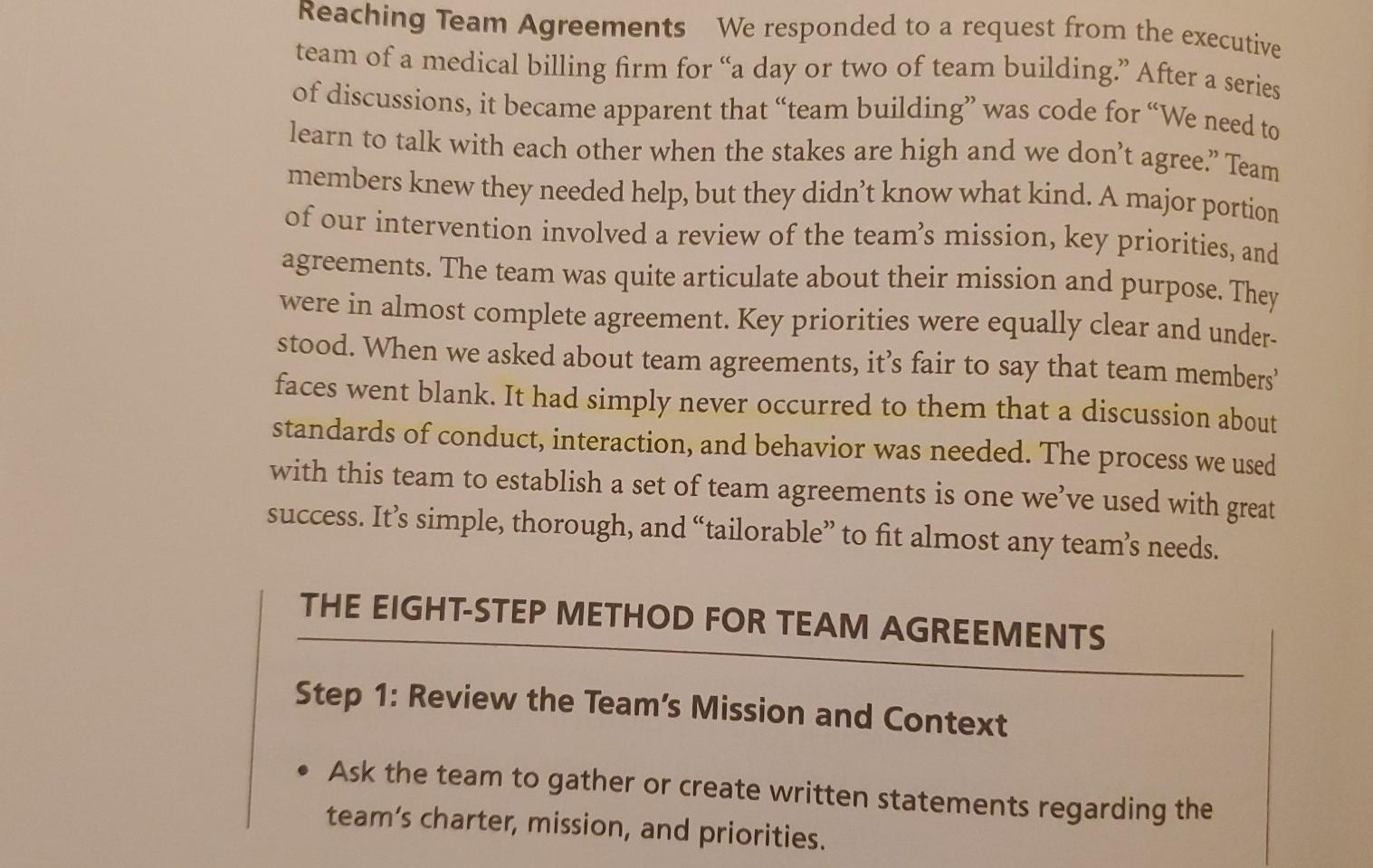
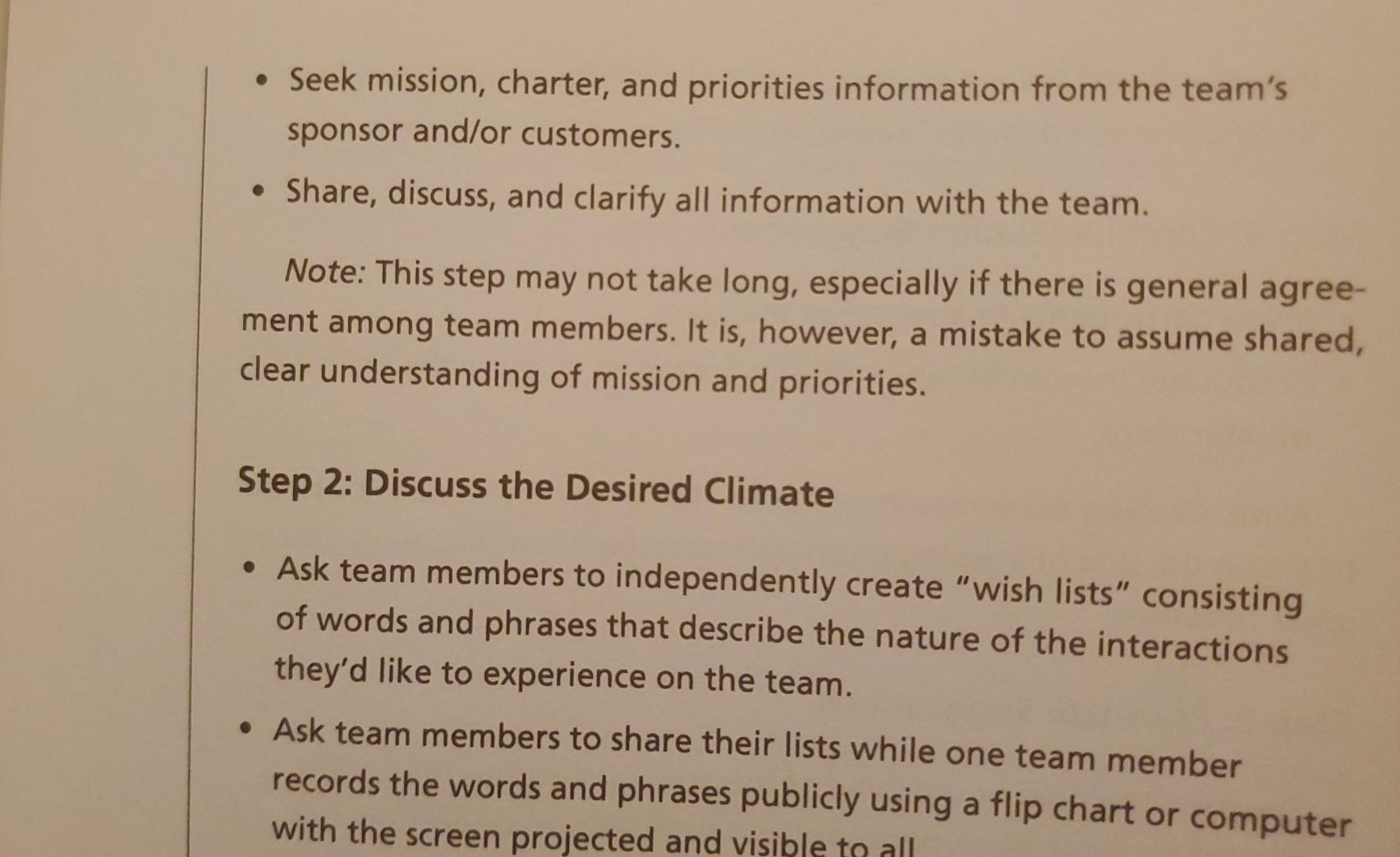
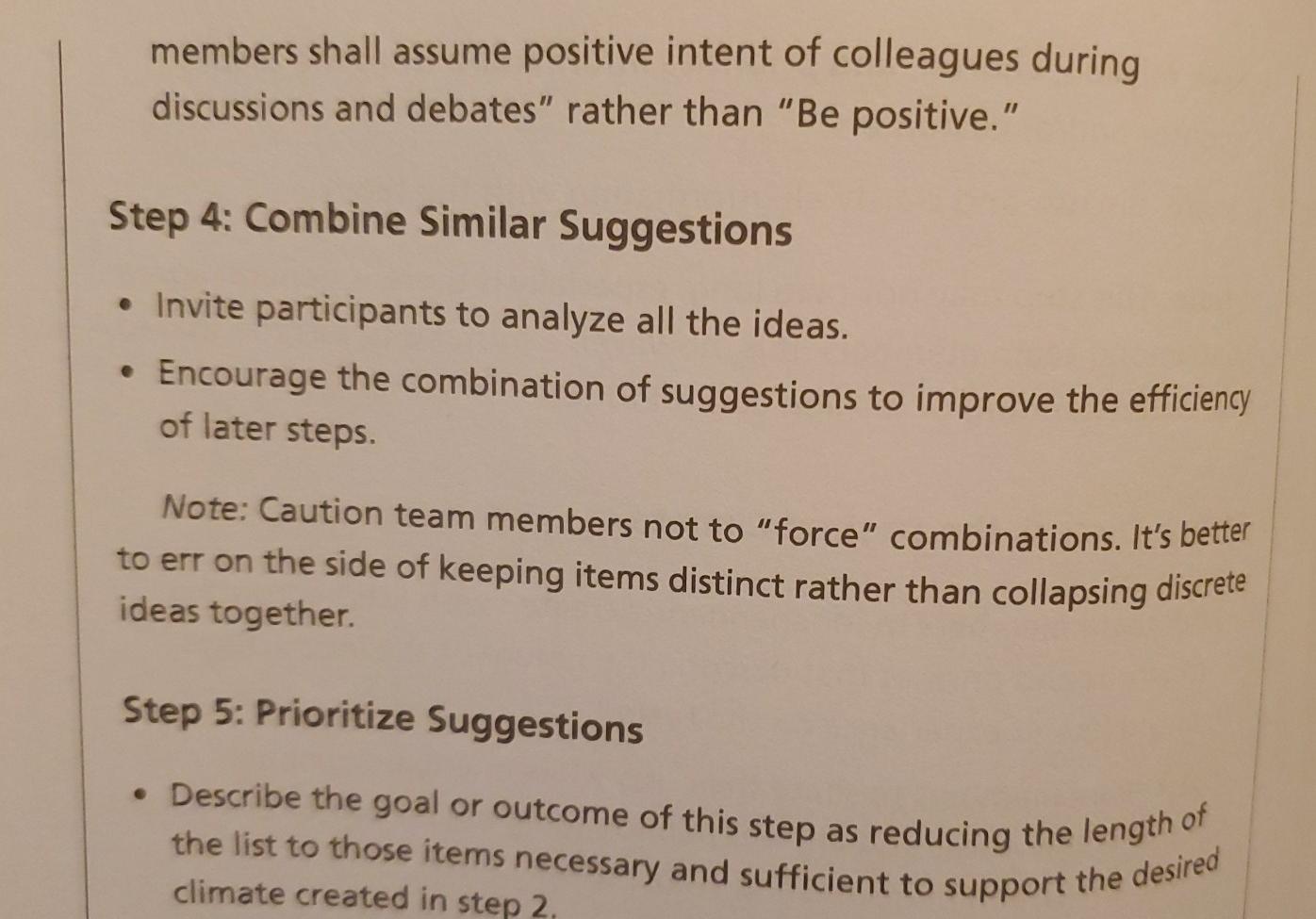
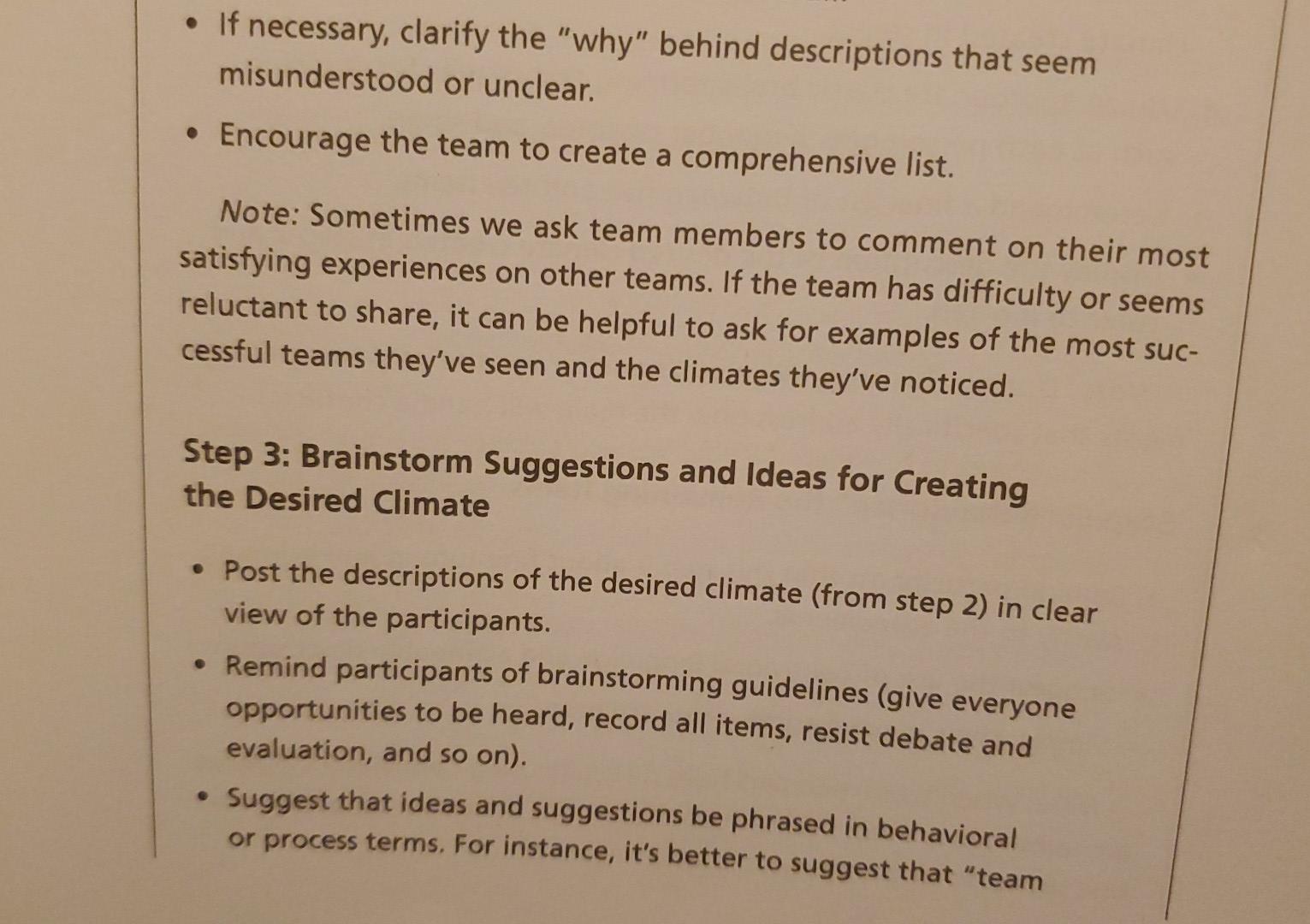
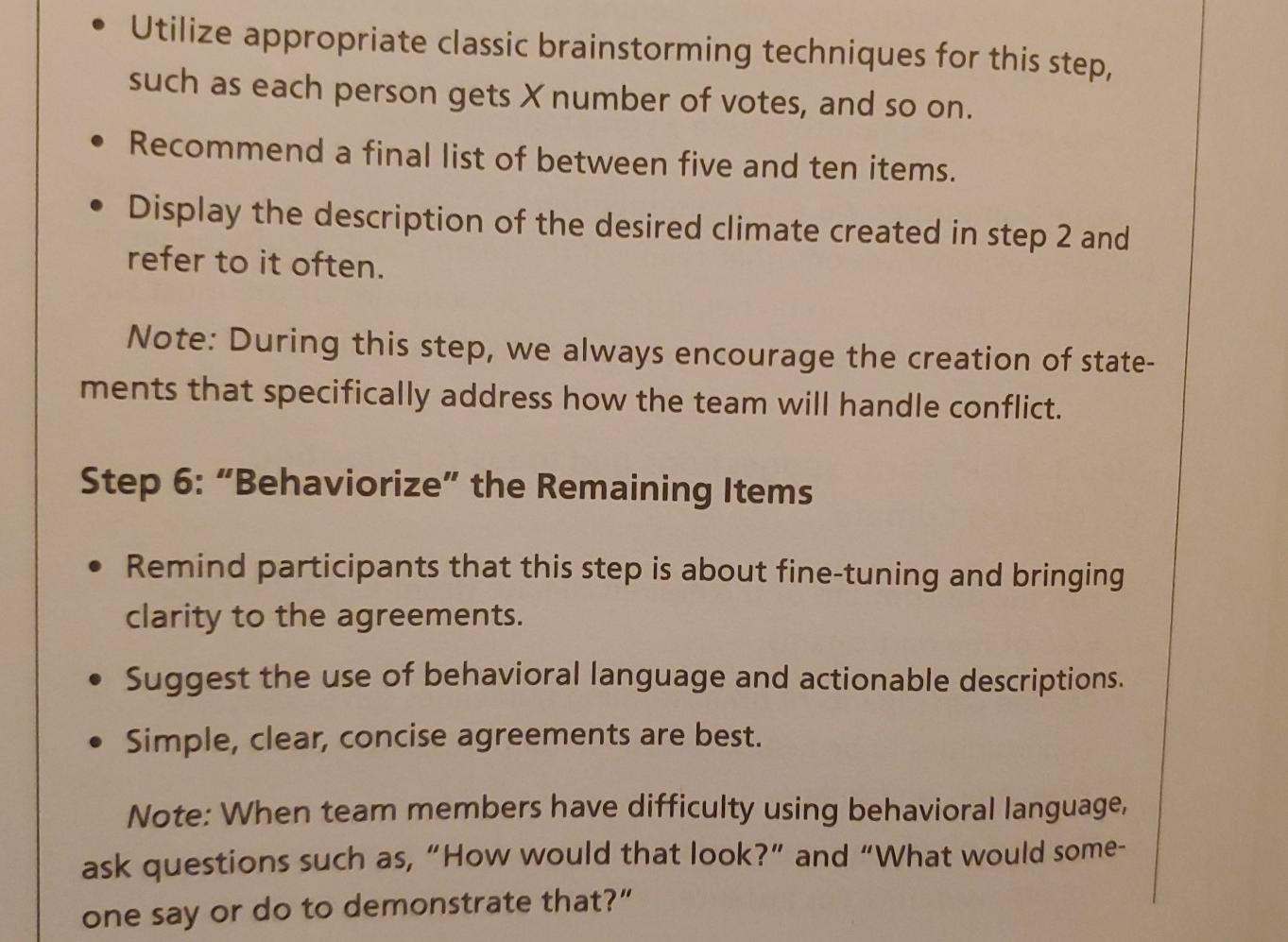
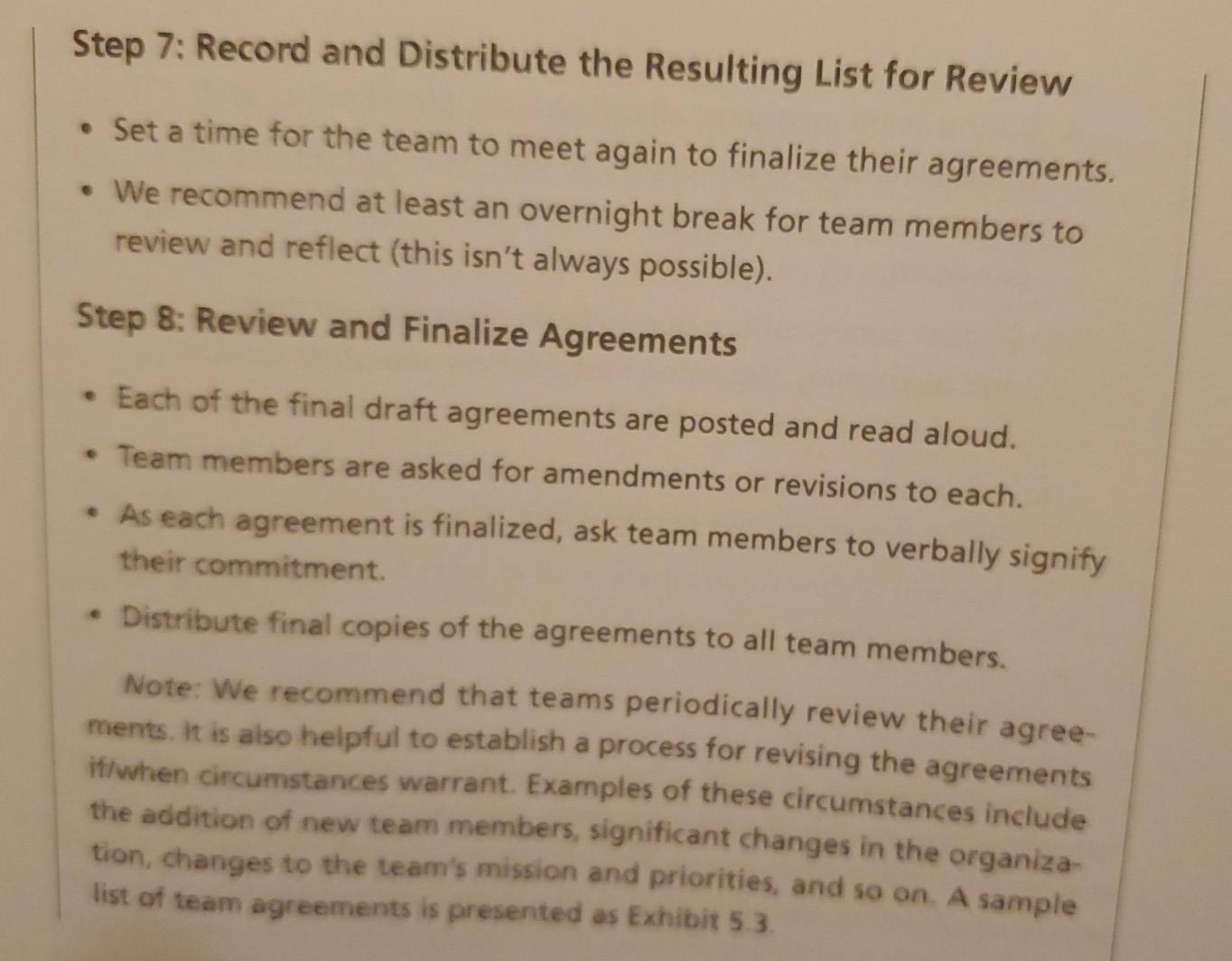
Reaching Team Agreements We responded to a request from the executive team of a medical billing firm for "a day or two of team building. After a series of discussions, it became apparent that team building was code for "We need to learn to talk with each other when the stakes are high and we don't agree. Team members knew they needed help, but they didn't know what kind. A major portion of our intervention involved a review of the team's mission, key priorities, and agreements. The team was quite articulate about their mission and purpose. They were in almost complete agreement. Key priorities were equally clear and under- stood. When we asked about team agreements, it's fair to say that team members' faces went blank. It had simply never occurred to them that a discussion about standards of conduct, interaction, and behavior was needed. The process we used with this team to establish a set of team agreements is one we've used with great success. It's simple, thorough, and tailorable to fit almost any team's needs. THE EIGHT-STEP METHOD FOR TEAM AGREEMENTS Step 1: Review the Team's Mission and Context Ask the team to gather or create written statements regarding the team's charter, mission, and priorities. Seek mission, charter, and priorities information from the team's sponsor and/or customers. Share, discuss, and clarify all information with the team. Note: This step may not take long, especially if there is general agree- ment among team members. It is, however, a mistake to assume shared, clear understanding of mission and priorities. Step 2: Discuss the Desired Climate Ask team members to independently create "wish lists" consisting of words and phrases that describe the nature of the interactions they'd like to experience on the team. Ask team members to share their lists while one team member records the words and phrases publicly using a flip chart or computer with the screen projected and visible to all members shall assume positive intent of colleagues during discussions and debates" rather than "Be positive." Step 4: Combine Similar Suggestions Invite participants to analyze all the ideas. Encourage the combination of suggestions to improve the efficiency of later steps. Note: Caution team members not to "force" combinations. It's better to err on the side of keeping items distinct rather than collapsing discrete ideas together. Step 5: Prioritize Suggestions Describe the goal or outcome of this step as reducing the length of the list to those items necessary and sufficient to support the desired climate created in step 2. If necessary, clarify the "why" behind descriptions that seem misunderstood or unclear. Encourage the team to create a comprehensive list. Note: Sometimes we ask team members to comment on their most satisfying experiences on other teams. If the team has difficulty or seems reluctant to share, it can be helpful to ask for examples of the most suc- cessful teams they've seen and the climates they've noticed. Step 3: Brainstorm Suggestions and Ideas for Creating the Desired Climate Post the descriptions of the desired climate (from step 2) in clear view of the participants. Remind participants of brainstorming guidelines (give everyone opportunities to be heard, record all items, resist debate and evaluation, and so on). Suggest that ideas and suggestions be phrased in behavioral or process terms. For instance, it's better to suggest that "team Utilize appropriate classic brainstorming techniques for this step, such as each person gets X number of votes, and so on. Recommend a final list of between five and ten items. Display the description of the desired climate created in step 2 and refer to it often. Note: During this step, we always encourage the creation of state- ments that specifically address how the team will handle conflict. Step 6: "Behaviorize" the Remaining Items Remind participants that this step is about fine-tuning and bringing clarity to the agreements. Suggest the use of behavioral language and actionable descriptions Simple, clear, concise agreements are best. Note: When team members have difficulty using behavioral language, ask questions such as, "How would that look?" and "What would some- one say or do to demonstrate that?" Step 7: Record and Distribute the resulting List for Review Set a time for the team to meet again to finalize their agreements. We recommend at least an overnight break for team members to review and reflect (this isn't always possible). Step 8: Review and Finalize Agreements Each of the final draft agreements are posted and read aloud. Team members are asked for amendments or revisions to each. As each agreement is finalized, ask team members to verbally signify their commitment. Distribute final copies of the agreements to all team members. Note: We recommend that teams periodically review their agree- ments. It is also helpful to establish a process for revising the agreements it/when circumstances warrant. Examples of these circumstances include the addition of new team members, significant changes in the organiza- tion, changes to the team's mission and priorities, and so on. A sample list of team agreements is presented as Exhibit 5.3. Reaching Team Agreements We responded to a request from the executive team of a medical billing firm for "a day or two of team building. After a series of discussions, it became apparent that team building was code for "We need to learn to talk with each other when the stakes are high and we don't agree. Team members knew they needed help, but they didn't know what kind. A major portion of our intervention involved a review of the team's mission, key priorities, and agreements. The team was quite articulate about their mission and purpose. They were in almost complete agreement. Key priorities were equally clear and under- stood. When we asked about team agreements, it's fair to say that team members' faces went blank. It had simply never occurred to them that a discussion about standards of conduct, interaction, and behavior was needed. The process we used with this team to establish a set of team agreements is one we've used with great success. It's simple, thorough, and tailorable to fit almost any team's needs. THE EIGHT-STEP METHOD FOR TEAM AGREEMENTS Step 1: Review the Team's Mission and Context Ask the team to gather or create written statements regarding the team's charter, mission, and priorities. Seek mission, charter, and priorities information from the team's sponsor and/or customers. Share, discuss, and clarify all information with the team. Note: This step may not take long, especially if there is general agree- ment among team members. It is, however, a mistake to assume shared, clear understanding of mission and priorities. Step 2: Discuss the Desired Climate Ask team members to independently create "wish lists" consisting of words and phrases that describe the nature of the interactions they'd like to experience on the team. Ask team members to share their lists while one team member records the words and phrases publicly using a flip chart or computer with the screen projected and visible to all members shall assume positive intent of colleagues during discussions and debates" rather than "Be positive." Step 4: Combine Similar Suggestions Invite participants to analyze all the ideas. Encourage the combination of suggestions to improve the efficiency of later steps. Note: Caution team members not to "force" combinations. It's better to err on the side of keeping items distinct rather than collapsing discrete ideas together. Step 5: Prioritize Suggestions Describe the goal or outcome of this step as reducing the length of the list to those items necessary and sufficient to support the desired climate created in step 2. If necessary, clarify the "why" behind descriptions that seem misunderstood or unclear. Encourage the team to create a comprehensive list. Note: Sometimes we ask team members to comment on their most satisfying experiences on other teams. If the team has difficulty or seems reluctant to share, it can be helpful to ask for examples of the most suc- cessful teams they've seen and the climates they've noticed. Step 3: Brainstorm Suggestions and Ideas for Creating the Desired Climate Post the descriptions of the desired climate (from step 2) in clear view of the participants. Remind participants of brainstorming guidelines (give everyone opportunities to be heard, record all items, resist debate and evaluation, and so on). Suggest that ideas and suggestions be phrased in behavioral or process terms. For instance, it's better to suggest that "team Utilize appropriate classic brainstorming techniques for this step, such as each person gets X number of votes, and so on. Recommend a final list of between five and ten items. Display the description of the desired climate created in step 2 and refer to it often. Note: During this step, we always encourage the creation of state- ments that specifically address how the team will handle conflict. Step 6: "Behaviorize" the Remaining Items Remind participants that this step is about fine-tuning and bringing clarity to the agreements. Suggest the use of behavioral language and actionable descriptions Simple, clear, concise agreements are best. Note: When team members have difficulty using behavioral language, ask questions such as, "How would that look?" and "What would some- one say or do to demonstrate that?" Step 7: Record and Distribute the resulting List for Review Set a time for the team to meet again to finalize their agreements. We recommend at least an overnight break for team members to review and reflect (this isn't always possible). Step 8: Review and Finalize Agreements Each of the final draft agreements are posted and read aloud. Team members are asked for amendments or revisions to each. As each agreement is finalized, ask team members to verbally signify their commitment. Distribute final copies of the agreements to all team members. Note: We recommend that teams periodically review their agree- ments. It is also helpful to establish a process for revising the agreements it/when circumstances warrant. Examples of these circumstances include the addition of new team members, significant changes in the organiza- tion, changes to the team's mission and priorities, and so on. A sample list of team agreements is presented as Exhibit 5.3
Step by Step Solution
There are 3 Steps involved in it
1 Expert Approved Answer
Step: 1 Unlock

Question Has Been Solved by an Expert!
Get step-by-step solutions from verified subject matter experts
Step: 2 Unlock
Step: 3 Unlock
 Study Help