



Question: Did Sleep Driving Nullify the Voluntary Act Requirement? Case In State v. Newman (2013), James Robert Newman was convicted in the Circuit Court, Multnomah County,
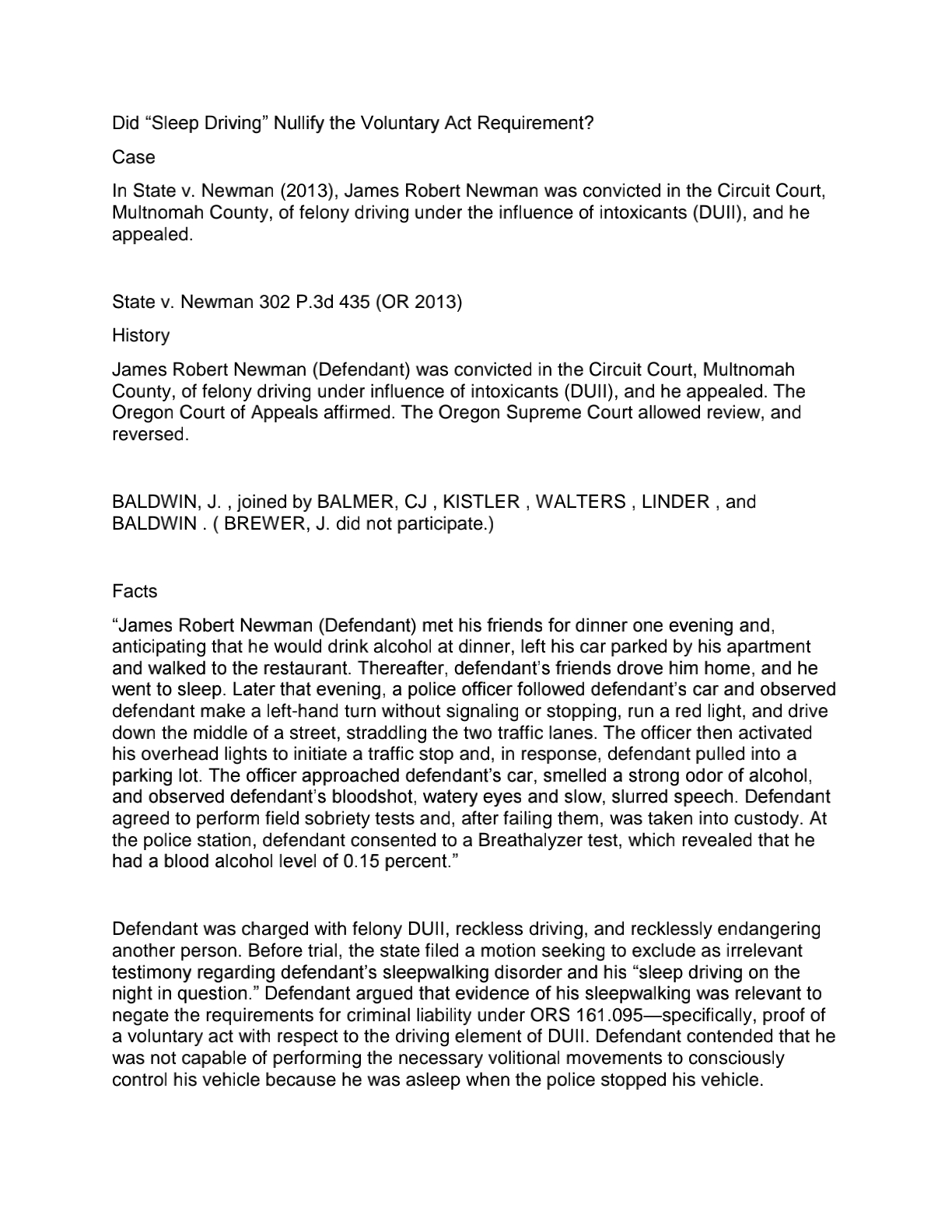
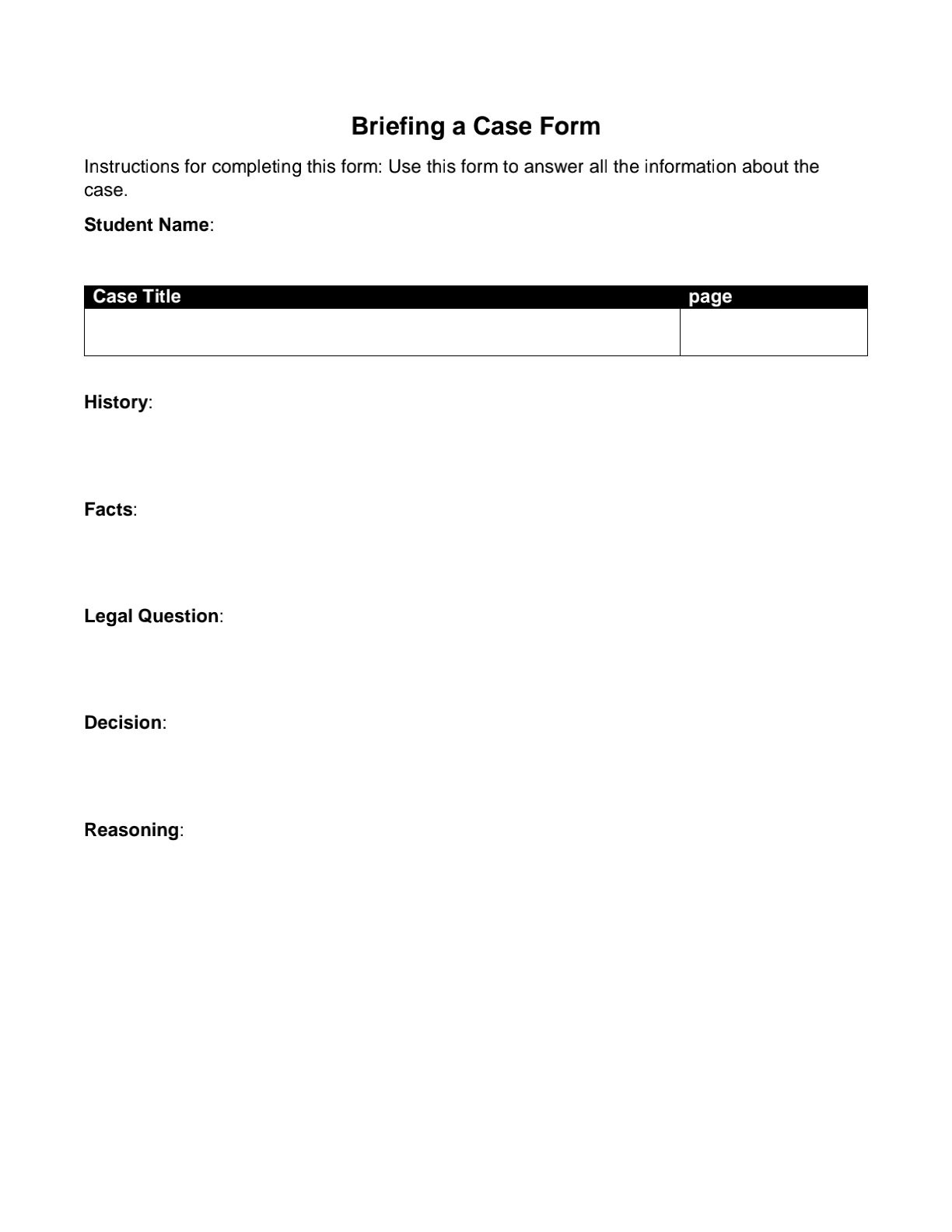
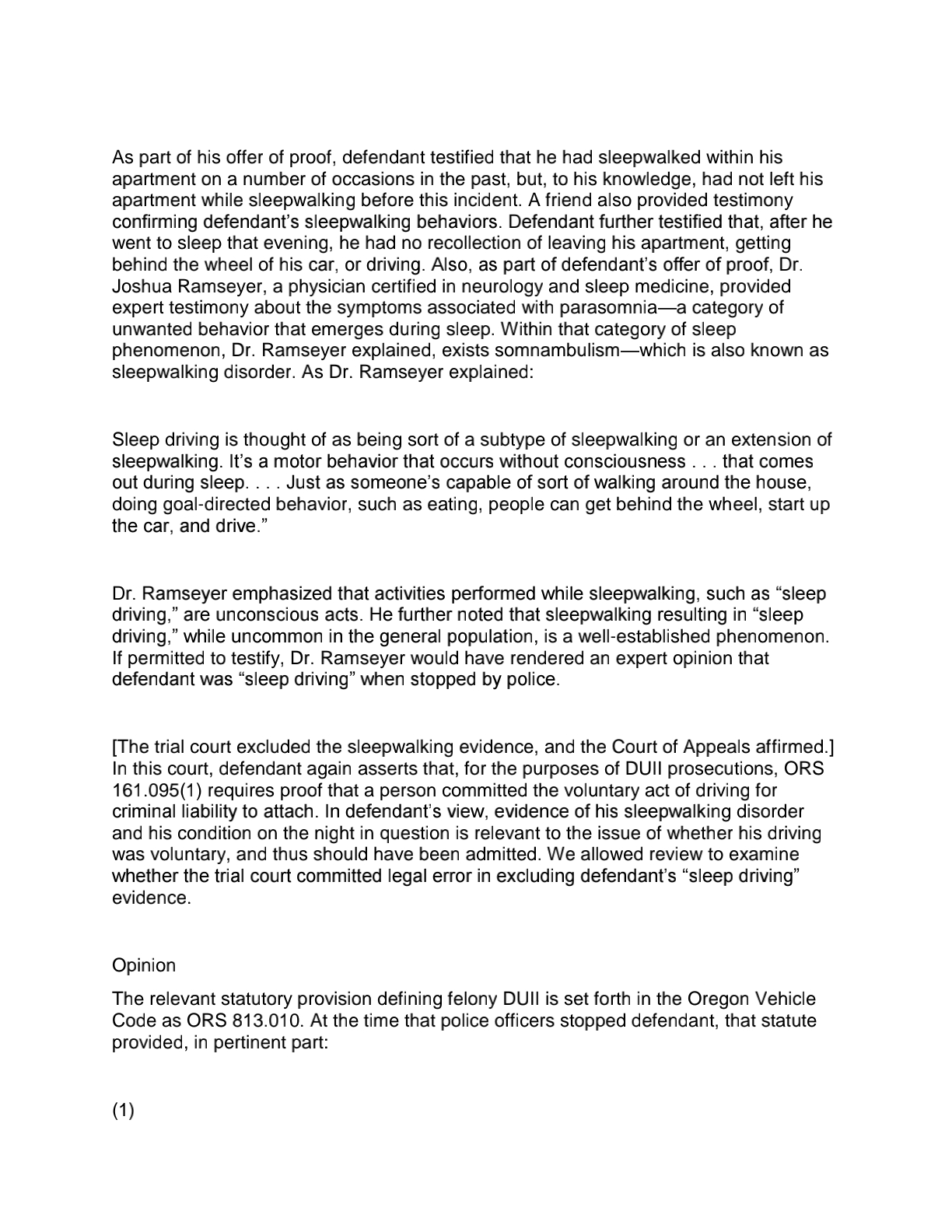
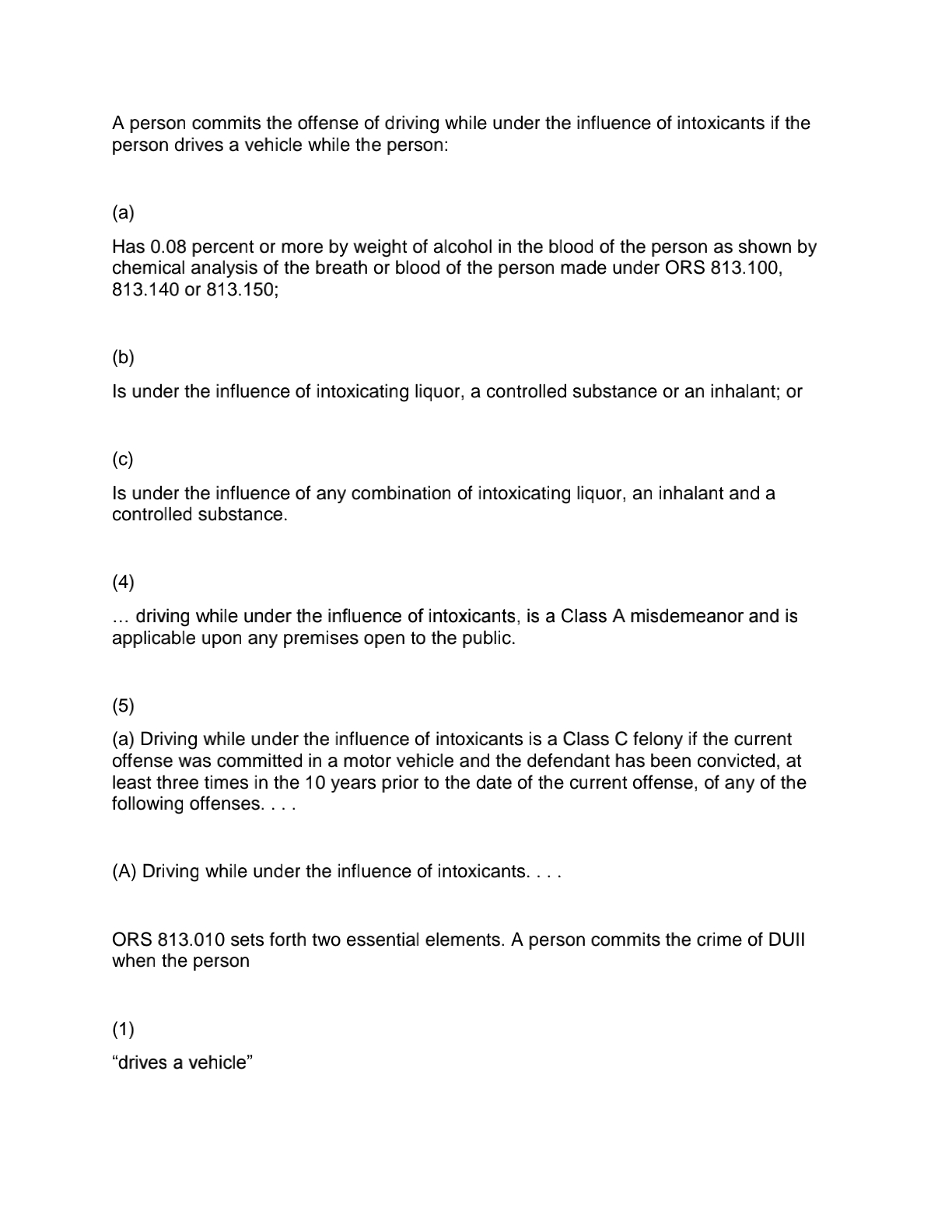
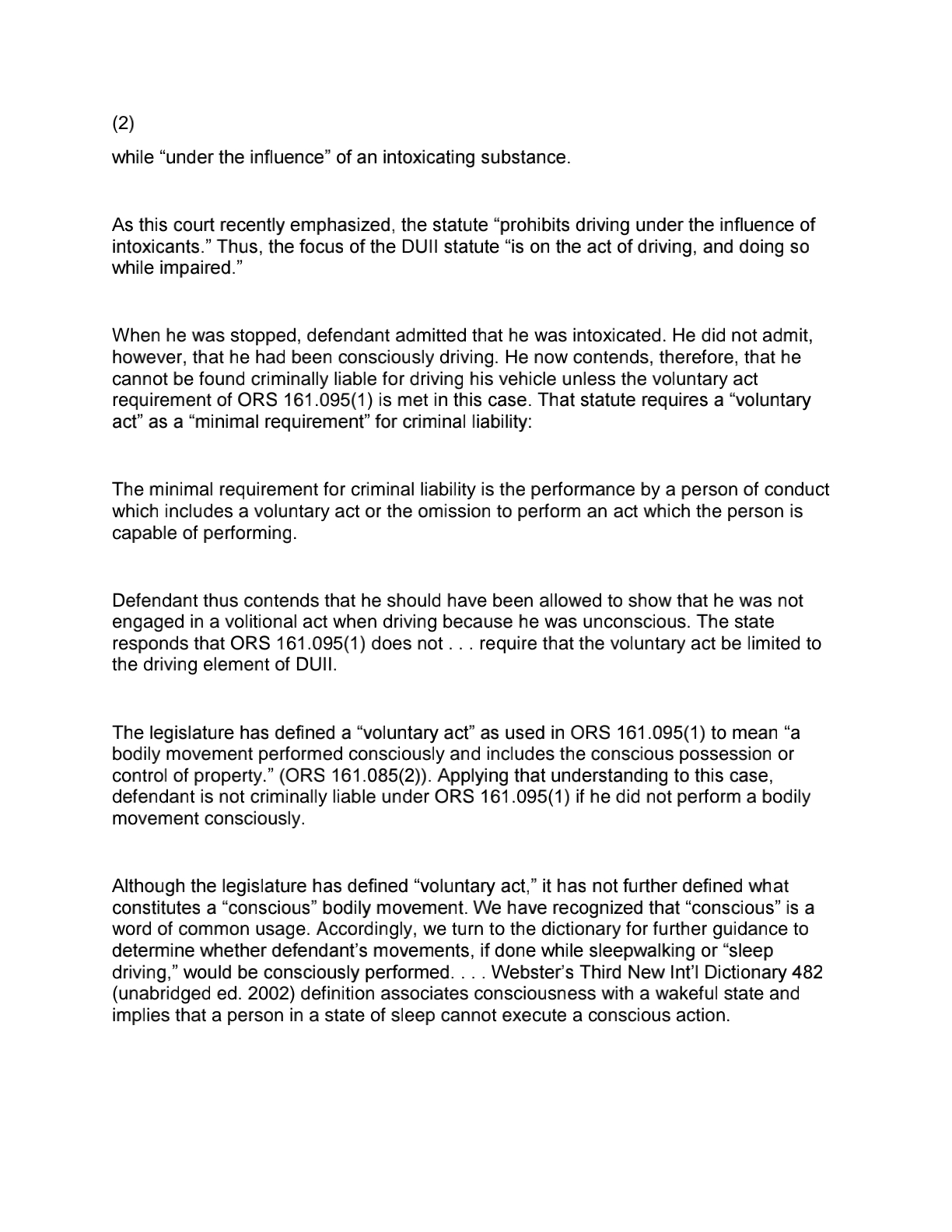
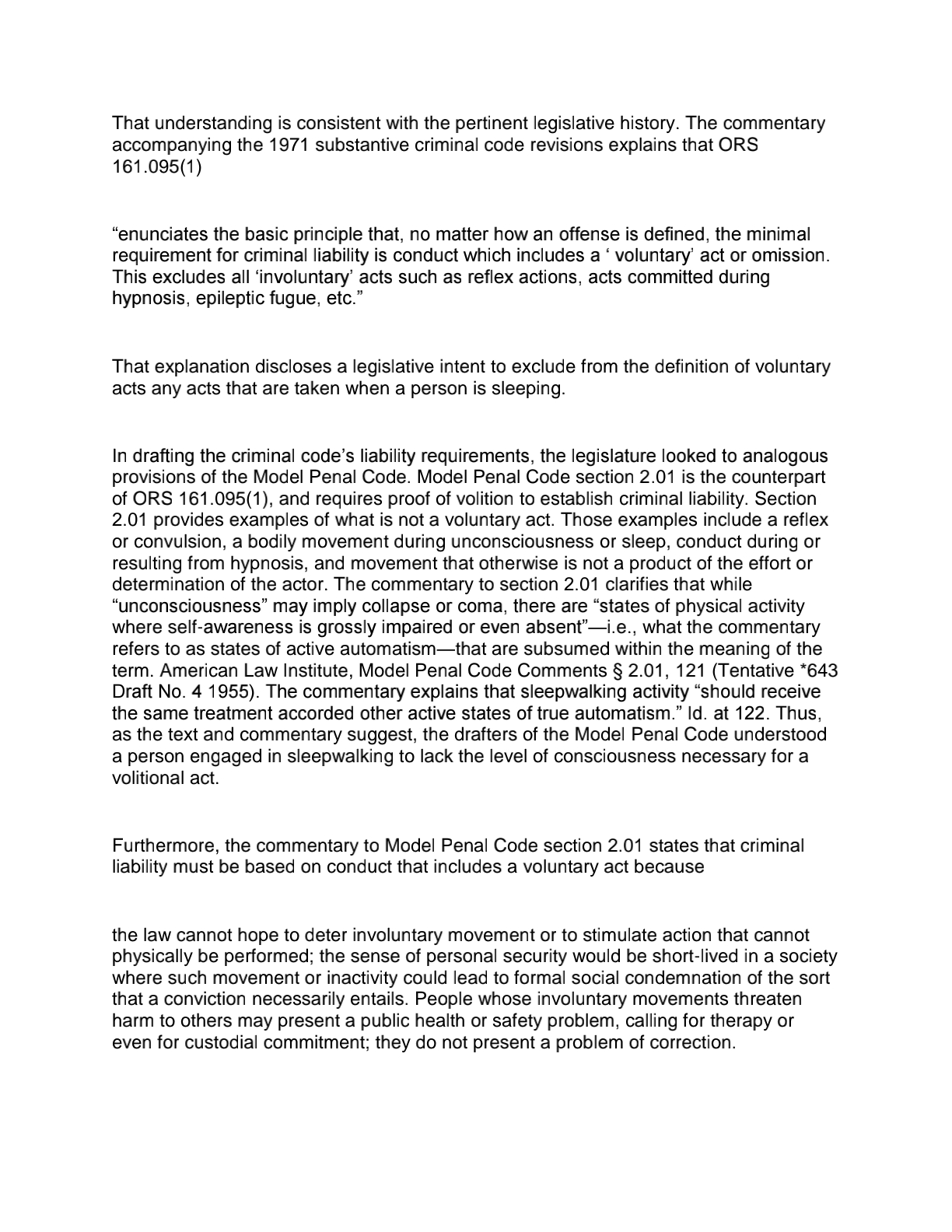
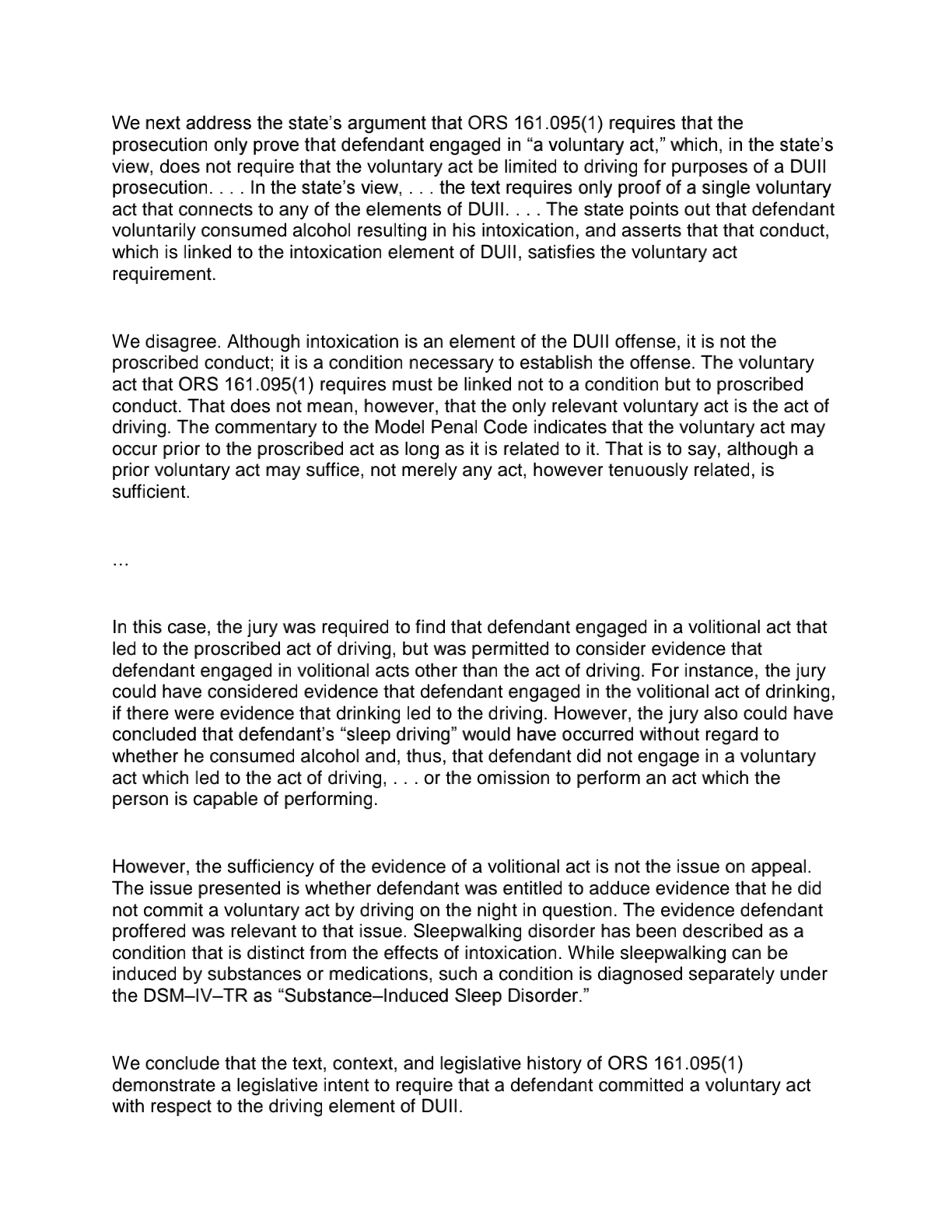
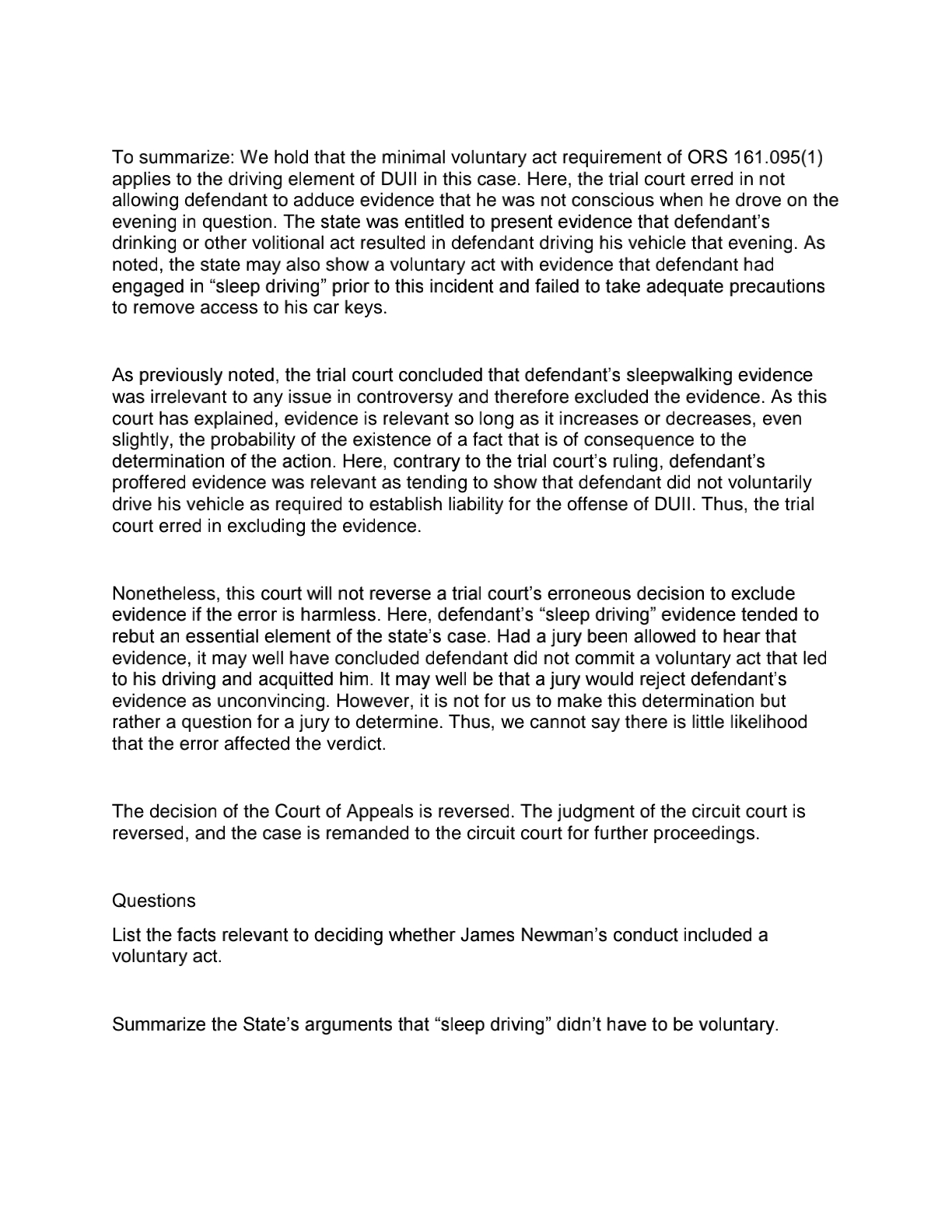
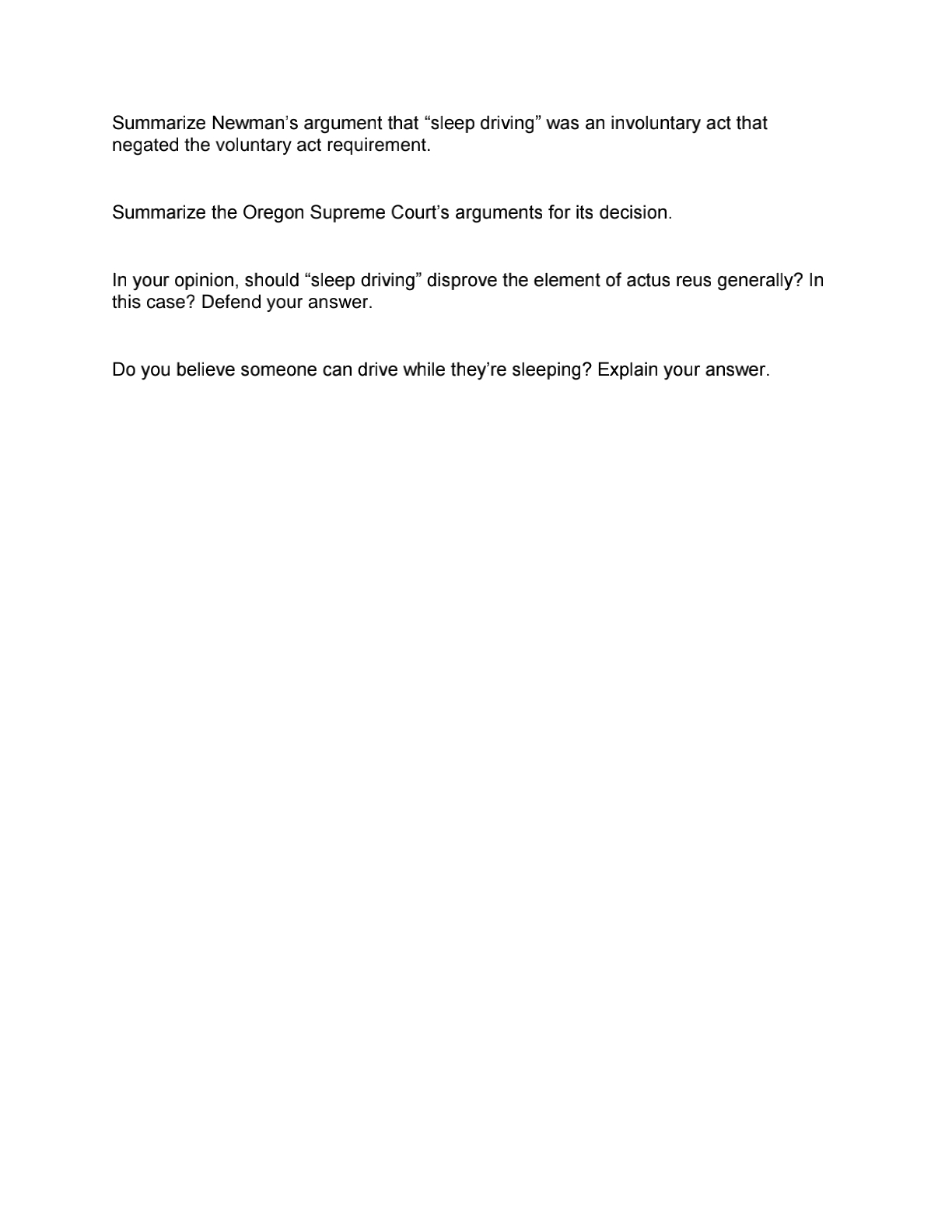
Did \"Sleep Driving\" Nullify the Voluntary Act Requirement? Case In State v. Newman (2013), James Robert Newman was convicted in the Circuit Court, Multnomah County, of felony driving under the influence of intoxicants (DUII), and he appealed. State v. Newman 302 P.3d 435 (OR 2013) History James Robert Newman (Defendant) was convicted in the Circuit Court, Multnomah County, of felony driving under influence of intoxicants (DUII), and he appealed. The Oregon Court of Appeals affirmed. The Oregon Supreme Court allowed review, and reversed. BALDWIN, J. , joined by BALMER, CJ , KISTLER , WALTERS , LINDER , and BALDWIN . ( BREWER, J. did not participate.) Facts \"James Robert Newman (Defendant) met his friends for dinner one evening and, anticipating that he would drink alcohol at dinner, left his car parked by his apartment and walked to the restaurant. Thereafter, defendant's friends drove him home, and he went to sleep. Later that evening, a police officer followed defendant's car and observed defendant make a left-hand turn without signaling or stopping, run a red light, and drive down the middle of a street, straddling the two traffic lanes. The officer then activated his overhead lights to initiate a traffic stop and, in response, defendant pulled into a parking lot. The officer approached defendant's car, smelled a strong odor of alcohol, and observed defendant's bloodshot, watery eyes and slow, slurred speech. Defendant agreed to perform field sobriety tests and, after failing them, was taken into custody. At the police station, defendant consented to a Breathalyzer test, which revealed that he had a blood alcohol level of 0.15 percent.\" Defendant was charged with felony DUII, reckless driving, and recklessly endangering another person. Before trial, the state filed a motion seeking to exclude as irrelevant testimony regarding defendant's sleepwalking disorder and his \"sleep driving on the night in question.\" Defendant argued that evidence of his sleepwalking was relevant to negate the requirements for criminal liability under ORS 161.095specifically, proof of a voluntary act with respect to the driving element of DUII. Defendant contended that he was not capable of performing the necessary volitional movements to consciously control his vehicle because he was asleep when the police stopped his vehicle. Briefing a Case Form Instructions for completing this form: Use this form to answer all the information about the case. Student Name: Case Title History: Facts: Legal Question: Decision: Reasoning: As part of his offer of proof, defendant testified that he had sleepwalked within his apartment on a number of occasions in the past, but, to his knowledge, had not left his apartment while sleepwalking before this incident. A friend also provided testimony confirming defendant's sleepwalking behaviors. Defendant further testified that, after he went to sleep that evening, he had no recollection of leaving his apartment, getting behind the wheel of his car, or driving. Also, as part of defendant's offer of proof, Dr. Joshua Ramseyer, a physician certified in neurology and sleep medicine, provided expert testimony about the symptoms associated with parasomniaa category of unwanted behavior that emerges during sleep. Within that category of sleep phenomenon, Dr. Ramseyer explained, exists somnambulismuwhich is also known as sleepwalking disorder. As Dr. Ramseyer explained: Sleep driving is thought of as being sort of a subtype of sleepwalking or an extension of sleepwalking. It's a motor behavior that occurs without consciousness . . . that comes out during sleep. . . . Just as someone's capable of sort of walking around the house, doing goal-directed behavior, such as eating, people can get behind the wheel, start up the car, and drive.\" Dr. Ramseyer emphasized that activities performed while sleepwalking, such as \"sleep driving,\" are unconscious acts. He further noted that sleepwalking resulting in \"sleep driving,\" while uncommon in the general population, is a well-established phenomenon. If permitted to testify, Dr. Ramseyer would have rendered an expert opinion that defendant was \"sleep driving\" when stopped by police. [The trial court excluded the sleepwalking evidence, and the Court of Appeals affirmed.] In this court, defendant again asserts that, for the purposes of DUII prosecutions, ORS 161.095(1) requires proof that a person committed the voluntary act of driving for criminal liability to attach. In defendant's view, evidence of his sleepwalking disorder and his condition on the night in question is relevant to the issue of whether his driving was voluntary, and thus should have been admitted. We allowed review to examine whether the trial court committed legal error in excluding defendant's \"sleep driving\" evidence. Opinion The relevant statutory provision defining felony DUII is set forth in the Oregon Vehicle Code as ORS 813.010. At the time that police officers stopped defendant, that statute provided, in pertinent part: (1) A person commits the offense of driving while under the influence of intoxicants if the person drives a vehicle while the person: (@) Has 0.08 percent or more by weight of alcohol in the blood of the person as shown by chemical analysis of the breath or blood of the person made under ORS 813.100, 813.140 or 813.150; (b) Is under the influence of intoxicating liquor, a controlled substance or an inhalant; or () Is under the influence of any combination of intoxicating liquor, an inhalant and a controlled substance. (4) ... driving while under the influence of intoxicants, is a Class A misdemeanor and is applicable upon any premises open to the public. (5) (a) Driving while under the influence of intoxicants is a Class C felony if the current offense was committed in a motor vehicle and the defendant has been convicted, at least three times in the 10 years prior to the date of the current offense, of any of the following offenses. . . . (A) Driving while under the influence of intoxicants. . . . ORS 813.010 sets forth two essential elements. A person commits the crime of DUII when the person (1) \"drives a vehicle\" (2) while \"under the influence\" of an intoxicating substance. As this court recently emphasized, the statute \"prohibits driving under the influence of intoxicants.\" Thus, the focus of the DUII statute \"is on the act of driving, and doing so while impaired.\" When he was stopped, defendant admitted that he was intoxicated. He did not admit, however, that he had been consciously driving. He now contends, therefore, that he cannot be found criminally liable for driving his vehicle unless the voluntary act requirement of ORS 161.095(1) is met in this case. That statute requires a \"voluntary act\" as a \"minimal requirement\" for criminal liability: The minimal requirement for criminal liability is the performance by a person of conduct which includes a voluntary act or the omission to perform an act which the person is capable of performing. Defendant thus contends that he should have been allowed to show that he was not engaged in a volitional act when driving because he was unconscious. The state responds that ORS 161.095(1) does not . . . require that the voluntary act be limited to the driving element of DUIL. The legislature has defined a \"voluntary act\" as used in ORS 161.095(1) to mean \"a bodily movement performed consciously and includes the conscious possession or control of property.\" (ORS 161.085(2)). Applying that understanding to this case, defendant is nat criminally liable under ORS 161.095(1) if he did not perform a bodily movement consciously. Although the legislature has defined \"voluntary act,\" it has not further defined what constitutes a \"conscious\" bodily movement. We have recognized that \"conscious\" is a word of common usage. Accordingly, we turn to the dictionary for further guidance to determine whether defendant's movements, if done while sleepwalking or \"sleep driving,\" would be consciously performed. . . . Webster's Third New Int'| Dictionary 482 (unabridged ed. 2002) definition associates consciousness with a wakeful state and implies that a person in a state of sleep cannot execute a conscious action. That understanding is consistent with the pertinent legislative history. The commentary accompanying the 1971 substantive criminal code revisions explains that ORS 161.095(1) \"enunciates the basic principle that, no matter how an offense is defined, the minimal requirement for criminal liability is conduct which includes a ' voluntary' act or omission. This excludes all 'involuntary' acts such as reflex actions, acts committed during hypnosis, epileptic fugue, etc.\" That explanation discloses a legislative intent to exclude from the definition of voluntary acts any acts that are taken when a person is sleeping. In drafting the criminal code's liability requirements, the legislature looked to analogous provisions of the Model Penal Code. Model Penal Code section 2.01 is the counterpart of ORS 161.095(1), and requires proof of volition to establish criminal liability. Section 2.01 provides examples of what is not a voluntary act. Those examples include a reflex or convulsion, a bodily movement during unconsciousness or sleep, conduct during or resulting from hypnosis, and movement that otherwise is not a product of the effort or determination of the actor. The commentary to section 2.01 clarifies that while \"unconsciousness\" may imply collapse or coma, there are \"states of physical activity where self-awareness is grossly impaired or even absent'i.e., what the commentary refers to as states of active automatismthat are subsumed within the meaning of the term. American Law Institute, Model Penal Code Comments 2.01, 121 (Tentative *643 Draft No. 4 1955). The commentary explains that sleepwalking activity \"should receive the same treatment accorded other active states of true automatism.\" Id. at 122. Thus, as the text and commentary suggest, the drafters of the Model Penal Code understood a person engaged in sleepwalking to lack the level of consciousness necessary for a volitional act. Furthermore, the commentary to Model Penal Code section 2.01 states that criminal liability must be based on conduct that includes a voluntary act because the law cannot hope to deter involuntary movement or to stimulate action that cannot physically be performed; the sense of personal security would be short-lived in a society where such movement or inactivity could lead to formal social condemnation of the sort that a conviction necessarily entails. People whose involuntary movements threaten harm to others may present a public health or safety problem, calling for therapy or even for custodial commitment; they do not present a problem of correction. We next address the state''s argument that ORS 161.095(1) requires that the prosecution only prove that defendant engaged in \"a voluntary act,\" which, in the state's view, does not require that the voluntary act be limited to driving for purposes of a DUII prosecution. . . . In the state's view, . . . the text requires only proof of a single voluntary act that connects to any of the elements of DUII. . . . The state points out that defendant voluntarily consumed alcohol resulting in his intoxication, and asserts that that conduct, which is linked to the intoxication element of DUII, satisfies the voluntary act requirement. We disagree. Although intoxication is an element of the DUII offense, it is not the proscribed conduct; it is a condition necessary to establish the offense. The voluntary act that ORS 161.095(1) requires must be linked not to a condition but to proscribed conduct. That does not mean, however, that the only relevant voluntary act is the act of driving. The commentary to the Model Penal Code indicates that the voluntary act may occur prior to the proscribed act as long as it is related to it. That is to say, although a prior voluntary act may suffice, not merely any act, however tenuously related, is sufficient. In this case, the jury was required to find that defendant engaged in a volitional act that led to the proscribed act of driving, but was permitted to consider evidence that defendant engaged in volitional acts other than the act of driving. For instance, the jury could have considered evidence that defendant engaged in the volitional act of drinking, if there were evidence that drinking led to the driving. However, the jury also could have concluded that defendant's \"sleep driving\" would have occurred without regard to whether he consumed alcohol and, thus, that defendant did not engage in a voluntary act which led to the act of driving, . . . or the omission to perform an act which the person is capable of performing. However, the sufficiency of the evidence of a volitional act is not the issue on appeal. The issue presented is whether defendant was entitled to adduce evidence that he did not commit a voluntary act by driving on the night in question. The evidence defendant proffered was relevant to that issue. Sleepwalking disorder has been described as a condition that is distinct from the effects of intoxication. While sleepwalking can be induced by substances or medications, such a condition is diagnosed separately under the DSM-IV-TR as \"SubstanceInduced Sleep Disorder.\" We conclude that the text, context, and legislative history of ORS 161.095(1) demonstrate a legislative intent to require that a defendant committed a voluntary act with respect to the driving element of DUIL. To summarize: We hold that the minimal voluntary act requirement of ORS 161.095(1) applies to the driving element of DUII in this case. Here, the trial court erred in not allowing defendant to adduce evidence that he was not conscious when he drove on the evening in question. The state was entitled to present evidence that defendant's drinking or other volitional act resulted in defendant driving his vehicle that evening. As noted, the state may also show a voluntary act with evidence that defendant had engaged in \"sleep driving\" prior to this incident and failed to take adequate precautions to remove access to his car keys. As previously noted, the trial court concluded that defendant's sleepwalking evidence was irrelevant to any issue in controversy and therefore excluded the evidence. As this court has explained, evidence is relevant so long as it increases or decreases, even slightly, the probability of the existence of a fact that is of consequence to the determination of the action. Here, contrary to the trial court's ruling, defendant's proffered evidence was relevant as tending to show that defendant did not voluntarily drive his vehicle as required to establish liability for the offense of DUII. Thus, the trial court erred in excluding the evidence. Nonetheless, this court will not reverse a trial court's erroneous decision to exclude evidence if the error is harmless. Here, defendant's \"sleep driving\" evidence tended to rebut an essential element of the state''s case. Had a jury been allowed to hear that evidence, it may well have concluded defendant did not commit a voluntary act that led to his driving and acquitted him. It may well be that a jury would reject defendant's evidence as unconvincing. However, it is not for us to make this determination but rather a question for a jury to determine. Thus, we cannot say there is little likelihood that the error affected the verdict. The decision of the Court of Appeals is reversed. The judgment of the circuit court is reversed, and the case is remanded to the circuit court for further proceedings. Questions List the facts relevant to deciding whether James Newman's conduct included a voluntary act. Summarize the State's arguments that \"sleep driving\" didn't have to be voluntary. Summarize Newman''s argument that \"sleep driving\" was an involuntary act that negated the voluntary act requirement. Summarize the Oregon Supreme Court''s arguments for its decision. In your opinion, should \"sleep driving\" disprove the element of actus reus generally? In this case? Defend your answer. Do you believe someone can drive while they're sleeping? Explain your
Step by Step Solution
There are 3 Steps involved in it

Get step-by-step solutions from verified subject matter experts