







Question: Dielectrics and Capacitance Ranking Task Review | Constants Six parallel-plate capacitors of identical plate separation have different plate areas A, different capacitances C, and
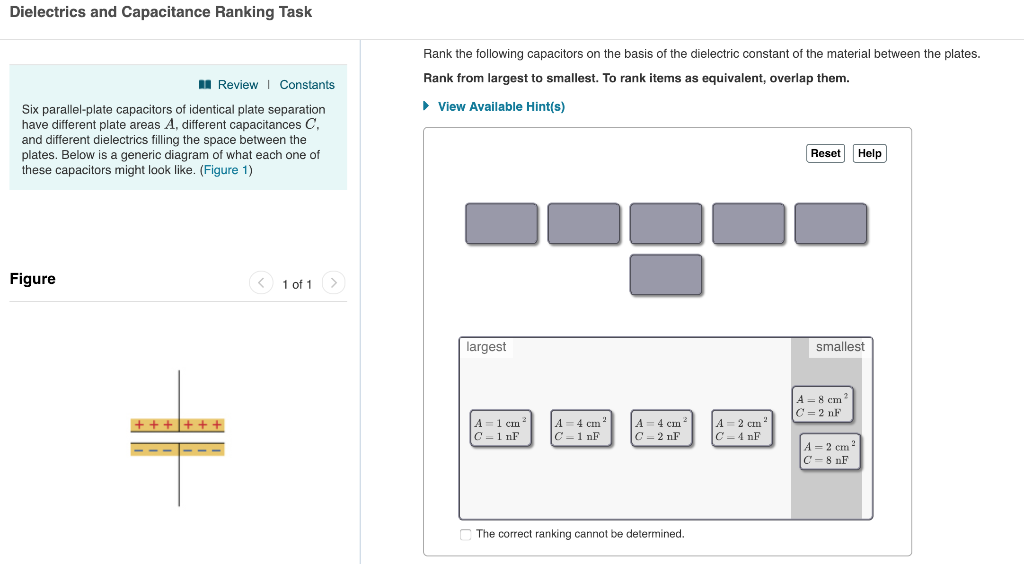
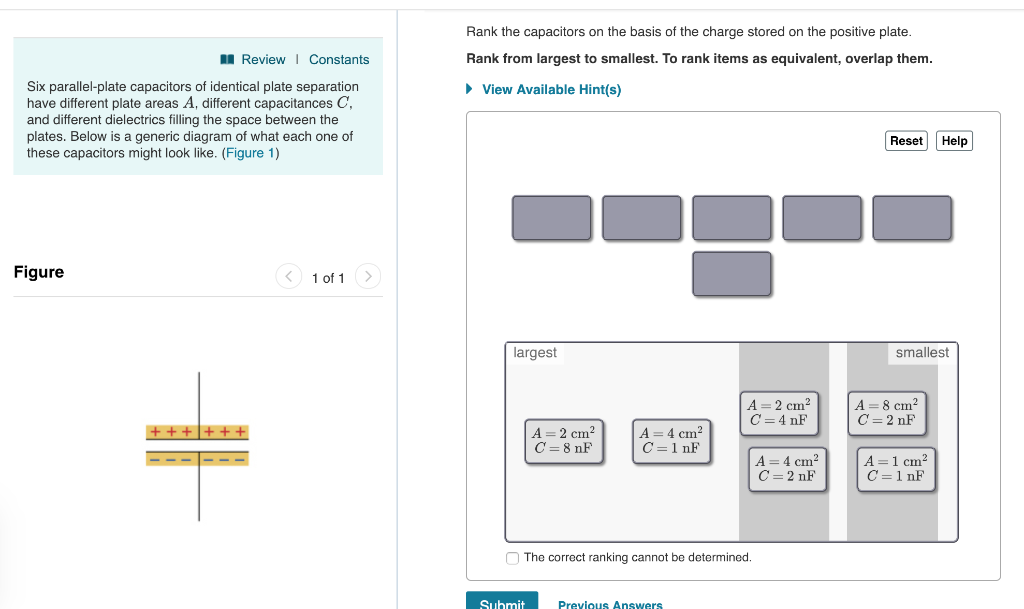
Dielectrics and Capacitance Ranking Task Review | Constants Six parallel-plate capacitors of identical plate separation have different plate areas A, different capacitances C, and different dielectrics filling the space between the plates. Below is a generic diagram of what each one of these capacitors might look like. (Figure 1) Figure ++++++ < 1 of 1 > Rank the following capacitors on the basis of the dielectric constant of the material between the plates. Rank from largest to smallest. To rank items as equivalent, overlap them. View Available Hint(s) largest A=1 cm C=1 nF A = 4 cm |C=1 nF 2 A = 4 cm C = 2 nF The correct ranking cannot be determined. A = 2 cm C-4 nF 2 Reset smallest A = 8 cm C = 2 nF Help A = 2 cm C-8 nF Review | Constants Six parallel-plate capacitors of identical plate separation have different plate areas A, different capacitances C, and different dielectrics filling the space between the plates. Below is a generic diagram of what each one of these capacitors might look like. (Figure 1) Figure +++++ 1 of 1 > Rank the capacitors on the basis of the charge stored on the positive plate. Rank from largest to smallest. To rank items as equivalent, overlap them. View Available Hint(s) largest A = 2 cm C = 8 nF Submit A = 4 cm C = 1 nF The correct ranking cannot be determined. A = 2 cm C = 4 nF Previous Answers A = 4 cm C = 2 nF Reset Help smallest A = 8 cm C = 2 nF A = 1 cm C=1 nF
Step by Step Solution
3.43 Rating (166 Votes )
There are 3 Steps involved in it
the pen Answer and Explanation 1 To rank the capacitors based on the dielectric constant of the mate... View full answer

Get step-by-step solutions from verified subject matter experts
 Study Help