







Question: differential of the function y = xz at point x = 1 with a dx = 0.01 7) What is the main difference between rational
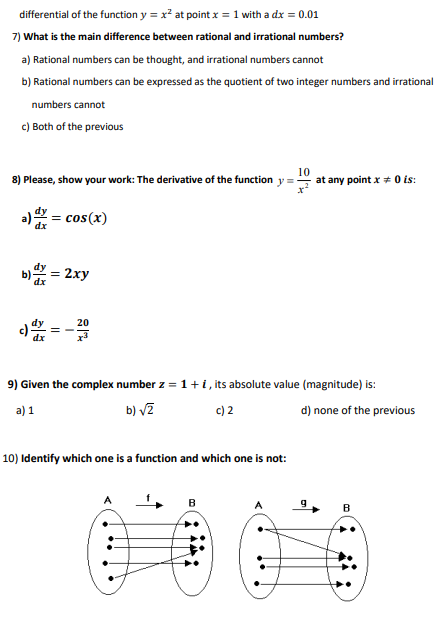
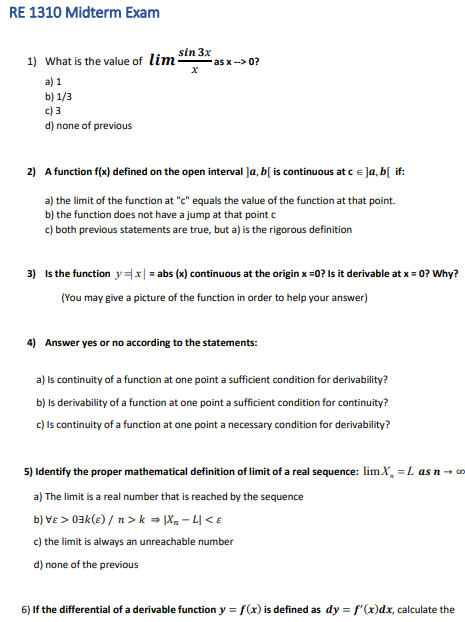
differential of the function y = xz at point x = 1 with a dx = 0.01 7) What is the main difference between rational and irrational numbers? a) Rational numbers can be thought, and irrational numbers cannot b) Rational numbers can be expressed as the quotient of two integer numbers and irrational numbers cannot c) Both of the previous 8) Please, show your work: The derivative of the function y= 10 at any point x * 0 is: dy a dx = cos(x) dy = 2xy c) dy 20 = 9) Given the complex number z = 1 + i, its absolute value (magnitude) is: a) 1 b) vZ c) 2 d) none of the previous 10) Identify which one is a function and which one is not: A BRE 1310 Midterm Exam sin 3x 1) What is the value of lim -as x -3 0? x a) 1 b) 1/3 c) 3 d) none of previous 2) A function f(x) defined on the open interval ]a, b[ is continuous at c e ]a, b[ if: a) the limit of the function at "c" equals the value of the function at that point. b) the function does not have a jump at that point c cj both previous statements are true, but a) is the rigorous definition 3) Is the function j x | = abs (x) continuous at the origin x =0? Is it derivable at x = 0? Why? (You may give a picture of the function in order to help your answer) 4) Answer yes or no according to the statements: a) Is continuity of a function at one point a sufficient condition for derivability? b) Is derivability of a function at one point a sufficient condition for continuity? c) Is continuity of a function at one point a necessary condition for derivability? 5) Identify the proper mathematical definition of limit of a real sequence: lim.X,, =_ asn - c a) The limit is a real number that is reached by the sequence 3> 17- "x - y
Step by Step Solution
There are 3 Steps involved in it

Get step-by-step solutions from verified subject matter experts
 Study Help