







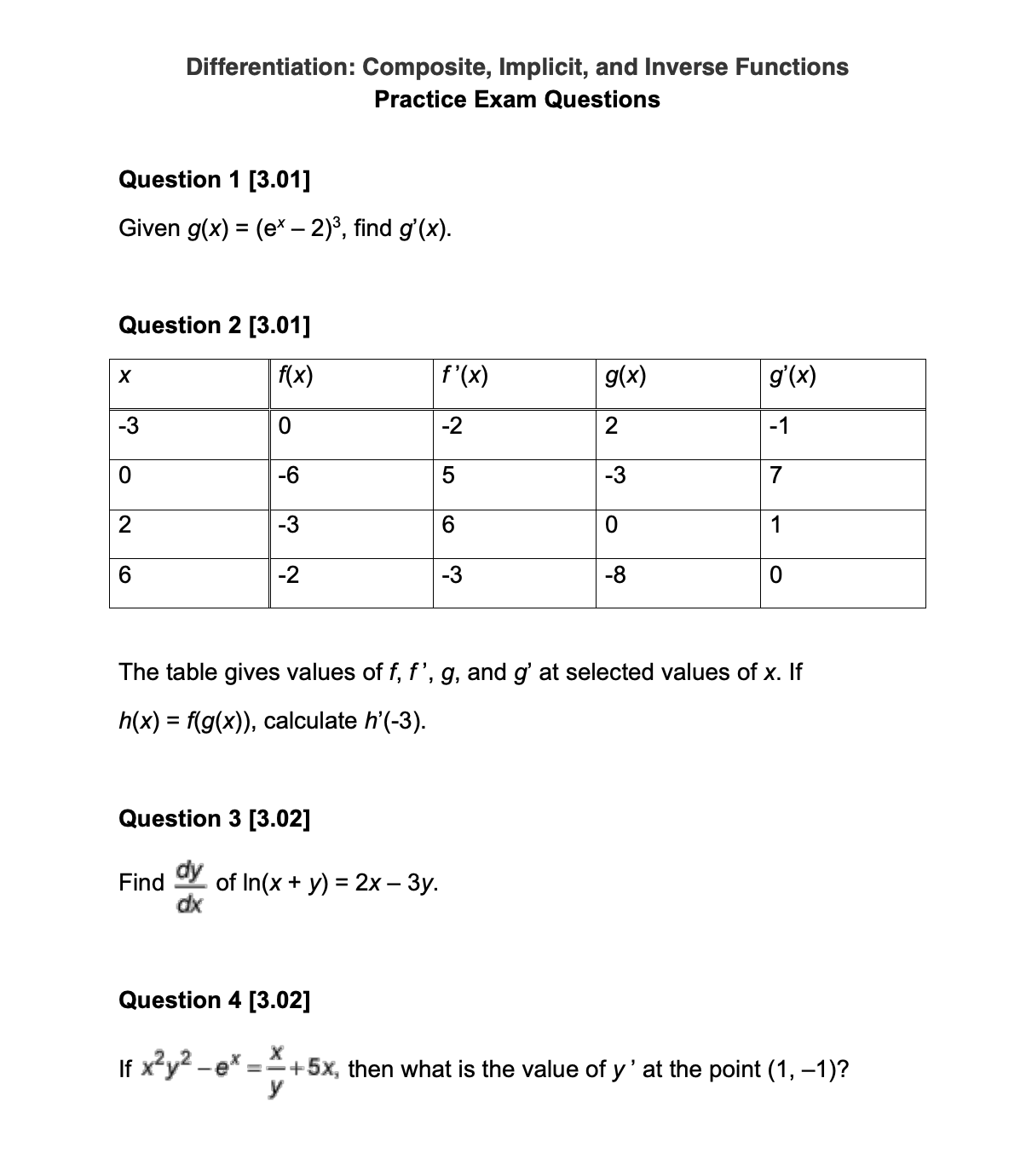
Question: Differentiation: Composite, Implicit, and Inverse Functions Practice Exam Questions Question 1 [3.01] Given g(x) = (e' 2)3, nd g'(x). Question 2 [3.01] X f(X) 3'
![[3.01] Given g(x) = (e"' 2)3, nd g'(x). Question 2 [3.01] X](https://s3.amazonaws.com/si.experts.images/answers/2024/06/667f408e9f26d_630667f408e7693e.jpg)
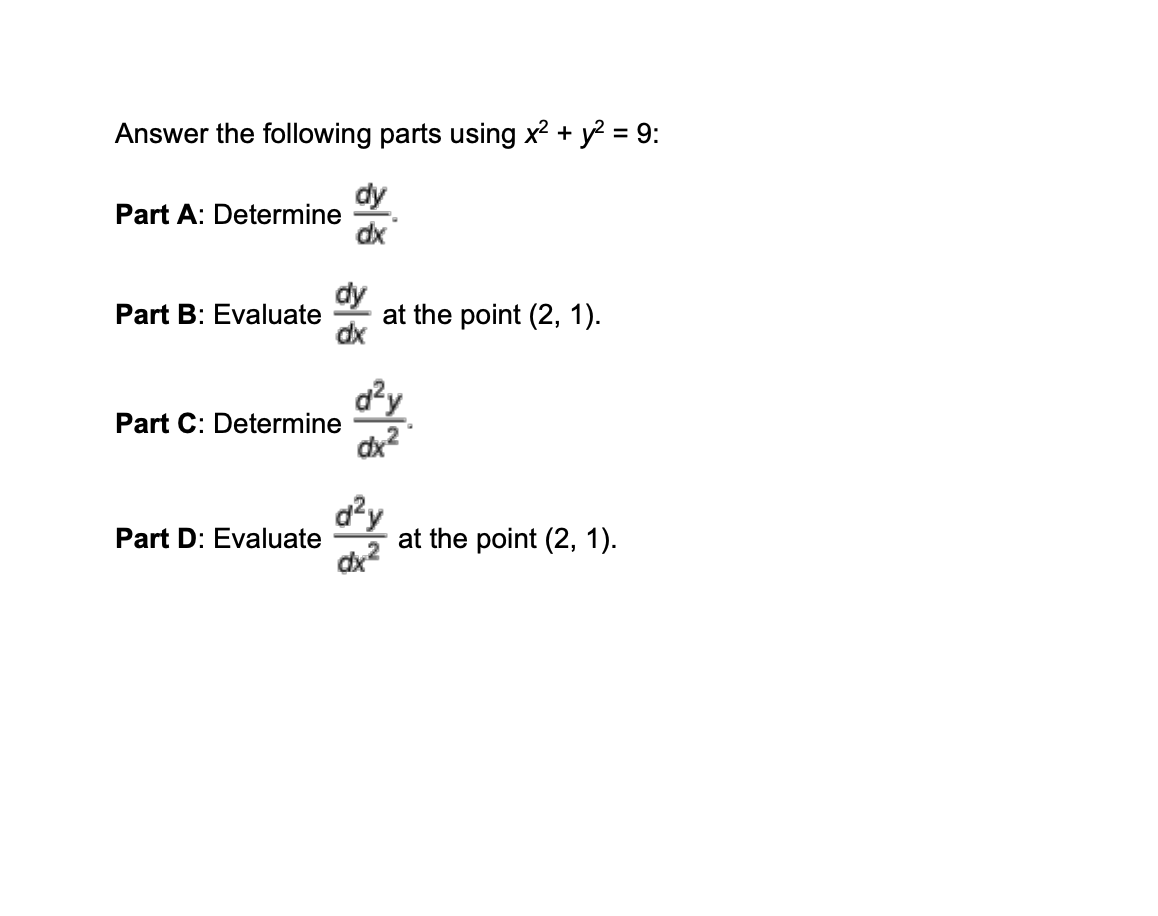
Differentiation: Composite, Implicit, and Inverse Functions Practice Exam Questions Question 1 [3.01] Given g(x) = (e"' 2)3, nd g'(x). Question 2 [3.01] X f(X) 3' '(X) 900 9'00 -3 0 -2 2 -1 0 -6 5 -3 7 2 -3 6 0 1 6 -2 -3 -8 0 The table gives values of f, f ', g, and g' at selected values of x. If h(x) = f(g(x)), calculate h'(-3). Question 3 [3.02] Findoflnm =2x3. m ( y) y Question 4 [3.02] r If 31192 9\" 234-153\"; then what is the value of y' at the point (1, 1)? Question 5 [3.03] Let f be the inverse of 9, where xj=3~lx +1. Write an equation of the tangent line of the graph of fat x = 6. Question 6 [3.03] Use implicit differentiation to solve for the derivative of the inverse of f when x = 5, given x) = 2x3 + 3x. Question 7 [3.05] Find the derivative of the function f{x]= sin'1(2x-1). Question 8 [3.05] Find y' if y = cos1(tanx). Question 9 [3.07] Let g be the function given by g(x) = e'x cos(x) + 2x2. What is the instantaneous rate of change of g'(x) at x = 0? Question 10 [3.07] 4 day If y= a\" ln(:r}. then what is ? :33 Question 11 [3.07] Answer the following parts using x2 + y2 = 9: Part A: Determine dy dx Part B: Evaluate dy dx at the point (2, 1). Part C: Determine dx 2 Part D: Evaluate 2 at the point (2, 1)
Step by Step Solution
There are 3 Steps involved in it

Get step-by-step solutions from verified subject matter experts
 Study Help