







Question: Diffraction and Interference Lab Online Instructions OBJECTIVE - To construct the mathematical relation describing diffraction through a slit and interference through two slits. - Verify
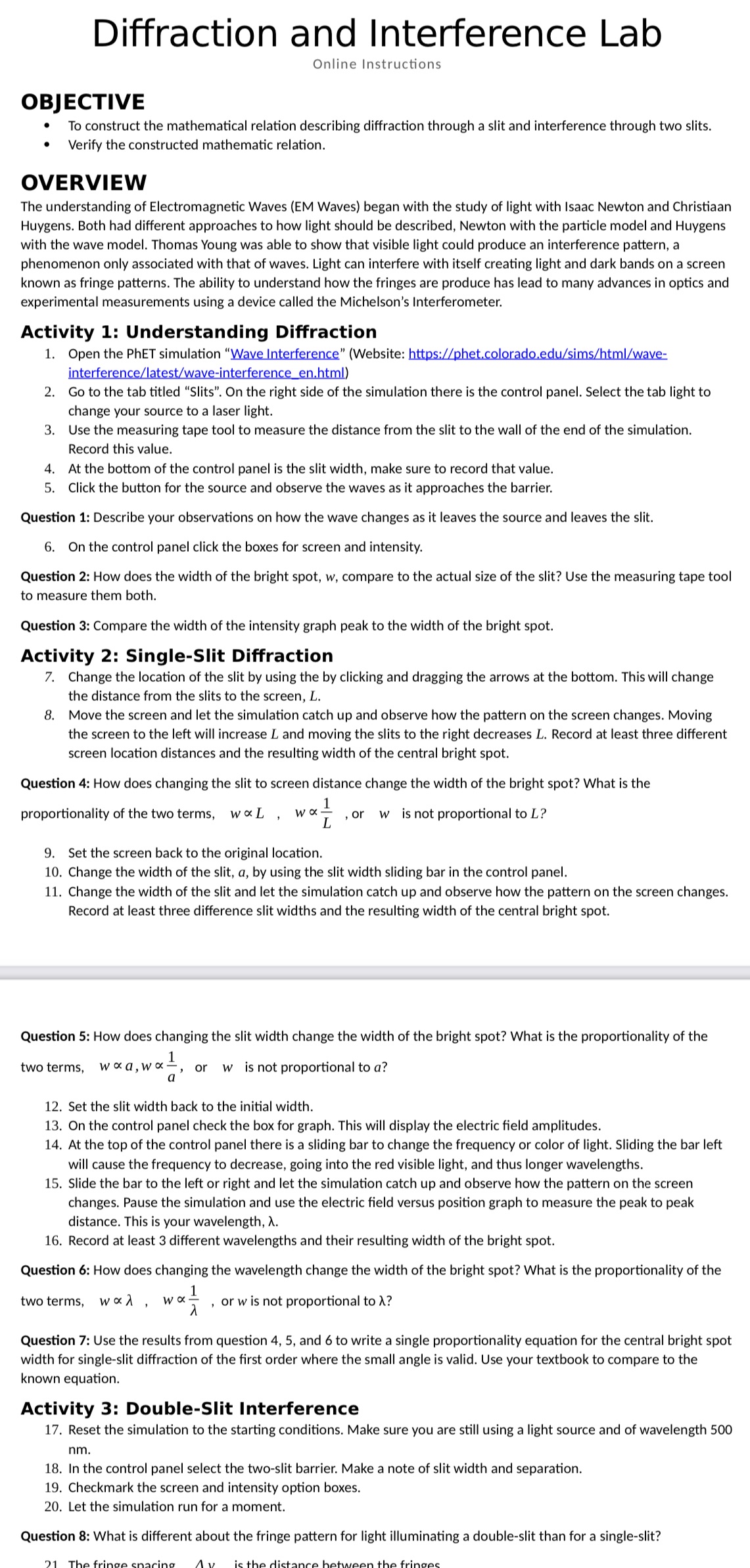
Diffraction and Interference Lab Online Instructions OBJECTIVE - To construct the mathematical relation describing diffraction through a slit and interference through two slits. - Verify the constructed mathematic relation. OVERVIEW The understanding of Electromagnetic Waves (EM Waves) began with the study of light with Isaac Newton and Chrisaan Huygens. Both had different approaches to how light should be described, Newton with the particle model and Huygens with the wave model. Thomas Young was able to show that visible light could produce an interference pattern. a phenomenon only associated with that of waves. Light can interfere with itself creating light and dark bands on a screen known as fringe patterns. The ability to understand how the fringes are produce has lead to many advances in optics and experimental measurements using a device called the Michelson's Interferometer. Activity 1: U nderstanding Diffraction 1, Open the PhET simulation "Waycintedetence" (Website: httpsllnbetmloradocduisimslhtmliwaw: mtiilmhml' -' I 2. Go to the tab titled \"Slits\". 0n the right side of the simulation there is the control panel. Select the tab light to change your source to a laser light. 3. Use the measuring tape tool to measure the distance from the slit to the wall of the end of the simulation. Record this value. 4. At the bottom of the control panel is the slit width, make sure to record that value. 5. Click the button for the source and observe the waves as it approaches the barrier. Question 1: Describe your observations on how the wave changes as it leaves the source and leaves the slit. 6. 0n the control panel click the boxes for screen and intensity. Question 2: How does the width of the bright spot. w, compare to the actual size of the slit? Use the measuring tape tool to measure them both. Question 3: Compare the width of the intensity graph peak to the width of the bright spot. Activity 2: Single-Slit Diffraction 7. Change the location of the slit by using the by clicking and dragging the arrows at the bottom. This will change the distance from the slits to the screen, L. 8. Move the screen and let the simulation catch up and observe how the pattern on the screen changes. Moving the screen to the left will increase L and moving the slits to the right decreases L. Record at least three different screen location distances and the resulting width of the central bright spot. Question 4: How does changing the slit to screen distance change the width of the bright spot? What is the 1 proportionality ofthe two terms, w a: L , W 0' I , or w is not proportional to L? 9. Set the screen back to the original location. 10. Change the width of the slit, a, by using the slit width sliding bar in the control panel. 11. Change the width of the slit and let the simulation catch up and observe how the pattern on the screen changes. Record at least three difference slit widths and the resulting width of the central bright spot. Question 5: How does changing the slit width change the width of the bright spot? What is the proportionality of the two terms. W ' (1, W G i , or w is not proportional to a? 12. Set the slit width back to the initial width. 13. on the control panel check the box for graph. This will display the electric eld amplitudes. 14. At the top of the control panel there is a sliding bar to change the frequency or color of light. Sliding the bar left will cause the frequency to decrease, going into the red visible light. and thus longer wavelengths. 15. Slide the bar to the left or right and let the simulation catch up and observe how the pattern on the screen changes. Pause the simulation and use the electric eld versus position graph to measure the peak to peak distance. This is your wavelength, A. 16. Record at least 3 different wavelengths and their resulting width of the bright spot. Question 6: How does changing the wavelength change the width of the bright spot? What is the proportionality of the 1 two terms. w
Step by Step Solution
There are 3 Steps involved in it

Get step-by-step solutions from verified subject matter experts
 Study Help