







Question: PHYS 2092_Lab 8_Instructions.docx Lab 8: Diffraction Grating INSTRUCTIONS Introduction In this lab, you will study diffiraction patterns produced by a monochromatic light source incident on
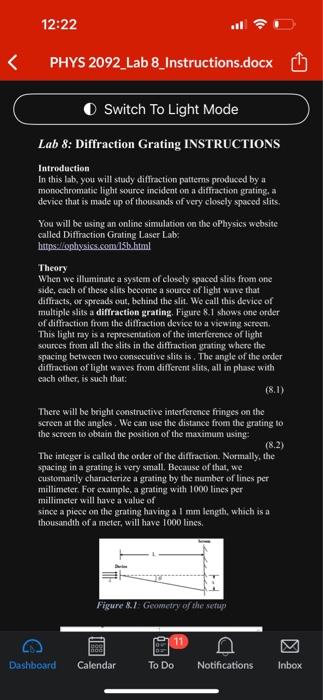
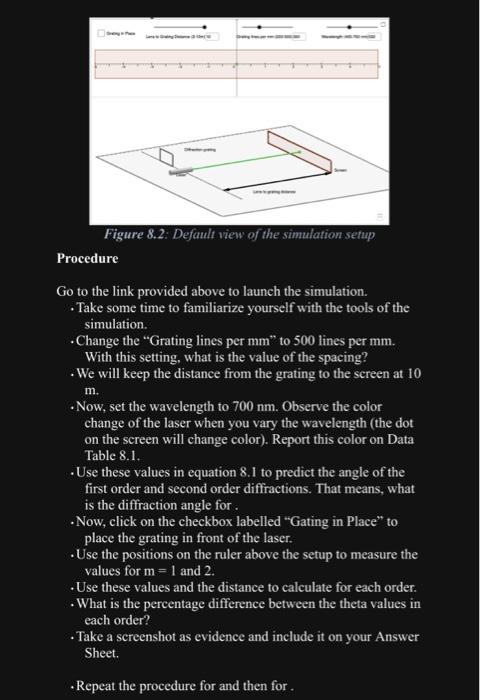
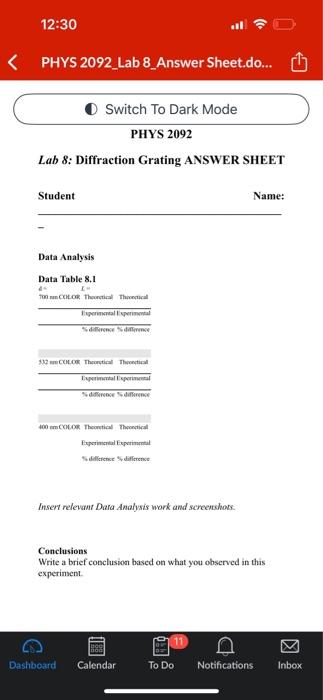
PHYS 2092_Lab 8_Instructions.docx Lab 8: Diffraction Grating INSTRUCTIONS Introduction In this lab, you will study diffiraction patterns produced by a monochromatic light source incident on a diffraction grating, a device that is made up of thousands of very closely spaced slits. You will be using an online simulation on the oPhysics website called Diffraction Grating Laser Lab: hitpsdophysicscoan Theory When we illuminate a system of elosely spaced slits from one side, each of these slits become a souree of light wave that diffracts, or spreads out, behind the slit. Wo call this device of multiple slits a diffraction grating. Figure 8.1 thows one order of diffraction from the diffraction device to a viewing screen. This light ray is a representation of the interference of light sources from all the slits in the diffrnction grating where the spacing between two consecutive slits is. The angle of the order diffriction of light waves from different slits, all in phase with each other, is such that: There will be bright constructive interference finges on the sereen at the angles. We ean wise the distance from the grating to the sereen to obtain the position of the maximum using: (8.2) The integer is called the order of the diffraction. Normally, the spacing in a grating is very small. Because of that, we customarily characterize a grating by the number of lines per millimeter. For example, a grating with 1000 tines per millimeter will have a value of since a piece on the grating having a 1mm length, which is a thousandth of a meter, will have 1000 lines. Procedure Go to the link provided above to launch the simulation. - Take some time to familiarize yourself with the tools of the simulation. - Change the "Grating lines per mm" to 500 lines per mm. With this setting, what is the value of the spacing? -We will keep the distance from the grating to the sereen at 10 m. - Now, set the wavelength to 700nm. Observe the color change of the laser when you vary the wavelength (the dot on the screen will change color). Report this color on Data Table 8.1. .Use these values in equation 8.1 to predict the angle of the first order and second order diffractions. That means, what is the diffraction angle for . -Now, click on the checkbox labelled "Gating in Place" to place the grating in front of the laser. -Use the positions on the ruler above the setup to measure the values for m=1 and 2 . -Use these values and the distance to calculate for each order. -What is the percentage difference between the theta values in each order? - Take a screenshot as evidence and include it on your Answer Sheet. Lab 8: Diffraction Grating ANSWER SHEET Student Name: Data Analysis Data Table 8.1 4* x= Tyermental feperimenal 400 amCOLion. Theontical Thenatical Feperincted feprimontal Nidference Nidiferenct Insent relewant Dara Analysis work and sereenshous. Conclusions Write a brief conclusion based on what you observed in this experiment
Step by Step Solution
There are 3 Steps involved in it

Get step-by-step solutions from verified subject matter experts
 Study Help