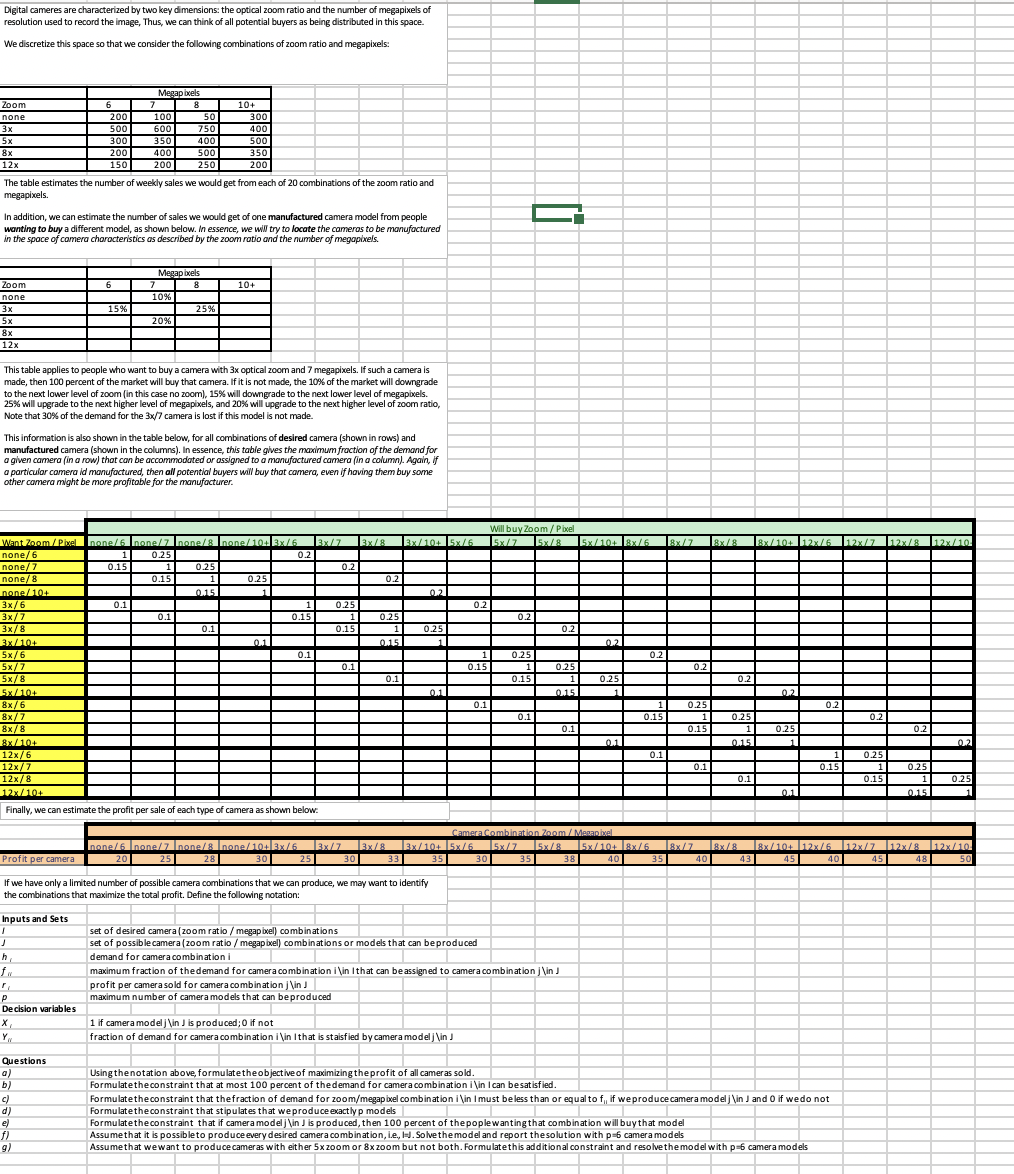
Digital cameres are characterized by two key dimensions: the optical zoom ratio and the number of megapixels of resolution used to record the image. Thus, we can think of all potential buyers as being distributed in this space. We discretize this space so that we consider the following combinations of zoom ratio and megapixels: Megapixels Zoom 6 8 10+ none 2001 100 50 300 3x 5001 600 7501 400 5x 300 350 400 500 8x 200 400 500 350 12x 150 200 2501 200 The table estimates the number of weekly sales we would get from each of 20 combinations of the zoom ratio and megapixels. In addition, we can estimate the number of sales we would get of one manufactured camera model from people wanting to buy a different model, as shown below. In essence, we will try to locate the cameras to be manufactured in the space of camera characteristics as described by the zoom ratio and the number of megapixels. 6 10+ Megap bels 7 78 10% 25% 20% Zoom none 3x 5x 8x 12x 15% This table applies to people who want to buy a camera with 3x optical zoom and 7 megapixels. If such a camera is made, then 100 percent of the market will buy that camera. If it is not made, the 10% of the market will downgrade to the next lower level of zoom (in this case no zoom), 15% will downgrade to the next lower level of megapixels. 25% will upgrade to the next higher level of megapixels, and 20% will upgrade to the next higher level of zoom ratio, Note that 30% of the demand for the 3x/7 camera is lost if this model is not made. This information is also shown in the table below, for all combinations of desired camera (shown in rows) and manufactured camera (shown in the columns). In essence, this table gives the maximum fraction of the demand for a given camera (in a row) that can be accommodated or assigned to a manufactured camera (in a column). Again, if a particular camera id manufactured, then all potential buyers will buy that camera, even if having them buy some other camera might be more profitable for the manufacturer. Will buy Zoom/Pbel Want Zoom/Pivelnone/ 6 none/7 Inone/s Inone/104 Bx/6 /7 Bx/7 Ex/ 8 Bx10+ 15x6 5x75x/8 15x/10+ Bx/6 8x/7 Bx/8 Bx/104 12/6 127 128 123/10 Bx/7 7 none/6 1 0.25 0.2 none/7 0.15 1 1 0.25 0.2 none/8 0.15 1 0.25 0.2 none/104 0.15 02 3x/6 0.1 1 0.25 0.2 3x/7 0.1 0.15 1 0.25 0.2 3x/8 0.1 0.151 1 0.25 0.2 3x/ 10+ 0.1 0.15 1 1 5x/6 0.1 1 0.25 0.2 5x/7 0.1 0.15 1 0.25 0.2 5x/8 0.1 0.15 1 0.25 0.2 5x10⁴ 01 0.15 02 8x/6 0.1 1 0.25 0.2 8x/7 0.1 0.15 1 0.25 0.2 8x/8 0.1 0.15 1 0.25 0.2 8x/10+ 01 0151 1 02 12x/6 0.1 0.25 12x/7 0.1 0.15 1 0.25 12x/8 0.1 0.15 1 12/104 0.1 0.15 Finally, we can estimate the profit per sale of each type of camera as shown below: 0.25 none/ 6 none/7 Inone / & none/1043x/6 Bx/7 Bx/8 7 20 25 28 30 25 30 33 Camera Combination Zoom / Menanvel Bx/10+ 5x/ 15x/7 5/8/10 Bx 7 + 6 18x/7 8x/8 8x/104 12/6 112/7 12/8 12/10 35 30 35 38 40 35 40 43 45 40 45 48 50 Profit per camera If we have only a limited number of possible camera combinations that we can produce, we may want to identify the combinations that maximize the total profit. Define the following notation: Inputs and Sets 1 h fi r p Decision variables X Y set of desired camera (zoom ratio / megap bel) combinations set of possible camera (zoom ratio / megap bel) combinations or models that can be produced demand for camera combination i maximum fraction of the demand for camera combination i\in Ithat can be assigned to camera combination j\in profit per camera sold for camera combination j \in J maximum number of camera models that can be produced 1 if camera model j \in ) is produced; O if not fraction of demand for camera combination i \in Ithat is staisfied by camera modelj \in } i\ Questions a) b) c) d) e) f) 9) Usingthenotation above, formulate the objective of maximizing the profit of all cameras sold. Formulate the constraint that at most 100 percent of the demand for camera combination i\in I can be satisfied. Formulate the constraint that the fraction of demand for zoom/megapixel combination i\in I must be less than or equal to f, if we produce camera modelj\in) and if wedo not Formulate the constraint that stipulates that weproduce exactlyp models Formulate the constraint that if camera model j \in J is produced, then 100 percent of the pople wanting that combination will buy that model Assume that it is possible to produce every desired camera combination, i.e., I. Solve the model and report the solution with p=6 camera models Assume that wewant to produce cameras with either 5x zoom or 8x zoom but not both. Formulate this additional constraint and resolve the model with p=6 camera models Digital cameres are characterized by two key dimensions: the optical zoom ratio and the number of megapixels of resolution used to record the image. Thus, we can think of all potential buyers as being distributed in this space. We discretize this space so that we consider the following combinations of zoom ratio and megapixels: Megapixels Zoom 6 8 10+ none 2001 100 50 300 3x 5001 600 7501 400 5x 300 350 400 500 8x 200 400 500 350 12x 150 200 2501 200 The table estimates the number of weekly sales we would get from each of 20 combinations of the zoom ratio and megapixels. In addition, we can estimate the number of sales we would get of one manufactured camera model from people wanting to buy a different model, as shown below. In essence, we will try to locate the cameras to be manufactured in the space of camera characteristics as described by the zoom ratio and the number of megapixels. 6 10+ Megap bels 7 78 10% 25% 20% Zoom none 3x 5x 8x 12x 15% This table applies to people who want to buy a camera with 3x optical zoom and 7 megapixels. If such a camera is made, then 100 percent of the market will buy that camera. If it is not made, the 10% of the market will downgrade to the next lower level of zoom (in this case no zoom), 15% will downgrade to the next lower level of megapixels. 25% will upgrade to the next higher level of megapixels, and 20% will upgrade to the next higher level of zoom ratio, Note that 30% of the demand for the 3x/7 camera is lost if this model is not made. This information is also shown in the table below, for all combinations of desired camera (shown in rows) and manufactured camera (shown in the columns). In essence, this table gives the maximum fraction of the demand for a given camera (in a row) that can be accommodated or assigned to a manufactured camera (in a column). Again, if a particular camera id manufactured, then all potential buyers will buy that camera, even if having them buy some other camera might be more profitable for the manufacturer. Will buy Zoom/Pbel Want Zoom/Pivelnone/ 6 none/7 Inone/s Inone/104 Bx/6 /7 Bx/7 Ex/ 8 Bx10+ 15x6 5x75x/8 15x/10+ Bx/6 8x/7 Bx/8 Bx/104 12/6 127 128 123/10 Bx/7 7 none/6 1 0.25 0.2 none/7 0.15 1 1 0.25 0.2 none/8 0.15 1 0.25 0.2 none/104 0.15 02 3x/6 0.1 1 0.25 0.2 3x/7 0.1 0.15 1 0.25 0.2 3x/8 0.1 0.151 1 0.25 0.2 3x/ 10+ 0.1 0.15 1 1 5x/6 0.1 1 0.25 0.2 5x/7 0.1 0.15 1 0.25 0.2 5x/8 0.1 0.15 1 0.25 0.2 5x10⁴ 01 0.15 02 8x/6 0.1 1 0.25 0.2 8x/7 0.1 0.15 1 0.25 0.2 8x/8 0.1 0.15 1 0.25 0.2 8x/10+ 01 0151 1 02 12x/6 0.1 0.25 12x/7 0.1 0.15 1 0.25 12x/8 0.1 0.15 1 12/104 0.1 0.15 Finally, we can estimate the profit per sale of each type of camera as shown below: 0.25 none/ 6 none/7 Inone / & none/1043x/6 Bx/7 Bx/8 7 20 25 28 30 25 30 33 Camera Combination Zoom / Menanvel Bx/10+ 5x/ 15x/7 5/8/10 Bx 7 + 6 18x/7 8x/8 8x/104 12/6 112/7 12/8 12/10 35 30 35 38 40 35 40 43 45 40 45 48 50 Profit per camera If we have only a limited number of possible camera combinations that we can produce, we may want to identify the combinations that maximize the total profit. Define the following notation: Inputs and Sets 1 h fi r p Decision variables X Y set of desired camera (zoom ratio / megap bel) combinations set of possible camera (zoom ratio / megap bel) combinations or models that can be produced demand for camera combination i maximum fraction of the demand for camera combination i\in Ithat can be assigned to camera combination j\in profit per camera sold for camera combination j \in J maximum number of camera models that can be produced 1 if camera model j \in ) is produced; O if not fraction of demand for camera combination i \in Ithat is staisfied by camera modelj \in } i\ Questions a) b) c) d) e) f) 9) Usingthenotation above, formulate the objective of maximizing the profit of all cameras sold. Formulate the constraint that at most 100 percent of the demand for camera combination i\in I can be satisfied. Formulate the constraint that the fraction of demand for zoom/megapixel combination i\in I must be less than or equal to f, if we produce camera modelj\in) and if wedo not Formulate the constraint that stipulates that weproduce exactlyp models Formulate the constraint that if camera model j \in J is produced, then 100 percent of the pople wanting that combination will buy that model Assume that it is possible to produce every desired camera combination, i.e., I. Solve the model and report the solution with p=6 camera models Assume that wewant to produce cameras with either 5x zoom or 8x zoom but not both. Formulate this additional constraint and resolve the model with p=6 camera models




