



Question: Directions: Consider the following function f(x) at a=1 . f(x)=x-5 Part 1 - Difference Quotient If h!=0 , then the difference quotient can be
Directions: Consider the following function
f(x)at
a=1.\
f(x)=x-5\ Part 1 - Difference Quotient\ If
h!=0, then the difference quotient can be simplified into the form
Ah+B. That is:\
(f(1+h)-f(1))/(h)=Ah+B\ where
Aand
Bare constants. Find these constants:\
A=, and B=\ (Note: It's possible for one or more of these constants to be 0.)\ Part 2 - Derivative\ Use the simplified expression from Part 1 to then calculate the derivative
f^(')(1):\
f^(')(1)=\\\\lim_(h->0)(f(1+h)-f(1))/(h)\
f^(')(1)= 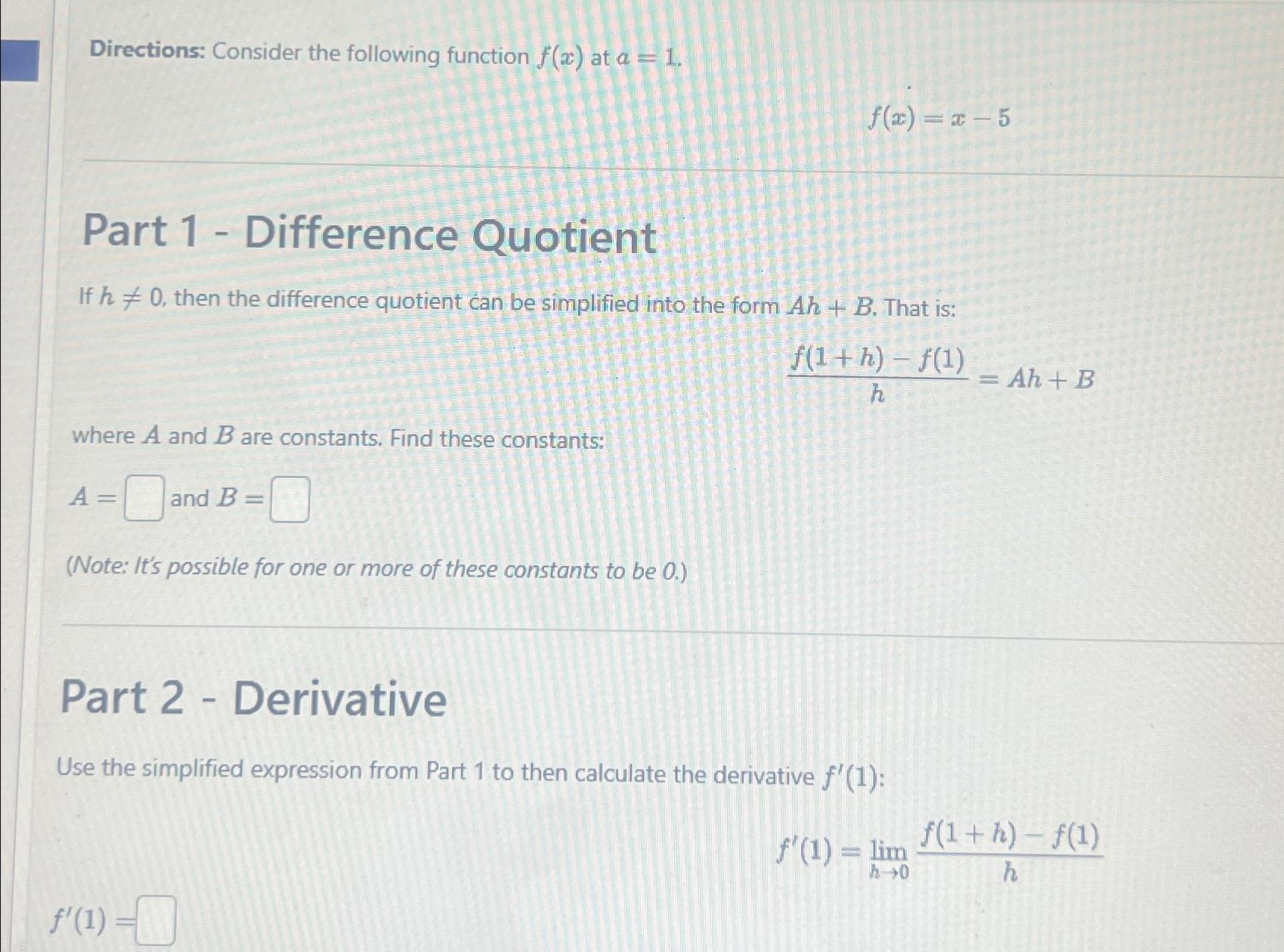
Directions: Consider the following function f(x) at a=1. f(x)=x5 Part 1 - Difference Quotient If h=0, then the difference quotient can be simplified into the form Ah+B. That is: hf(1+h)f(1)=Ah+B where A and B are constants. Find these constants: A=andB= (Note: It's possible for one or more of these constants to be 0.) Part 2 - Derivative Use the simplified expression from Part 1 to then calculate the derivative f(1) : f(1)=limh0hf(1+h)f(1) f(1)=
Step by Step Solution
There are 3 Steps involved in it

Get step-by-step solutions from verified subject matter experts