







Question: DISCOUNTING INTENT WITH SEGMENTATION - AN EXCEL PRICING EXAMPLE Many experiments measure intent as a business outcome because it is easier to ask potential customers
DISCOUNTING INTENT WITH SEGMENTATION AN EXCEL PRICING EXAMPLE
Many experiments measure intent as a business outcome because it is easier to ask potential customers about their intent to purchase in a survey than to measure an actual purchase. For example, we might ask customers their intent to purchase a product on a scale from to where very unlikely and very likely. Oftentimes, this is analyzed without discounting intent. However, it is better to apply a discount because people do not do what they say they will do In other words, if someone responds with a out of yes, they are very likely to purchase, how many of them would actually purchase?
The answer is usually less than Consider ACNielsen BASES Predicted Purchase Intent: Very Likely to Buy Product Likely to Buy Product Somewhat Likely to Buy Product Undecided Somewhat Unlikely to Buy Product Unlikely to Buy Product Very Unlikely to Buy Product This means that we expect only out of people who say they are very likely to actually make the purchase when given the real chance. Analytically we must adjust the outcome to reflect this. Use the data collected on intent in the Assignment file Assignment # Intent Excel Sheet and adjust for discounting intent as follows:
For each price point: a Apply discounting intent adjustments to predict estimated conversion
b Estimate promotion expenditures: How much money will you spend on promotion? A good # for this example can be $
c Estimate estimated exposure: How many people representative of your experiments sample will see the ad based on promotion expenditures? Let's use M d Estimate COGs variable & fixed costs let's use $ for this example e Calculate profit price COGs costsestimated quantity fixed costs
You should now have a calculated gain for marketing to both segments. Note this total $ figure.
Now calculate separately for those in segment versus those in segment just copy the spreadsheet, sort the copy by segment and retain only the records of a segment, deleting the others Compare the total $ gains with a chart; what segments should you target? Note: The Intent Excel Sheet is a file with results from an experiment in which people were exposed to a promotional message for the same product but with two possible price points, $ and $ People were randomly assigned to see EITHER $ or $ as the price and then responded to the question, How likely are you to purchase this product? using a to scare, with very unlikely and very likely scale. People were identified as being in one of two segments. DISCOUNTING INTENT WITH SEGMENTATION AN EXCEL PRICING EXAMPLE
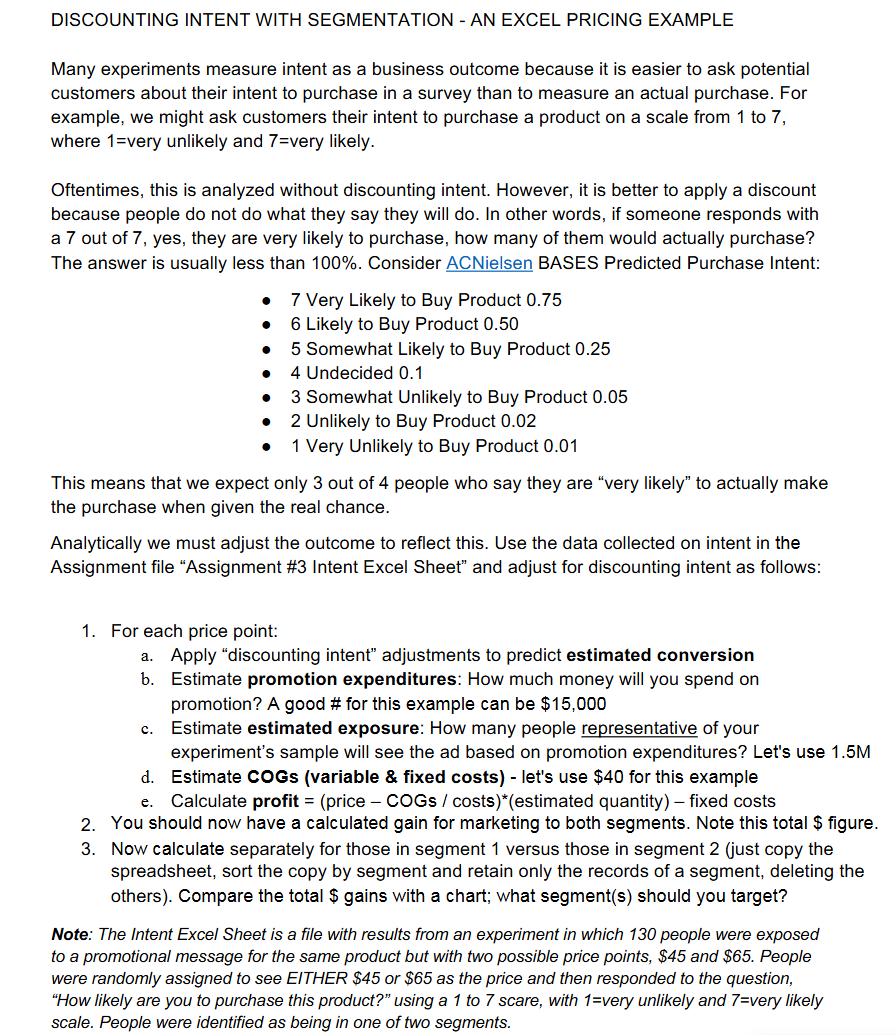
Many experiments measure intent as a business outcome because it is easier to ask potential customers about their intent to purchase in a survey than to measure an actual purchase. For example, we might ask customers their intent to purchase a product on a scale from to where very unlikely and very likely.
Oftentimes, this is analyzed without discounting intent. However, it is better to apply a discount because people do not do what they say they will do In other words, if someone responds with a out of yes, they are very likely to purchase, how many of them would actually purchase? The answer is usually less than Consider ACNielsen BASES Predicted Purchase Intent:
Very Likely to Buy Product
Likely to Buy Product
Somewhat Likely to Buy Product
Undecided
Somewhat Unlikely to Buy Product
Unlikely to Buy Product
Very Unlikely to Buy Product
This means that we expect only out of people who say they are "very likely" to actually make the purchase when given the real chance.
Analytically we must adjust the outcome to reflect this. Use the data collected on intent in the Assignment file "Assignment # Intent Excel Sheet" and adjust for discounting intent as follows:
For each price point:
a Apply "discounting intent" adjustments to predict estimated conversion
b Estimate promotion expenditures: How much money will you spend on promotion? A good # for this example can be $
c Estimate estimated exposure: How many people representative of your experiment's sample will see the ad based on promotion expenditures? Let's use M
d Estimate COGs variable & fixed costs let's use $ for this example
e Calculate profit text price text COGs text costs estimated quantity fixed costs
You should now have a calculated gain for marketing to both segments. Note this total $ figure.
Now calculate separately for those in segment versus those in segment just copy the spreadsheet, sort the copy by segment and retain only the records of a segment, deleting the others Compare the total $ gains with a chart; what segments should yo
Step by Step Solution
There are 3 Steps involved in it
1 Expert Approved Answer
Step: 1 Unlock

Question Has Been Solved by an Expert!
Get step-by-step solutions from verified subject matter experts
Step: 2 Unlock
Step: 3 Unlock
 Study Help