







Question: Discreet Structure Predicate Logic and Proofing Hw help!! Question 1 (8 points) What is the truth value of the following wffs in the interpretation where
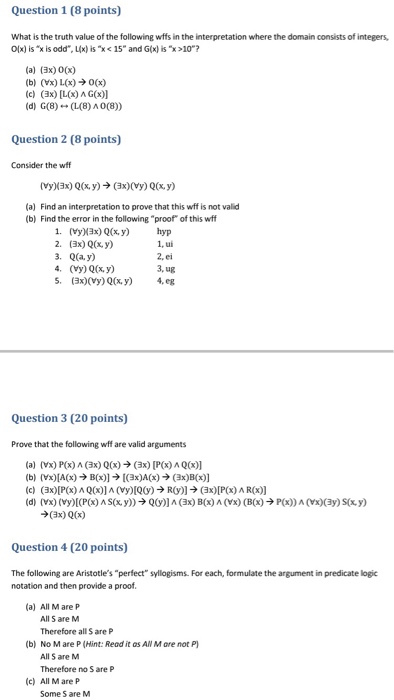
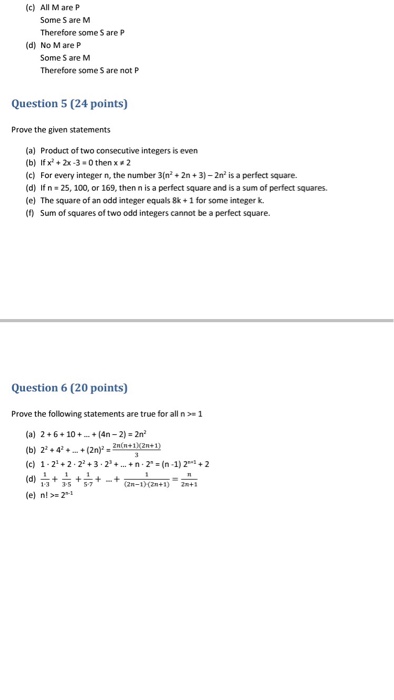
Question 1 (8 points) What is the truth value of the following wffs in the interpretation where the domain consists of integers, Olx) is "x is odd, Lx)is "x10 ? (a) (Bx) 0(x) (b) (Vx) L(x) 0(x) (c) (3x) [L(x) A G(x)] (d) G(8)..048)^0(8)) Question 2 (8 points) Consider the wff (Vy)(3x) Q(x, y) (3x)(Vy) Q(x, y) (a) Find an interpretation to prove that this wff is not valid (b) Find the error in the following proof of this wff 1. (y3x) Q(x,y) hyp 2. (Bx) Q0x.y) 3. Q(a, y) 4. (Vy) Q(x, y) . (Bx)(y)Qxy 4,eg 1, ui 3, ug Question 3 (20 points) Prove that the following wff are valid arguments (a) (Vx) P(x) ^ (3x) Q(x) (3x) [P(x) ^ Q(x)] (c) (3x)[P(x) ^ Q(x)JA (vy)(Q(y) R(y)] (3x)[P(x) AR(x)] (d) CVX) (Vy)[(P(x) ^ S(x, y)) Q(y)JA (3x) B(x) ^ (Vx) (B(x) P(x)) ^ (Vx)(3y) S(x, y) (3x) Q(x) Question 4 (20 points) The following are Aristotle's "perfect syllogisms. For each, formulate the argument in predicate logic notation and then provide a proof. (a) All M are P All S are M Therefore all S areP (b) No M are P (Hint: Read it as AN M ore not P All S are M Therefore no S are P (c) All M are P Some S are M
Step by Step Solution
There are 3 Steps involved in it

Get step-by-step solutions from verified subject matter experts
 Study Help