







Question: Discrete math (a) Prove by mathematical induction that: n^2 > n + 1 forall n greaterthanorequalto 2. (b) Use mathematical induction to prove the following
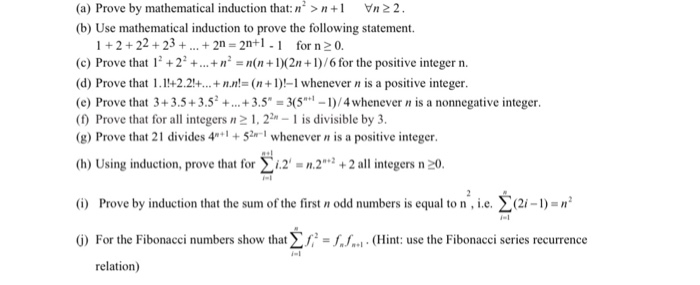
(a) Prove by mathematical induction that: n^2 > n + 1 forall n greaterthanorequalto 2. (b) Use mathematical induction to prove the following statement. 1 + 2 + 2^2 + 2^3 + ... + 2^n = 2^n+1 - 1 for n greaterthanorequalto 0. (c) Prove that 1^1 + 2^2 + ... + n^2 = n(n + 1)(2n + 1)/6 for the positive integer n. (d) Prove that 1.1!+2.2!+...+ n.n! = (n + 1)!-1 whenever n is a positive integer. (e) Prove that 3 + 3.5 + 3.5^2 + ... + 3.5^n = 3(5^n+1 - 1)/4 whenever n is a nonnegative integer. (f) Prove that for all integers n greaterthanorequalto 1, 2^2n - l is divisible by 3. (g) Prove that 21 divides 4^n + 1 + 5^2n - 1 whenever n is a positive integer. (h) Using induction, prove that for sigma^n+1_i=1 i.2^i = n.2^n + 2 + 2 all integers n greaterthanorequalto 0. (i) Prove by induction that the sum of the first n odd numbers is equal to n^2, i.e. sigma^n_i=1 (2i - 1) = n^2 (j) For the Fibonacci numbers show that sigma^n_i=1 f^2_i = f_n f_n+1
Step by Step Solution
There are 3 Steps involved in it

Get step-by-step solutions from verified subject matter experts
 Study Help