







Question: ANSWER 2-8 please ! 1. Use a membership table to prove the first of De Morgan's Laws (A U B)-AnB- i.e. the complement of the
ANSWER 2-8 please! 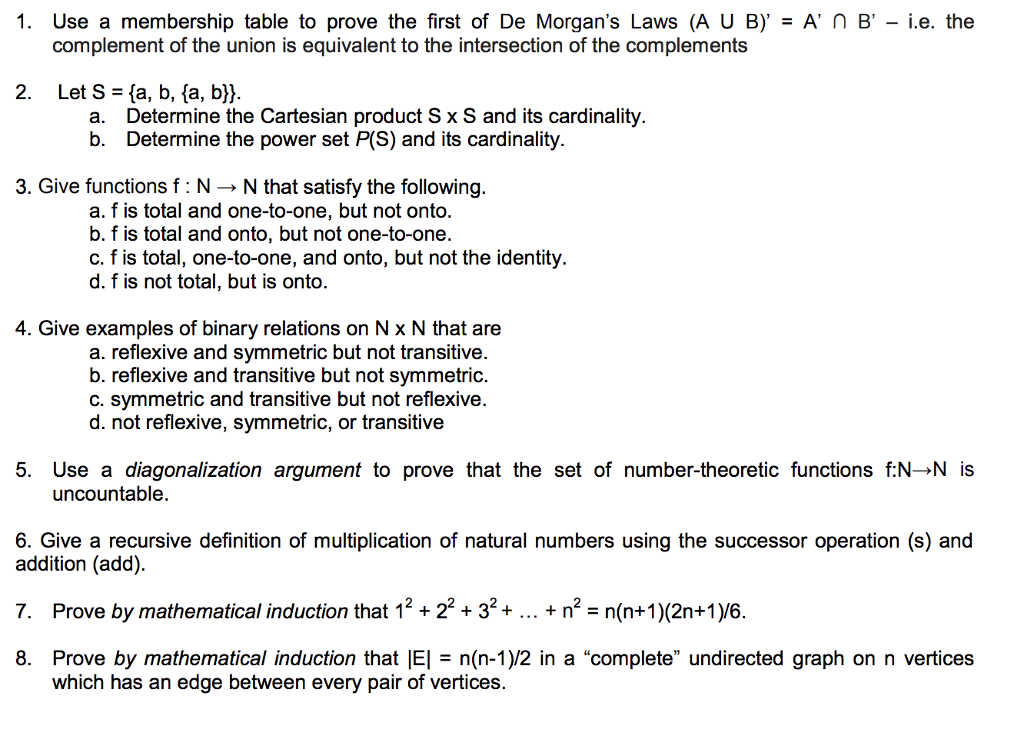
1. Use a membership table to prove the first of De Morgan's Laws (A U B)-AnB- i.e. the complement of the union is equivalent to the intersection of the complements 2. Let S-(a, b, (a, bly. a. b. Determine the Cartesian product S x S and its cardinality. Determine the power set P(S) and its cardinality. 3. Give functions f N N that satisfy the following. a. f is total and one-to-one, but not onto b. f is total and onto, but not one-to-one. c. f is total, one-to-one, and onto, but not the identity. d. f is not total, but is onto. 4. Give examples of binary relations on N x N that are a. reflexive and symmetric but not transitive. b. reflexive and transitive but not symmetric. c. symmetric and transitive but not reflexive. d. not reflexive, symmetric, or transitive 5. Use a diagonalization argument to prove that the set of number-theoretic functions f:N-N is uncountable. 6. Give a recursive definition of multiplication of natural numbers using the successor operation (s) and addition (add) 7. Prove by mathematical induction that 12 + 22 + 32 + + n2 = n(n+1)(2n+1y6 8. Prove by mathematical induction that IE n(n-1)/2 in a "complete" undirected graph on n vertices which has an edge between every pair of vertices
Step by Step Solution
There are 3 Steps involved in it

Get step-by-step solutions from verified subject matter experts
 Study Help