





Question: Discrete Math, Graph Theory please only answer if know and can portray a correct answer Please answer f) with a suitable proof technique Given a
Discrete Math, Graph Theory

please only answer if know and can portray a correct answer

Please answer f) with a suitable proof technique

Discrete Math, Graph Theory please only answer if
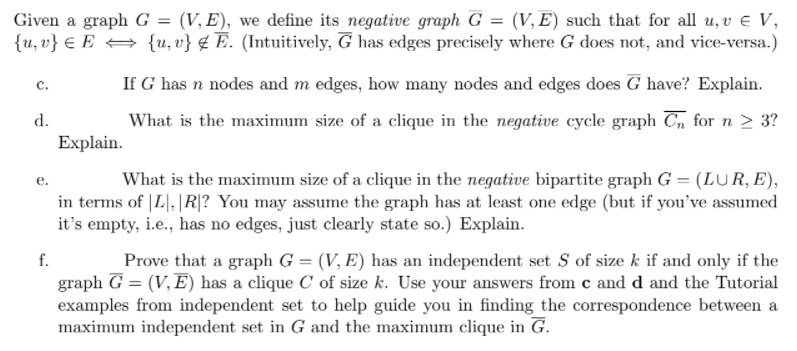
Given a graph G = (V, E), we define its negative graph G = (V, E) such that for all u, v E V, {u,v} EE 3? Explain. e. What is the maximum size of a clique in the negative bipartite graph G = (LUR, E), in terms of | L), |R)? You may assume the graph has at least one edge (but if you've assumed it's empty, i.e., has no edges, just clearly state so.) Explain. f. Prove that a graph G = (V, E) has an independent set S of size k if and only if the graph G = (V, E) has a clique C of size k. Use your answers from c and d and the Tutorial examples from independent set to help guide you in finding the correspondence between a maximum independent set in G and the maximum clique in G

Step by Step Solution

There are 3 Steps involved in it

1 Expert Approved Answer
Step: 1 Unlock blur-text-image

Question Has Been Solved by an Expert!

Get step-by-step solutions from verified subject matter experts

Step: 2 Unlock
Step: 3 Unlock

Students Have Also Explored These Related Mathematics Questions!